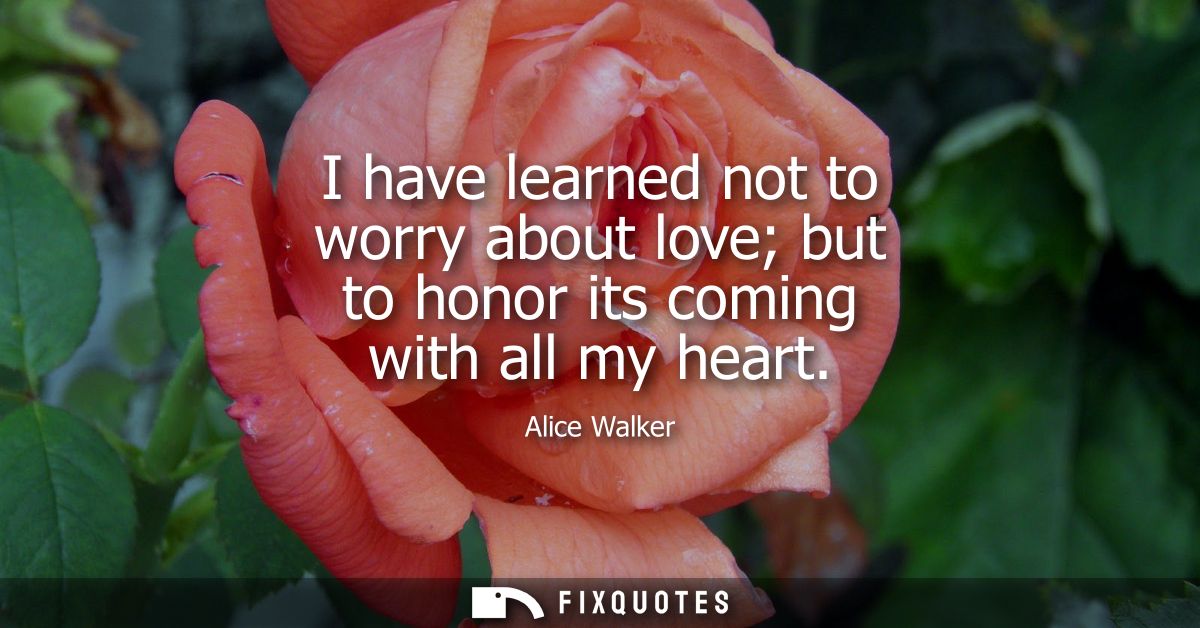
"I have learned not to worry about love; but to honor its coming with all my heart"
About this Quote
The sentence is built like a small conversion narrative. "I have learned" signals hard-won knowledge, the kind acquired through disappointment, survival, and recalibration. The phrase "not to worry" implies she has worried - deeply - and found the worry both ineffective and corrosive. Then comes the real provocation: love is not owed, not controllable, not guaranteed. It "comes". Agency shifts away from the speaker's grasping and toward a receptive stance that still demands courage: "with all my heart". Totality is the risk. You can't honor love halfway.
In Walker's broader context - a writer whose work insists on the dignity of Black women's interior lives, and on healing without sentimental lies - the subtext reads as self-protection that doesn't calcify into numbness. It's a mature ethic: stop bargaining with the future, stop policing intimacy into safety, and meet the real thing when it arrives with full presence. Not because it will last, but because it matters while it's here.
Quote Details
| Topic | Love |
|---|---|
| Source | Help us find the source |
| Cite |
Citation Formats
APA Style (7th ed.)
Walker, Alice. (2026, January 17). I have learned not to worry about love; but to honor its coming with all my heart. FixQuotes. https://fixquotes.com/quotes/i-have-learned-not-to-worry-about-love-but-to-38405/
Chicago Style
Walker, Alice. "I have learned not to worry about love; but to honor its coming with all my heart." FixQuotes. January 17, 2026. https://fixquotes.com/quotes/i-have-learned-not-to-worry-about-love-but-to-38405/.
MLA Style (9th ed.)
"I have learned not to worry about love; but to honor its coming with all my heart." FixQuotes, 17 Jan. 2026, https://fixquotes.com/quotes/i-have-learned-not-to-worry-about-love-but-to-38405/. Accessed 3 Apr. 2026.