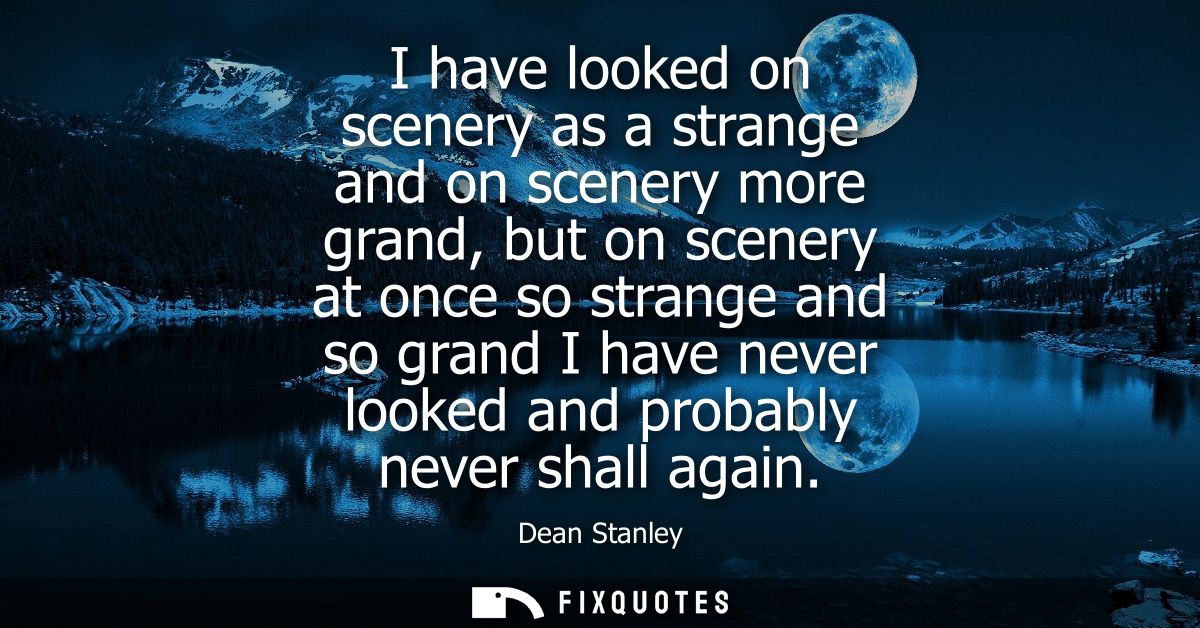
"I have looked on scenery as a strange, and on scenery more grand, but on scenery at once so strange and so grand, I have never looked, and probably never shall again"
About this Quote
The key move is the doubling: strange and grand are kept separate until the final fuse, "at once so strange and so grand". Sublime landscapes are supposed to be legible in one register - beautiful, majestic, reassuringly ordered. Stanley insists on a mixed signal, a holiness that is not comfortable. "Strange" smuggles in disorientation, even dread; "grand" keeps the experience from collapsing into mere fear. The subtext is theological: creation as both invitation and rebuke, a reminder of scale, otherness, and limits. Nature is not a postcard; it is a confrontation.
Context matters. As a Victorian Anglican priest and later a prominent churchman, Stanley lived in an age that loved to catalogue the world - geology, archaeology, travel writing - while also worrying about what those discoveries did to faith. His line balances on that fault line. The final turn, "probably never shall again", is not just traveler's bragging. It is a memento mori: a recognition that certain revelations are singular, unrepeatable, and that the self who saw them will never quite be the same.
Quote Details
| Topic | Nature |
|---|---|
| Source | Help us find the source |
| Cite |
Citation Formats
APA Style (7th ed.)
Stanley, Dean. (2026, February 16). I have looked on scenery as a strange, and on scenery more grand, but on scenery at once so strange and so grand, I have never looked, and probably never shall again. FixQuotes. https://fixquotes.com/quotes/i-have-looked-on-scenery-as-a-strange-and-on-124331/
Chicago Style
Stanley, Dean. "I have looked on scenery as a strange, and on scenery more grand, but on scenery at once so strange and so grand, I have never looked, and probably never shall again." FixQuotes. February 16, 2026. https://fixquotes.com/quotes/i-have-looked-on-scenery-as-a-strange-and-on-124331/.
MLA Style (9th ed.)
"I have looked on scenery as a strange, and on scenery more grand, but on scenery at once so strange and so grand, I have never looked, and probably never shall again." FixQuotes, 16 Feb. 2026, https://fixquotes.com/quotes/i-have-looked-on-scenery-as-a-strange-and-on-124331/. Accessed 29 Mar. 2026.