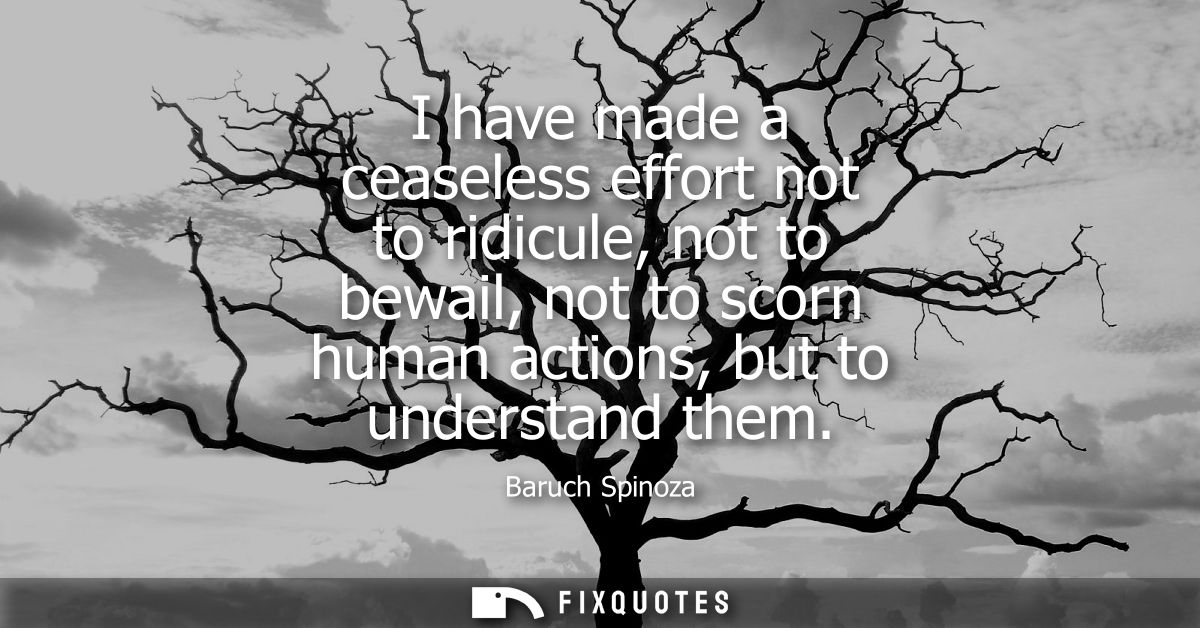
"I have made a ceaseless effort not to ridicule, not to bewail, not to scorn human actions, but to understand them"
About this Quote
The line’s bravest move is that it frames understanding as an achievement, not a temperament: “a ceaseless effort.” That’s Spinoza’s ethic in miniature. He’s writing in a 17th-century Europe where theology policed thought, sectarian conflict was recent memory, and he himself was excommunicated from the Jewish community of Amsterdam. In that world, judging wasn’t just a habit; it was a social technology. Declare someone ridiculous, sinful, or tragic enough and you don’t have to live with their arguments.
Under the hood sits Spinoza’s anti-moralistic psychology: humans act from causes - desires, fears, constraints - not from cartoonish “free” wickedness. Understanding, then, isn’t indulgence; it’s diagnosis. It asks you to trade the pleasure of condemnation for the harder clarity of seeing why a person did what they did, how a system incentivized it, what passions drove it. The quote lands now because it refuses both cynicism and naivete. It’s a demand for adult attention in a culture that keeps rewarding the easier reactions.
Quote Details
| Topic | Ethics & Morality |
|---|---|
| Source | Unverified source: Opera posthuma (includes Tractatus Politicus) (Baruch Spinoza, 1677)
Evidence: Sedulo curavi humanas actiones non ridere non lugere neque detestari sed intelligere. (Tractatus Politicus, Caput I, § 4 (in Opera posthuma; Tractatus Politicus begins at p. 265 in some paginations)). Primary source is Spinoza’s own Political Treatise (Tractatus Politicus), Chapter 1, section 4. ... Other candidates (1) The Anthropology of Religion, Magic, and Witchcraft (Rebecca L. Stein, Philip L. Stein, 2017) compilation96.7% ... Baruch Spinoza , writing in the seventeenth century , " I have made a ceaseless effort not to ridicule , not to b... |
| Cite |
Citation Formats
APA Style (7th ed.)
Spinoza, Baruch. (2026, February 15). I have made a ceaseless effort not to ridicule, not to bewail, not to scorn human actions, but to understand them. FixQuotes. https://fixquotes.com/quotes/i-have-made-a-ceaseless-effort-not-to-ridicule-62706/
Chicago Style
Spinoza, Baruch. "I have made a ceaseless effort not to ridicule, not to bewail, not to scorn human actions, but to understand them." FixQuotes. February 15, 2026. https://fixquotes.com/quotes/i-have-made-a-ceaseless-effort-not-to-ridicule-62706/.
MLA Style (9th ed.)
"I have made a ceaseless effort not to ridicule, not to bewail, not to scorn human actions, but to understand them." FixQuotes, 15 Feb. 2026, https://fixquotes.com/quotes/i-have-made-a-ceaseless-effort-not-to-ridicule-62706/. Accessed 9 Mar. 2026.