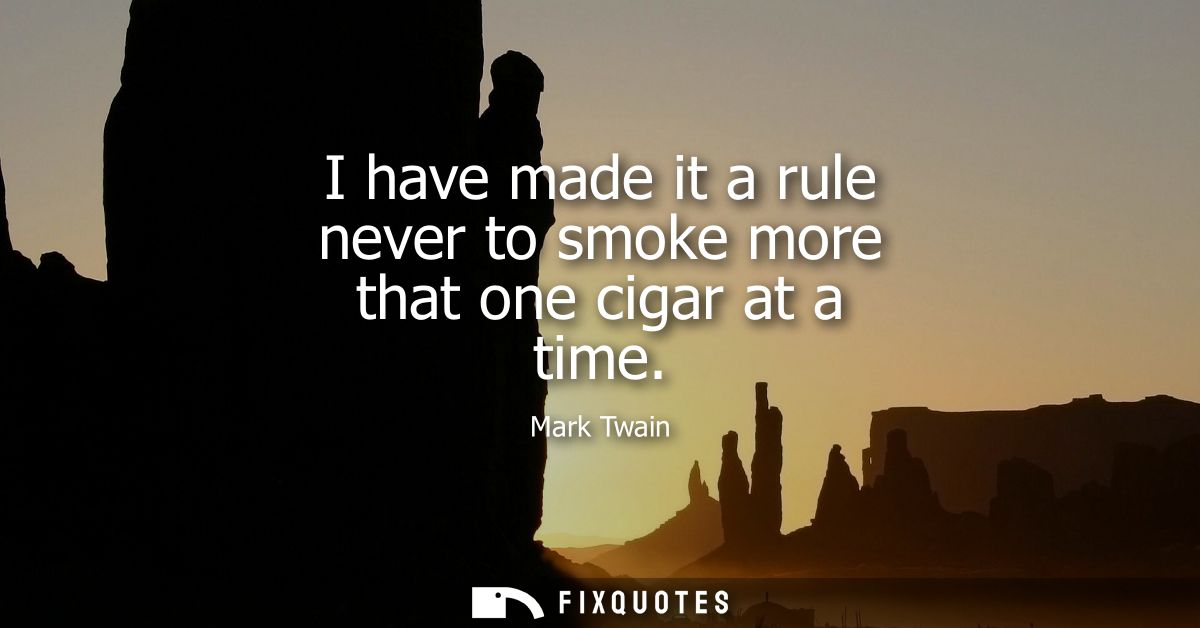
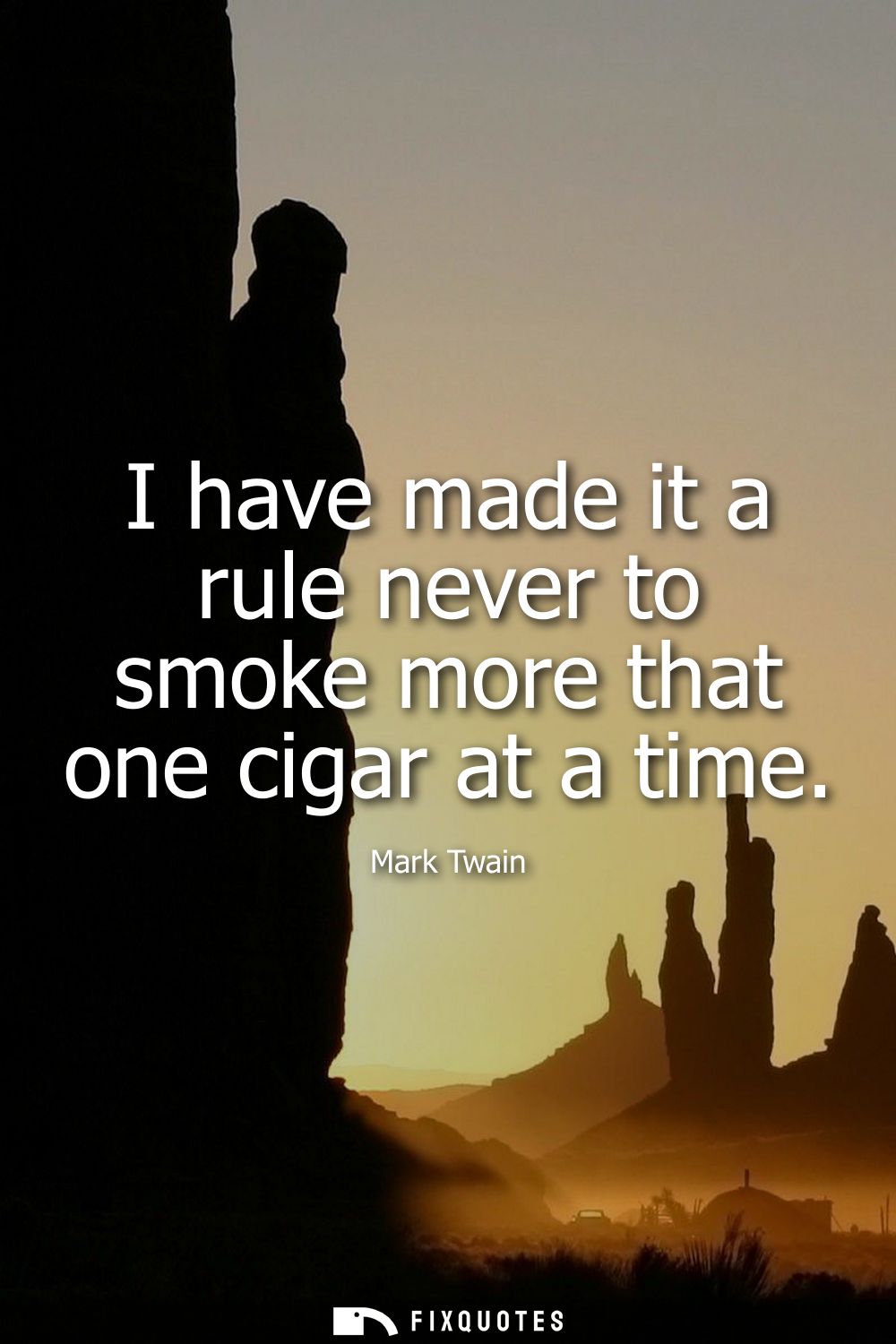
"I have made it a rule never to smoke more that one cigar at a time"
About this Quote
Twain’s joke lands because it’s built like a moral principle and delivered like a loophole. “A rule” signals discipline, self-command, the sort of earnest self-improvement Victorian America loved to preach. Then he punctures it with “at a time,” a tiny clause that turns restraint into permission. The humor is not just that he likes cigars; it’s that he knows exactly how language can be used to launder indulgence into virtue. He’s parodying the way people weaponize rules to feel righteous while changing nothing.
The intent is classic Twain: expose hypocrisy without sounding like a scold. He doesn’t argue against temperance culture directly; he sidesteps it with a grin, implying that moral strictures often serve the ego more than the body. The subtext reads like a wink at the listener: I can appear moderate and still smoke all day, because the rule is technically true. That’s Twain’s larger project in miniature - a suspicion of pieties, especially when they come packaged as self-control.
Context matters. Twain wrote in an era thick with reform movements and public virtue campaigns, when habits like drinking and smoking were increasingly moralized. He also cultivated a public persona: the plainspoken American with a talent for skewering sanctimony. The line is a small masterclass in American irony - using the vocabulary of responsibility to confess, cheerfully, that he’s found a way around it.
The intent is classic Twain: expose hypocrisy without sounding like a scold. He doesn’t argue against temperance culture directly; he sidesteps it with a grin, implying that moral strictures often serve the ego more than the body. The subtext reads like a wink at the listener: I can appear moderate and still smoke all day, because the rule is technically true. That’s Twain’s larger project in miniature - a suspicion of pieties, especially when they come packaged as self-control.
Context matters. Twain wrote in an era thick with reform movements and public virtue campaigns, when habits like drinking and smoking were increasingly moralized. He also cultivated a public persona: the plainspoken American with a talent for skewering sanctimony. The line is a small masterclass in American irony - using the vocabulary of responsibility to confess, cheerfully, that he’s found a way around it.
Quote Details
| Topic | Witty One-Liners |
|---|---|
| Source | Help us find the source |
| Cite |
Citation Formats
APA Style (7th ed.)
Twain, Mark. (2026, January 17). I have made it a rule never to smoke more that one cigar at a time. FixQuotes. https://fixquotes.com/quotes/i-have-made-it-a-rule-never-to-smoke-more-that-26390/
Chicago Style
Twain, Mark. "I have made it a rule never to smoke more that one cigar at a time." FixQuotes. January 17, 2026. https://fixquotes.com/quotes/i-have-made-it-a-rule-never-to-smoke-more-that-26390/.
MLA Style (9th ed.)
"I have made it a rule never to smoke more that one cigar at a time." FixQuotes, 17 Jan. 2026, https://fixquotes.com/quotes/i-have-made-it-a-rule-never-to-smoke-more-that-26390/. Accessed 29 Mar. 2026.
More Quotes by Mark
Add to List