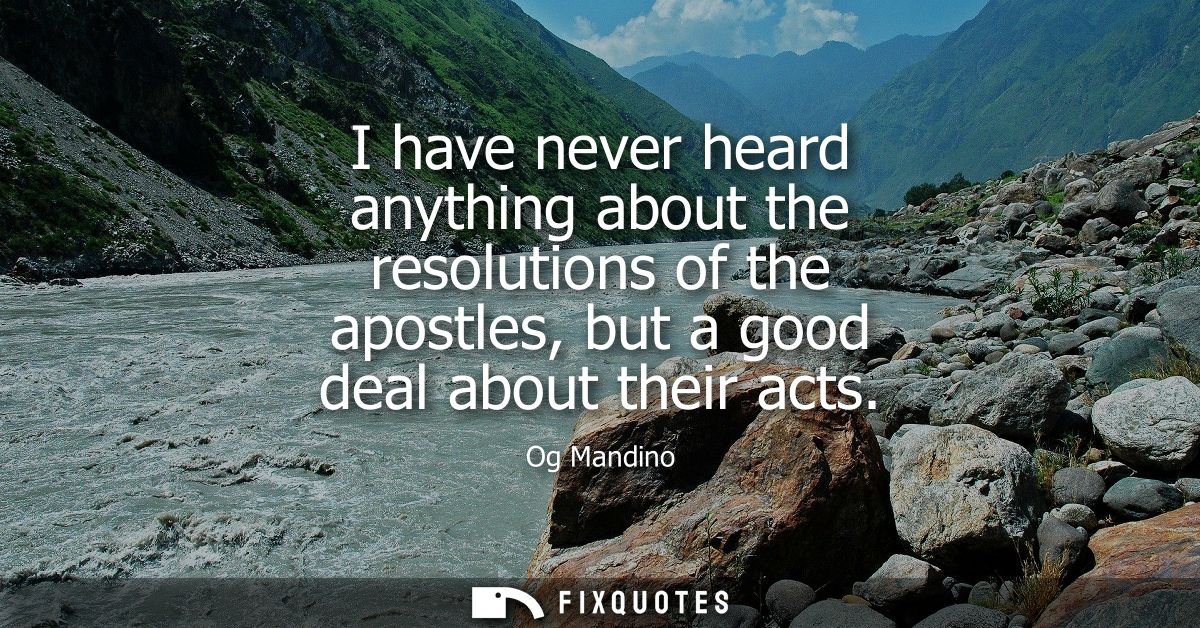
"I have never heard anything about the resolutions of the apostles, but a good deal about their acts"
About this Quote
Mandino’s jab lands because it smuggles a modern self-help critique into biblical clothing: nobody was saved, inspired, or persuaded by a committee’s promises. “Resolutions” evokes paperwork, virtue-signaling, New Year’s vows that feel productive precisely because they don’t cost anything. By contrast, “acts” is blunt, bodily, and public. The line doesn’t just praise action; it mocks the comforting theater of intention.
The apostles are a strategic choice. They’re not philosophers with treatises or administrators with policy memos; in the Christian imagination they’re defined by movement, risk, and messy follow-through. Mandino leans on that cultural memory to shame the reader into motion. He’s not arguing theology so much as recruiting the authority of sacred history to prosecute a familiar habit: announcing change instead of doing it. The subtext is personal and pointed: your goals are irrelevant until they leave your mouth and enter your schedule.
Context matters. Mandino built a career in motivational literature that treats discipline as destiny and habit as a kind of secular salvation. In that world, “resolutions” are suspect because they’re performative and easily reversible; “acts” are measurable, repeatable, and accountable. The quote’s quiet provocation is that morality itself is legible only in behavior. You can’t curate your way into being good. You can only practice it.
The apostles are a strategic choice. They’re not philosophers with treatises or administrators with policy memos; in the Christian imagination they’re defined by movement, risk, and messy follow-through. Mandino leans on that cultural memory to shame the reader into motion. He’s not arguing theology so much as recruiting the authority of sacred history to prosecute a familiar habit: announcing change instead of doing it. The subtext is personal and pointed: your goals are irrelevant until they leave your mouth and enter your schedule.
Context matters. Mandino built a career in motivational literature that treats discipline as destiny and habit as a kind of secular salvation. In that world, “resolutions” are suspect because they’re performative and easily reversible; “acts” are measurable, repeatable, and accountable. The quote’s quiet provocation is that morality itself is legible only in behavior. You can’t curate your way into being good. You can only practice it.
Quote Details
| Topic | Wisdom |
|---|
More Quotes by Og
Add to List