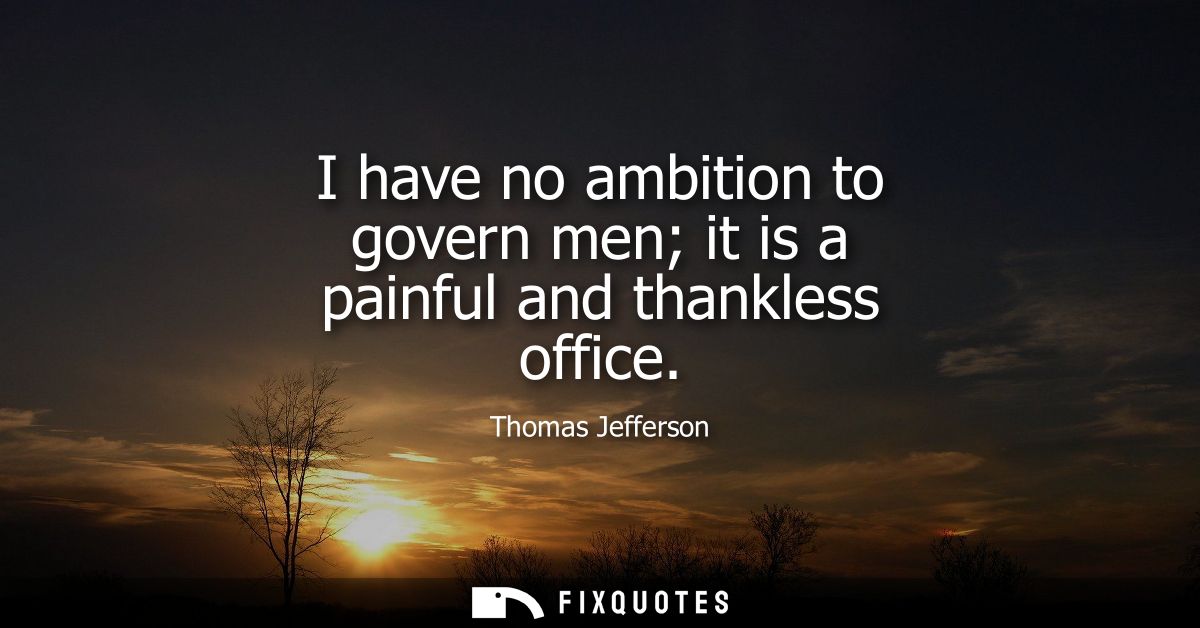
"I have no ambition to govern men; it is a painful and thankless office"
About this Quote
The second clause sharpens the pose into something weightier. Calling governance “painful and thankless” reframes public office as a form of civic self-sacrifice, the republican version of martyrdom. That phrasing lowers expectations and raises sympathy at the same time: if the job is inherently bruising and gratitude is scarce, then criticism can be dismissed as inevitable, not necessarily earned. It’s also a warning shot to rivals and factions. Jefferson knew that leadership in a young, argumentative democracy meant constant accusation of corruption or tyranny; he’s pre-emptively narrating the suffering of the office-holder.
The subtext is especially pointed coming from Jefferson, a master of political messaging who built a movement, fought ferociously in print, and understood that governing required coalition, discipline, and appetite. “No ambition” is a public-facing virtue; the private reality is that the new nation needed people willing to steer it, and Jefferson wanted that steering to be read as duty, not desire. The line flatters the citizenry too: if rulers aren’t supposed to enjoy ruling, the people remain the real sovereign, and government stays on probation.
Quote Details
| Topic | Leadership |
|---|---|
| Source | Help us find the source |
| Cite |
Citation Formats
APA Style (7th ed.)
Jefferson, Thomas. (2026, January 17). I have no ambition to govern men; it is a painful and thankless office. FixQuotes. https://fixquotes.com/quotes/i-have-no-ambition-to-govern-men-it-is-a-painful-33458/
Chicago Style
Jefferson, Thomas. "I have no ambition to govern men; it is a painful and thankless office." FixQuotes. January 17, 2026. https://fixquotes.com/quotes/i-have-no-ambition-to-govern-men-it-is-a-painful-33458/.
MLA Style (9th ed.)
"I have no ambition to govern men; it is a painful and thankless office." FixQuotes, 17 Jan. 2026, https://fixquotes.com/quotes/i-have-no-ambition-to-govern-men-it-is-a-painful-33458/. Accessed 8 Mar. 2026.