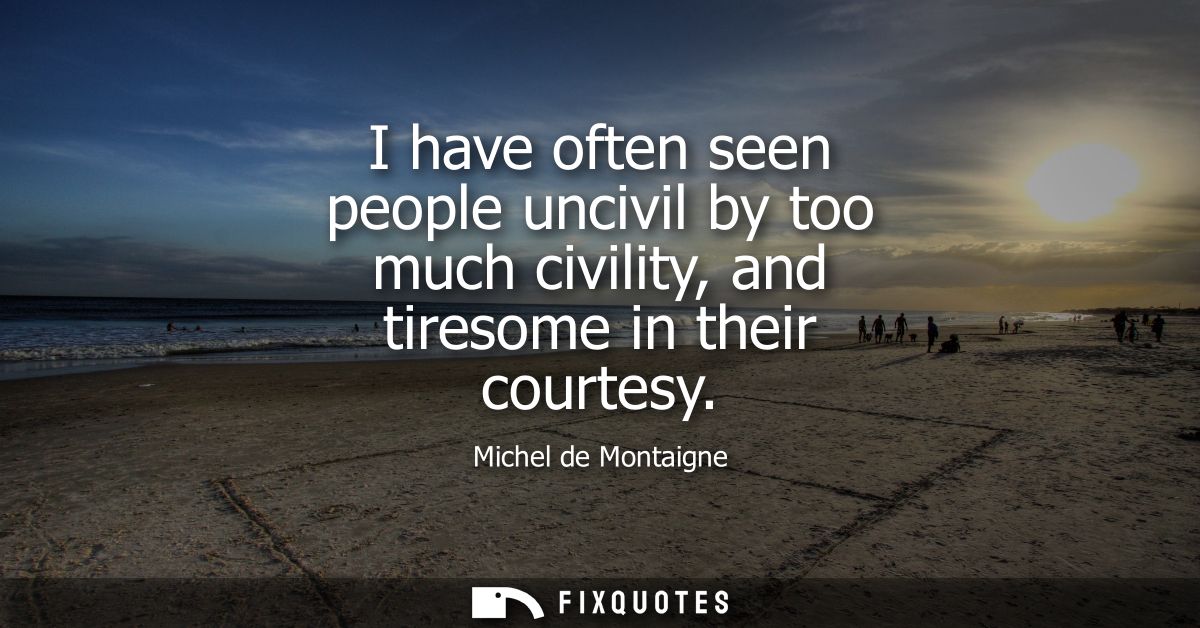
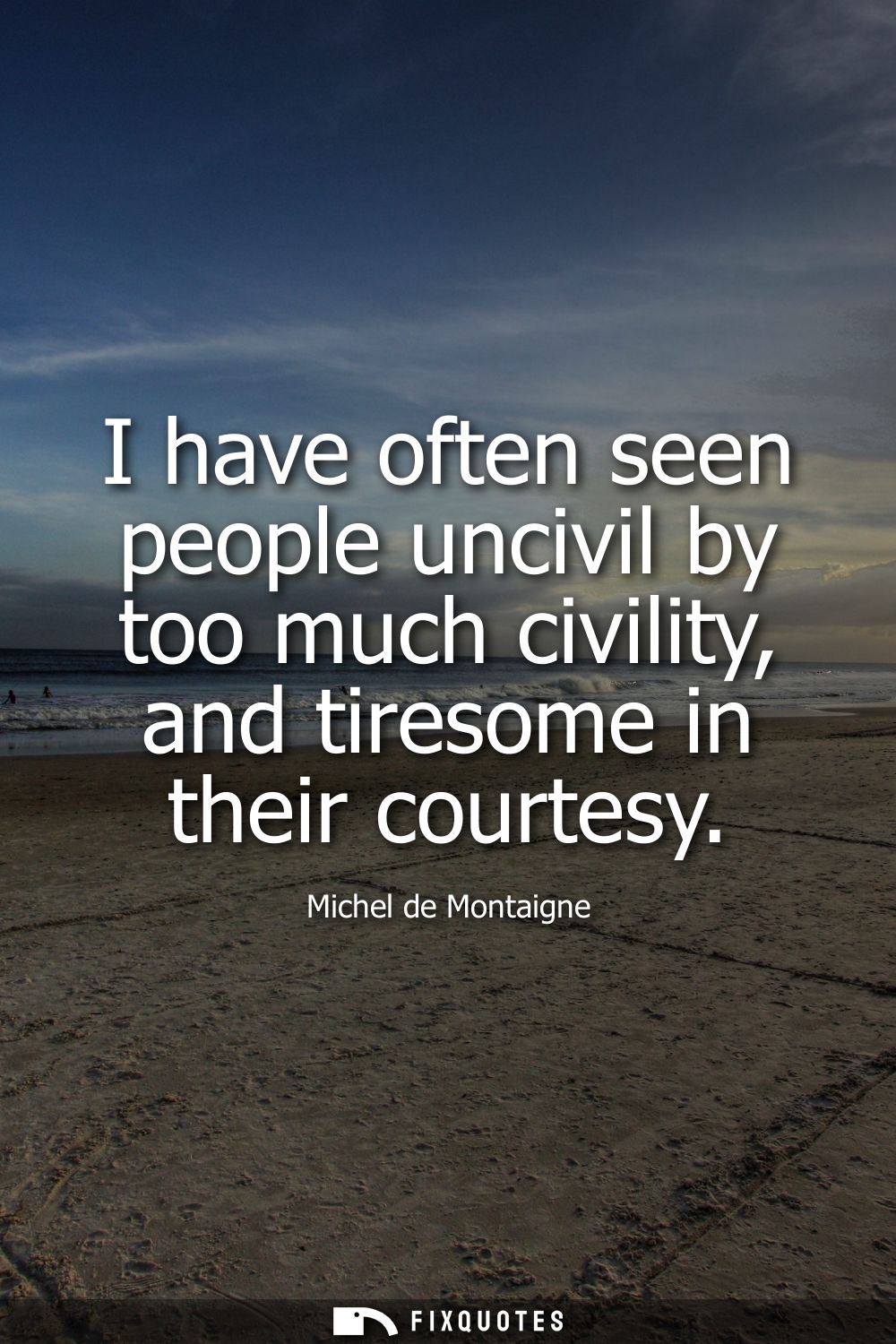
"I have often seen people uncivil by too much civility, and tiresome in their courtesy"
About this Quote
The intent is diagnostic, not merely cranky. Montaigne is warning that excessive deference often masks a hunger for control. Hyper-civility can be a way to dominate a room without ever raising your voice: insist on protocol, force everyone to play along, make dissent feel like rudeness. The “uncivil” here isn’t open brutality; it’s the quiet coercion of someone who weaponizes politeness, turning social interaction into a test you can fail.
“Tiresome in their courtesy” lands with special bite because it treats boredom as a moral signal. If someone’s courtliness exhausts you, Montaigne suggests, that fatigue is data: the exchange has shifted from mutual regard to self-display. Courtesy becomes vanity dressed as virtue.
Context matters. Writing in a France racked by religious civil war and aristocratic codes, Montaigne mistrusted absolutes and loved the messy middle of human behavior. His Essays repeatedly prefer lived experience over rigid systems. This sentence fits that project: it punctures the era’s obsession with decorum by insisting that manners aren’t automatically moral. Style without substance, even when impeccably “civil,” can be its own kind of violence.
Quote Details
| Topic | Respect |
|---|---|
| Source | Help us find the source |
| Cite |
Citation Formats
APA Style (7th ed.)
Montaigne, Michel de. (2026, January 18). I have often seen people uncivil by too much civility, and tiresome in their courtesy. FixQuotes. https://fixquotes.com/quotes/i-have-often-seen-people-uncivil-by-too-much-17395/
Chicago Style
Montaigne, Michel de. "I have often seen people uncivil by too much civility, and tiresome in their courtesy." FixQuotes. January 18, 2026. https://fixquotes.com/quotes/i-have-often-seen-people-uncivil-by-too-much-17395/.
MLA Style (9th ed.)
"I have often seen people uncivil by too much civility, and tiresome in their courtesy." FixQuotes, 18 Jan. 2026, https://fixquotes.com/quotes/i-have-often-seen-people-uncivil-by-too-much-17395/. Accessed 18 Feb. 2026.