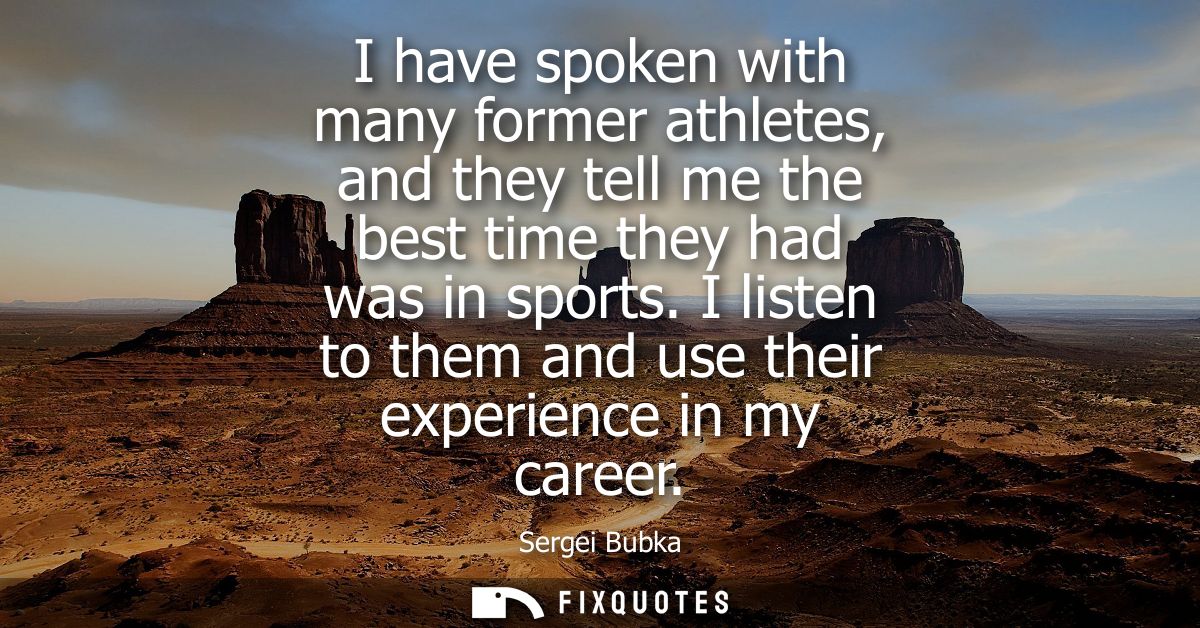
"I have spoken with many former athletes, and they tell me the best time they had was in sports. I listen to them and use their experience in my career"
About this Quote
There is a quiet humility baked into Bubka's line, the kind that plays well in a culture that expects champions to sound like lone geniuses. He frames success not as raw talent or personal destiny, but as a relay: stories passed down, lessons borrowed, mistakes pre-lived. Coming from a man who didn’t just win but rewrote the limits of his sport, that restraint is its own flex.
The specific intent is practical and public-facing. Bubka positions himself as someone who studies the emotional truth of a career, not just the mechanics of training: former athletes don’t rave about podiums, they miss the lived texture of sport. The “best time” isn’t necessarily victory; it’s belonging, routine, shared stakes, the daily narrative that ends too abruptly when retirement hits. By foregrounding that, he’s also issuing a warning to himself: don’t postpone joy until after the record is set, because the “after” often arrives empty.
The subtext is about longevity and identity. Athletes are encouraged to turn their lives into optimization projects; Bubka suggests another metric worth optimizing for: memory. “I listen” reads like a small act of rebellion against the myth that winners are self-made. It’s also cultural code from an era of Eastern Bloc sport where institutions loomed large: knowledge is communal, careers are shaped by what the system teaches and what elders confess off the record.
In a broader context, it’s a soft critique of modern sports branding. The highlight reel is not the point; the lived season is.
The specific intent is practical and public-facing. Bubka positions himself as someone who studies the emotional truth of a career, not just the mechanics of training: former athletes don’t rave about podiums, they miss the lived texture of sport. The “best time” isn’t necessarily victory; it’s belonging, routine, shared stakes, the daily narrative that ends too abruptly when retirement hits. By foregrounding that, he’s also issuing a warning to himself: don’t postpone joy until after the record is set, because the “after” often arrives empty.
The subtext is about longevity and identity. Athletes are encouraged to turn their lives into optimization projects; Bubka suggests another metric worth optimizing for: memory. “I listen” reads like a small act of rebellion against the myth that winners are self-made. It’s also cultural code from an era of Eastern Bloc sport where institutions loomed large: knowledge is communal, careers are shaped by what the system teaches and what elders confess off the record.
In a broader context, it’s a soft critique of modern sports branding. The highlight reel is not the point; the lived season is.
Quote Details
| Topic | Sports |
|---|
More Quotes by Sergei
Add to List