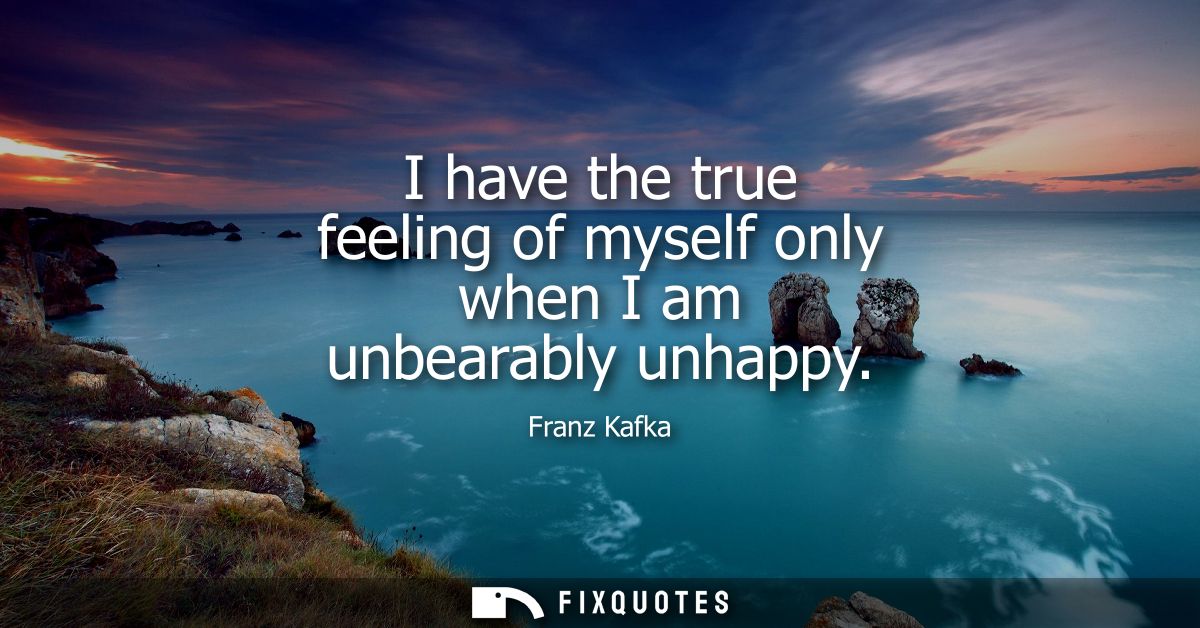
"I have the true feeling of myself only when I am unbearably unhappy"
About this Quote
Kafka’s line doesn’t just confess misery; it weaponizes it as a kind of authenticity test. “True feeling of myself” implies a self that’s normally muffled, managed, or performed. Only when he’s “unbearably unhappy” does the mask slip, and what’s left is not relief but recognition. The extremity matters: not sad, not depressed, but past endurance. That’s the point at which self-knowledge stops being a tasteful insight and becomes a bodily fact.
The subtext is a brutal inversion of the usual modern self-help promise that clarity follows healing. For Kafka, clarity is the symptom of breakdown. Happiness, or even ordinary functioning, reads like a distraction that lets him pass as a person in the world - a son, a worker, a citizen - without touching the raw nerve underneath. Unhappiness, in this formulation, is not merely suffering; it’s the only state that can’t be faked, the only one that refuses the social script.
Context sharpens the edge. Kafka lived under the pressures of a demanding father, an impersonal bureaucracy, and a cultural position that made belonging complicated: a German-speaking Jew in Prague, suspended between communities. His fiction turns institutions into nightmares because he experienced modern life as an apparatus that processes human beings into cases. The line fits that worldview: the self is most “true” when it can no longer be processed. It’s a bleak kind of integrity - the authenticity of a system failure.
The subtext is a brutal inversion of the usual modern self-help promise that clarity follows healing. For Kafka, clarity is the symptom of breakdown. Happiness, or even ordinary functioning, reads like a distraction that lets him pass as a person in the world - a son, a worker, a citizen - without touching the raw nerve underneath. Unhappiness, in this formulation, is not merely suffering; it’s the only state that can’t be faked, the only one that refuses the social script.
Context sharpens the edge. Kafka lived under the pressures of a demanding father, an impersonal bureaucracy, and a cultural position that made belonging complicated: a German-speaking Jew in Prague, suspended between communities. His fiction turns institutions into nightmares because he experienced modern life as an apparatus that processes human beings into cases. The line fits that worldview: the self is most “true” when it can no longer be processed. It’s a bleak kind of integrity - the authenticity of a system failure.
Quote Details
| Topic | Sadness |
|---|---|
| Source | Help us find the source |
More Quotes by Franz
Add to List