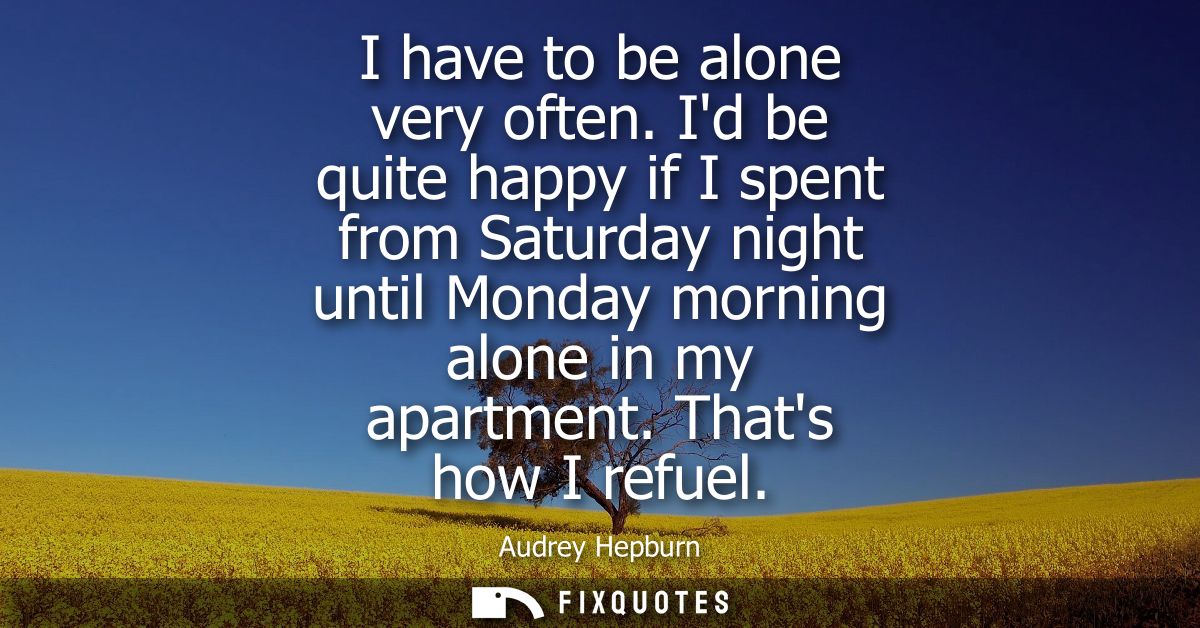
"I have to be alone very often. I'd be quite happy if I spent from Saturday night until Monday morning alone in my apartment. That's how I refuel"
About this Quote
The weekend detail is doing a lot of work. Saturday night to Monday morning is peak time for other people’s fun, the window when you’re supposed to be seen, wanted, photographed, paired off. Hepburn flips that script: her ideal is an empty apartment, a closed door, a controlled environment. It’s not antisocial; it’s strategic. “That’s how I refuel” borrows the language of machinery, not glamour, implying that the body and mind have finite reserves and that solitude is the only charger that actually fits.
In context, Hepburn’s public life was a constant negotiation between extreme visibility and guarded interiority - a star whose image was meticulously curated, and later, a humanitarian whose work required emotional output on an entirely different scale. The subtext is almost political: don’t confuse charisma with availability. The most radical thing a beloved icon can admit is that her happiness doesn’t require an audience.
Quote Details
| Topic | Self-Care |
|---|---|
| Source | Later attribution: Audrey Hepburn’s Abstract Life Guide (Sreechinth C) modern compilationID: MH3rDwAAQBAJ
Evidence:
Audrey Hepburn Quotes Sreechinth C. “People associate me with a time when movies were ... I have to be alone very often. I'd be quite happy if I spent from Saturday night until Monday morning alone in my apartment. That's how I refuel ... |
| Cite |
Citation Formats
APA Style (7th ed.)
Hepburn, Audrey. (2026, March 23). I have to be alone very often. I'd be quite happy if I spent from Saturday night until Monday morning alone in my apartment. That's how I refuel. FixQuotes. https://fixquotes.com/quotes/i-have-to-be-alone-very-often-id-be-quite-happy-29948/
Chicago Style
Hepburn, Audrey. "I have to be alone very often. I'd be quite happy if I spent from Saturday night until Monday morning alone in my apartment. That's how I refuel." FixQuotes. March 23, 2026. https://fixquotes.com/quotes/i-have-to-be-alone-very-often-id-be-quite-happy-29948/.
MLA Style (9th ed.)
"I have to be alone very often. I'd be quite happy if I spent from Saturday night until Monday morning alone in my apartment. That's how I refuel." FixQuotes, 23 Mar. 2026, https://fixquotes.com/quotes/i-have-to-be-alone-very-often-id-be-quite-happy-29948/. Accessed 27 Mar. 2026.