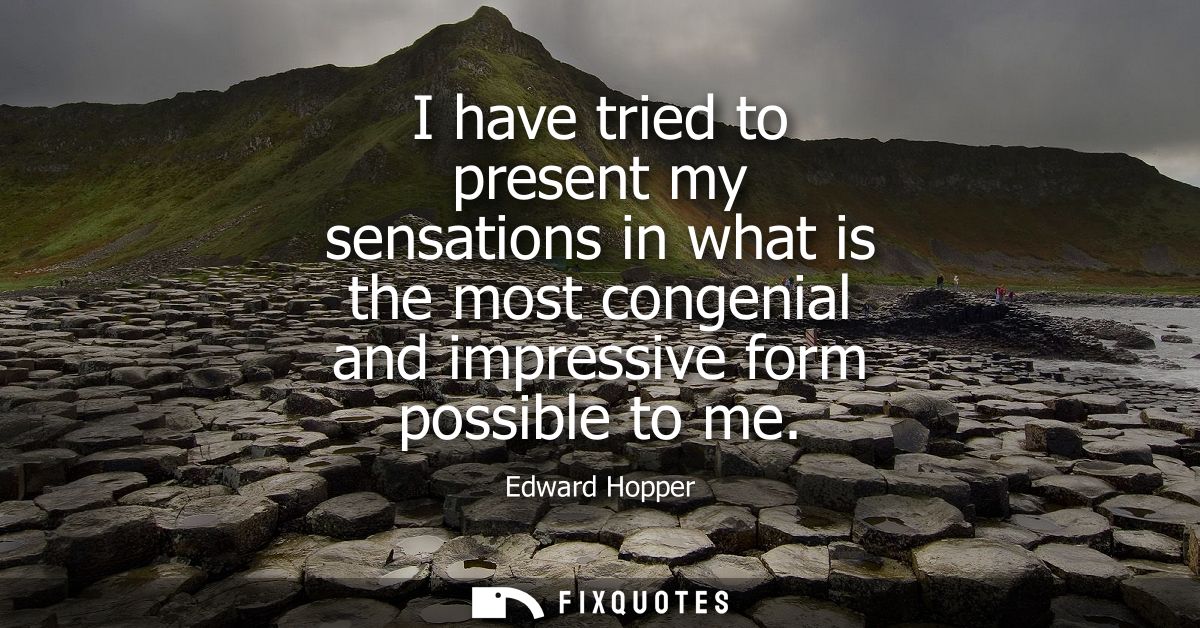
"I have tried to present my sensations in what is the most congenial and impressive form possible to me"
About this Quote
Hopper isn’t pitching realism; he’s defending a kind of edited honesty. “Sensations” is doing the heavy lifting here, steering us away from narrative, ideology, even “message,” and toward the felt residue of experience: the chill of a late-night diner, the hum of a hotel corridor, the particular loneliness of sunlight on an empty wall. He’s telling you the subject is not the street corner or the woman at the window. The subject is what that corner does to his nervous system.
The phrase “most congenial and impressive” is quietly radical because it admits art is a translation shaped by temperament. “Congenial” signals personal fit: the form has to match his inner weather. “Impressive” isn’t about impressing the audience so much as making the sensation press itself into visibility, giving it weight and contour. Hopper’s cool, architectural compositions and stark lighting aren’t neutral observations; they’re tools for intensifying mood, for turning everyday American space into psychological space.
Context matters: Hopper is working through early-to-mid 20th-century modernism, when abstraction is ascendant and representational painters are often treated as conservative. This line is his sidestep. He’s not pledging allegiance to tradition; he’s claiming a modernist mandate on his own terms: form serves perception, not doctrine. The subtext is an artist asking to be judged not by what he depicts, but by whether the depiction transmits a charge. If the paintings feel eerily quiet, it’s because quiet is the sensation he learned to make “impressive.”
The phrase “most congenial and impressive” is quietly radical because it admits art is a translation shaped by temperament. “Congenial” signals personal fit: the form has to match his inner weather. “Impressive” isn’t about impressing the audience so much as making the sensation press itself into visibility, giving it weight and contour. Hopper’s cool, architectural compositions and stark lighting aren’t neutral observations; they’re tools for intensifying mood, for turning everyday American space into psychological space.
Context matters: Hopper is working through early-to-mid 20th-century modernism, when abstraction is ascendant and representational painters are often treated as conservative. This line is his sidestep. He’s not pledging allegiance to tradition; he’s claiming a modernist mandate on his own terms: form serves perception, not doctrine. The subtext is an artist asking to be judged not by what he depicts, but by whether the depiction transmits a charge. If the paintings feel eerily quiet, it’s because quiet is the sensation he learned to make “impressive.”
Quote Details
| Topic | Art |
|---|---|
| Source | Help us find the source |
More Quotes by Edward
Add to List