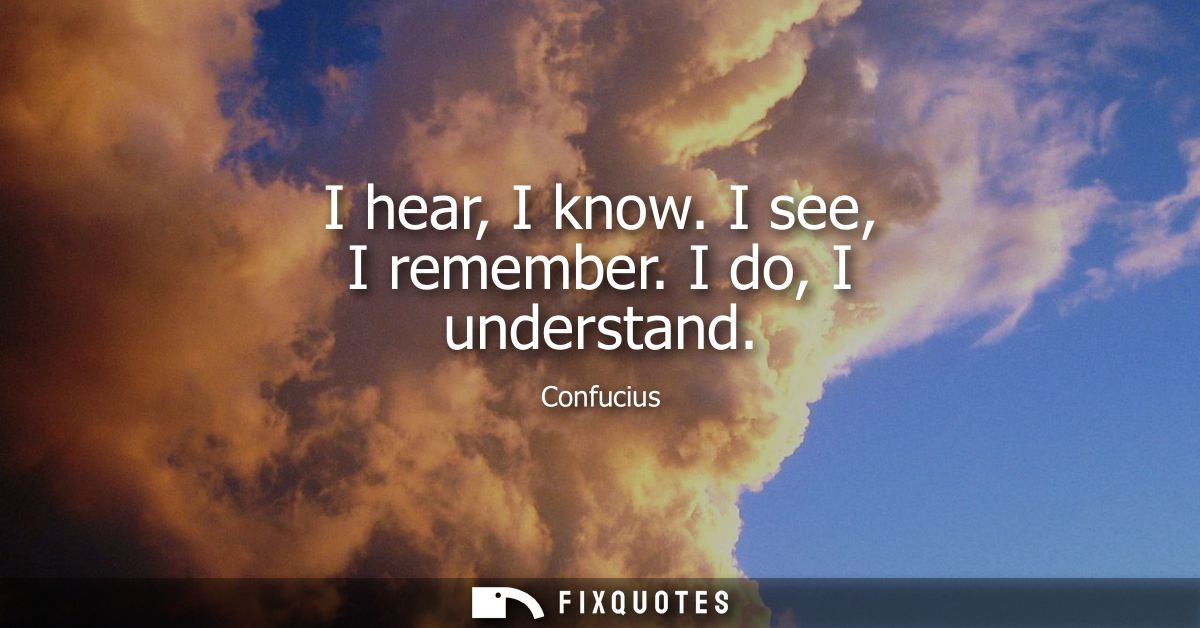
"I hear, I know. I see, I remember. I do, I understand"
About this Quote
A neat ladder of verbs, this line sells a theory of learning that’s less mystical than it first sounds: knowledge is cheap until it’s embodied. Confucius stacks three sensory gates - hearing, seeing, doing - and pairs each with a deeper cognitive outcome. The structure is almost pedagogical choreography: input becomes retention, then action becomes comprehension. It’s memorable because it’s rhythmic and incremental, like a teacher pacing a room, refusing to let students mistake exposure for mastery.
The subtext is a critique of passive “knowing.” In Confucian society, where education could slide into rote recitation of classics and social norms, the quote pushes against the trap of performance learning: you can repeat the right words, even “know” the right rules, and still be ethically hollow. “I do, I understand” implies that understanding is not a private mental state but a public competence - tested in conduct, relationships, ritual, and responsibility. That’s classic Confucius: virtue isn’t a vibe; it’s a practice.
Context matters because Confucius wasn’t writing self-help for individual fulfillment. He was trying to repair social order during political fragmentation, arguing that stable government begins with cultivated people. This little progression doubles as a civic argument: a society of mere hearers produces slogans; a society of doers produces judgment. The line works because it flatters no one. It insists that the proof of learning is what your life can carry.
The subtext is a critique of passive “knowing.” In Confucian society, where education could slide into rote recitation of classics and social norms, the quote pushes against the trap of performance learning: you can repeat the right words, even “know” the right rules, and still be ethically hollow. “I do, I understand” implies that understanding is not a private mental state but a public competence - tested in conduct, relationships, ritual, and responsibility. That’s classic Confucius: virtue isn’t a vibe; it’s a practice.
Context matters because Confucius wasn’t writing self-help for individual fulfillment. He was trying to repair social order during political fragmentation, arguing that stable government begins with cultivated people. This little progression doubles as a civic argument: a society of mere hearers produces slogans; a society of doers produces judgment. The line works because it flatters no one. It insists that the proof of learning is what your life can carry.
Quote Details
| Topic | Learning |
|---|---|
| Source | Help us find the source |
| Cite |
Citation Formats
APA Style (7th ed.)
Confucius. (2026, January 14). I hear, I know. I see, I remember. I do, I understand. FixQuotes. https://fixquotes.com/quotes/i-hear-i-know-i-see-i-remember-i-do-i-understand-24767/
Chicago Style
Confucius. "I hear, I know. I see, I remember. I do, I understand." FixQuotes. January 14, 2026. https://fixquotes.com/quotes/i-hear-i-know-i-see-i-remember-i-do-i-understand-24767/.
MLA Style (9th ed.)
"I hear, I know. I see, I remember. I do, I understand." FixQuotes, 14 Jan. 2026, https://fixquotes.com/quotes/i-hear-i-know-i-see-i-remember-i-do-i-understand-24767/. Accessed 30 Mar. 2026.
More Quotes by Confucius
Add to List