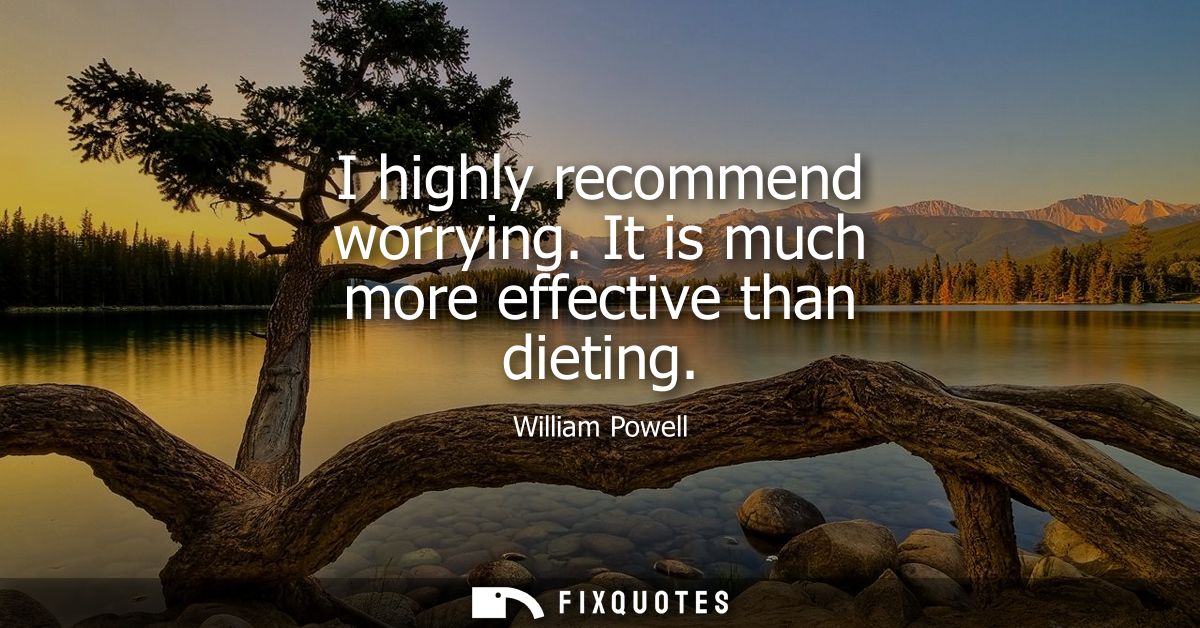
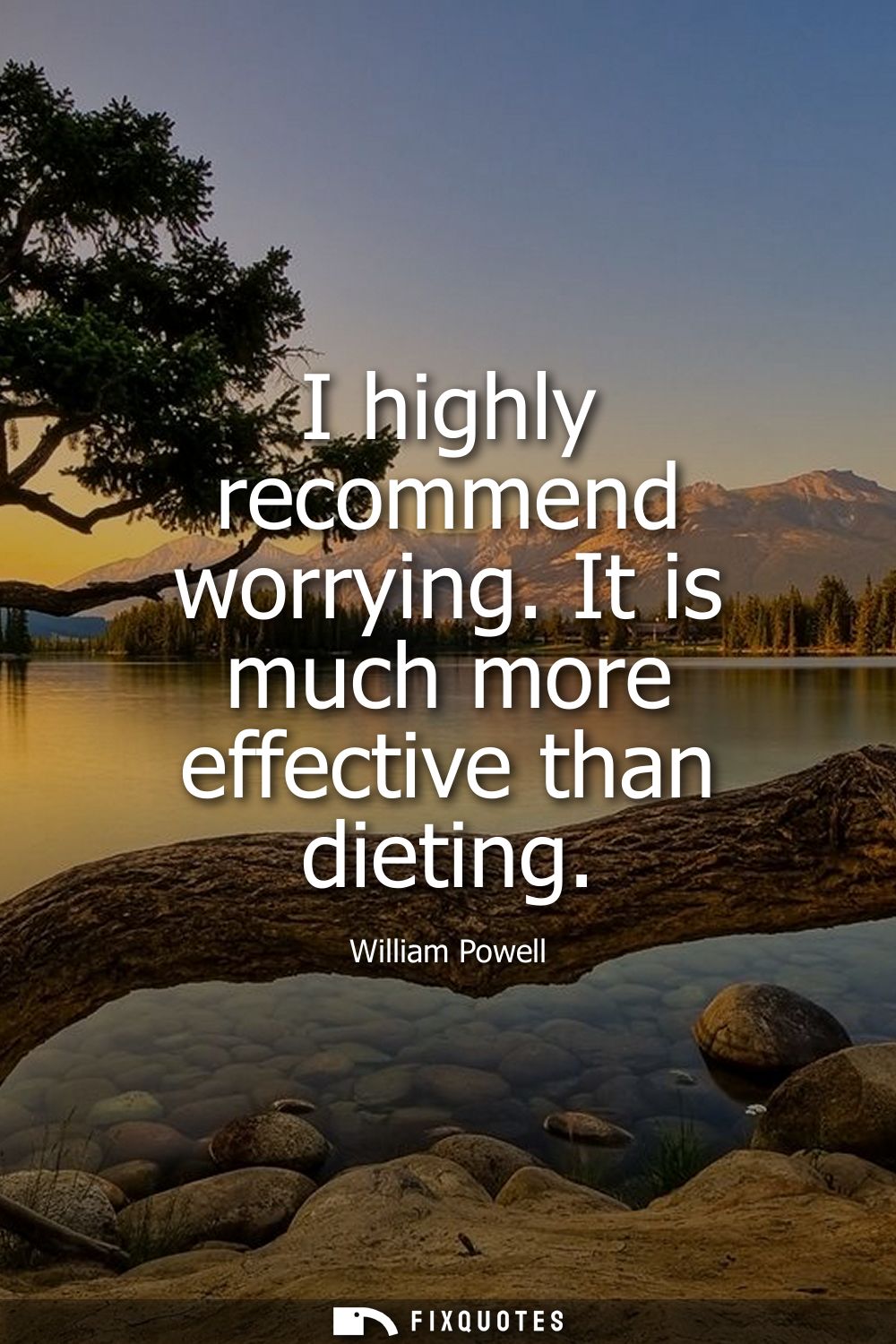
"I highly recommend worrying. It is much more effective than dieting"
About this Quote
Worrying gets pitched here like a miracle product, and that’s the joke: Powell flips self-help logic on its head, treating anxiety as a superior weight-loss plan. Coming from an actor whose persona often traded in elegance and dry sophistication, the line lands with that old Hollywood martini-dry snap. It’s less a health tip than a knowing jab at the ways we try to manage our bodies and lives through “disciplines” that are supposed to feel virtuous.
The subtext is darker than it sounds. Dieting is framed as optional, chosen, even socially performative; worrying is involuntary, sticky, and culturally rewarded in its own perverse way. If dieting is the visible labor of self-improvement, worrying is the invisible labor of modern life: the constant mental bookkeeping that churns beneath polite conversation. Powell’s punchline implies that the real engine of people’s “results” isn’t willpower but stress - the kind that steals appetite, sleep, and joy while still getting mistaken for responsibility.
It works because it flatters and indicts at the same time. You laugh because you recognize the absurdity of recommending something miserable. You also wince because the recommendation isn’t entirely false. In a culture that markets control - calories, routines, optimization - Powell points to the unglamorous force that actually controls us: anxious rumination. The line’s elegance is its cruelty: it’s a one-sentence portrait of a society that confuses suffering with effectiveness.
The subtext is darker than it sounds. Dieting is framed as optional, chosen, even socially performative; worrying is involuntary, sticky, and culturally rewarded in its own perverse way. If dieting is the visible labor of self-improvement, worrying is the invisible labor of modern life: the constant mental bookkeeping that churns beneath polite conversation. Powell’s punchline implies that the real engine of people’s “results” isn’t willpower but stress - the kind that steals appetite, sleep, and joy while still getting mistaken for responsibility.
It works because it flatters and indicts at the same time. You laugh because you recognize the absurdity of recommending something miserable. You also wince because the recommendation isn’t entirely false. In a culture that markets control - calories, routines, optimization - Powell points to the unglamorous force that actually controls us: anxious rumination. The line’s elegance is its cruelty: it’s a one-sentence portrait of a society that confuses suffering with effectiveness.
Quote Details
| Topic | Witty One-Liners |
|---|---|
| Source | Help us find the source |
| Cite |
Citation Formats
APA Style (7th ed.)
Powell, William. (2026, January 16). I highly recommend worrying. It is much more effective than dieting. FixQuotes. https://fixquotes.com/quotes/i-highly-recommend-worrying-it-is-much-more-133981/
Chicago Style
Powell, William. "I highly recommend worrying. It is much more effective than dieting." FixQuotes. January 16, 2026. https://fixquotes.com/quotes/i-highly-recommend-worrying-it-is-much-more-133981/.
MLA Style (9th ed.)
"I highly recommend worrying. It is much more effective than dieting." FixQuotes, 16 Jan. 2026, https://fixquotes.com/quotes/i-highly-recommend-worrying-it-is-much-more-133981/. Accessed 12 Feb. 2026.
More Quotes by William
Add to List