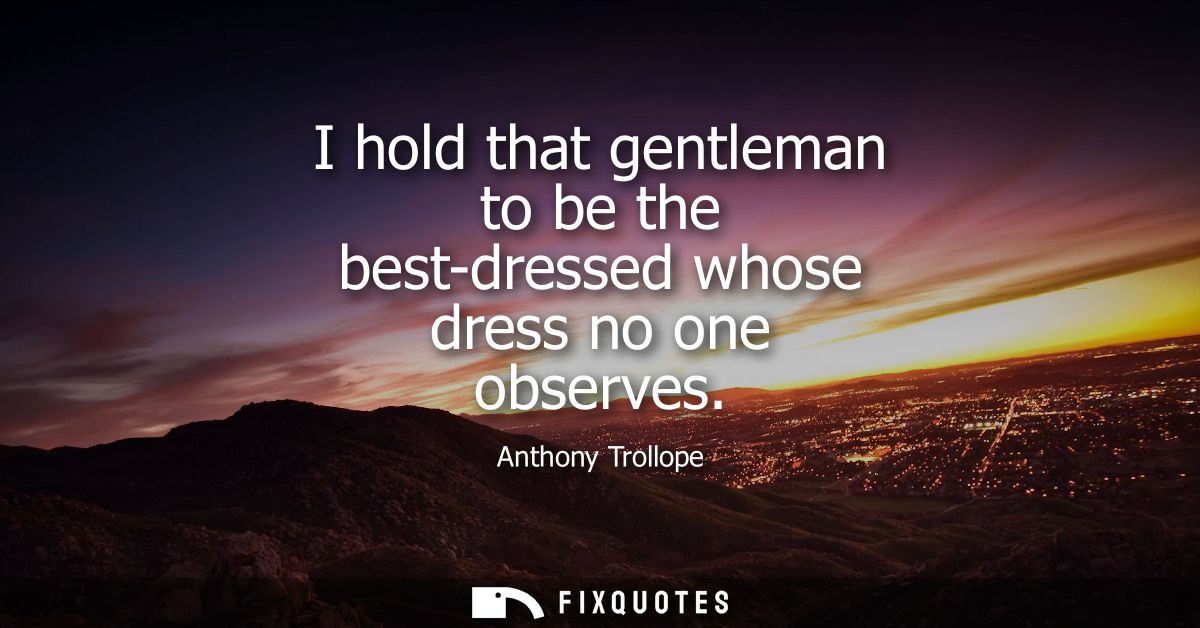
"I hold that gentleman to be the best-dressed whose dress no one observes"
About this Quote
The line works because it flips the typical logic of display. Instead of treating fashion as self-expression, Trollope treats it as social lubrication. Being “observed” is the telltale sign of trying too hard, of announcing yourself when a gentleman is supposed to move through public life with practiced ease. The real status marker isn’t novelty; it’s invisibility. You don’t earn respect by becoming a spectacle. You earn it by looking like you naturally belong.
There’s also a moral nudge buried in the tailoring. Trollope’s novels are full of people climbing, posing, angling for advantage. Here, conspicuous dress becomes a proxy for conspicuous ambition. The gentleman who cannot resist being noticed invites suspicion: vanity, insecurity, arriviste hunger. The one no one observes signals confidence and restraint, the Victorian ideal of power that doesn’t need to introduce itself.
Read now, it lands as a quiet takedown of “main character” aesthetics. Trollope isn’t arguing against beauty; he’s arguing against performance. The sharpest look is the one that leaves your character, not your clothes, doing the talking.
Quote Details
| Topic | Witty One-Liners |
|---|---|
| Source | Help us find the source |
| Cite |
Citation Formats
APA Style (7th ed.)
Trollope, Anthony. (2026, January 15). I hold that gentleman to be the best-dressed whose dress no one observes. FixQuotes. https://fixquotes.com/quotes/i-hold-that-gentleman-to-be-the-best-dressed-39007/
Chicago Style
Trollope, Anthony. "I hold that gentleman to be the best-dressed whose dress no one observes." FixQuotes. January 15, 2026. https://fixquotes.com/quotes/i-hold-that-gentleman-to-be-the-best-dressed-39007/.
MLA Style (9th ed.)
"I hold that gentleman to be the best-dressed whose dress no one observes." FixQuotes, 15 Jan. 2026, https://fixquotes.com/quotes/i-hold-that-gentleman-to-be-the-best-dressed-39007/. Accessed 5 Apr. 2026.