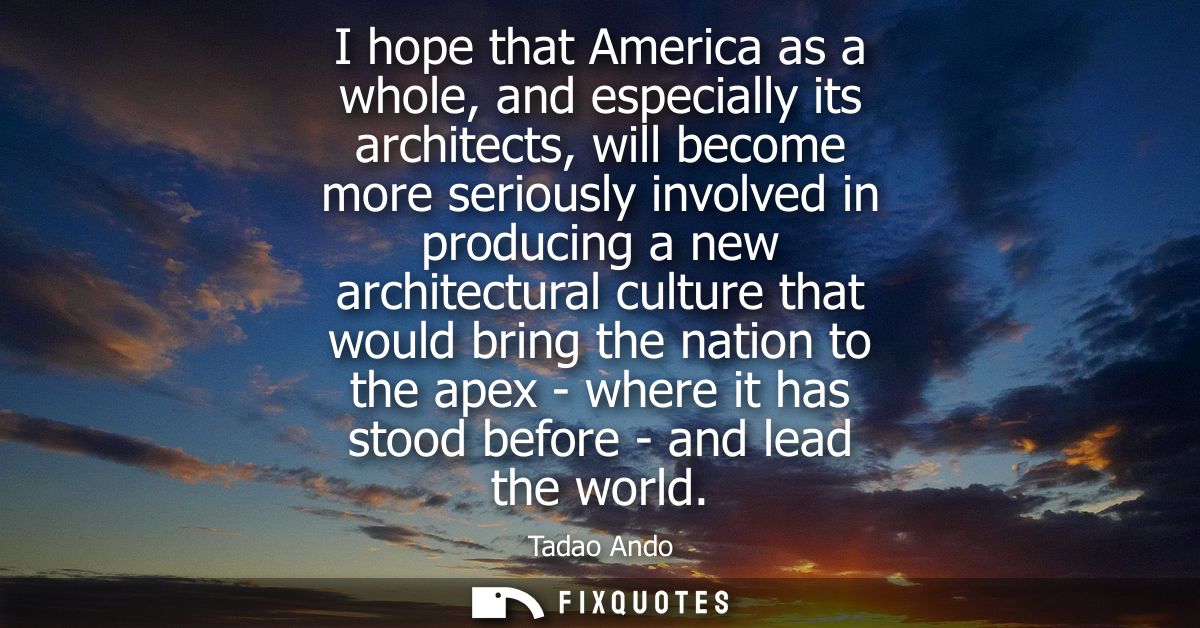
"I hope that America as a whole, and especially its architects, will become more seriously involved in producing a new architectural culture that would bring the nation to the apex - where it has stood before - and lead the world"
About this Quote
Ando’s line lands like a polite provocation: America, he implies, has been coasting on inherited prestige, and its built environment is the evidence. By singling out “architects,” he’s not flattering the profession so much as assigning it responsibility for a national mood. Architecture here isn’t decoration; it’s a public instrument, a way a country announces what it values when no one is giving a speech.
The phrase “new architectural culture” does the real work. Ando isn’t asking for a few better buildings or another signature skyline. He’s calling for a shift in the ecosystem that produces architecture: clients who demand more than square footage, institutions that reward civic ambition, cities willing to treat space as a common good. “More seriously involved” reads like a jab at a market logic that often reduces buildings to financial containers, with architects hired to make the container feel premium.
Then there’s the loaded nostalgia of “the apex - where it has stood before.” He’s invoking an earlier America that exported ideals through form: modernism as confidence, universities as civic laboratories, museums and libraries as democratic monuments. Coming from Ando, a self-taught architect whose work turns concrete into quiet moral force, the subtext is clear: leadership isn’t volume, it’s rigor. If America wants to “lead the world,” it won’t be by building louder, but by building with enough discipline and public purpose that the rest of the world notices again.
The phrase “new architectural culture” does the real work. Ando isn’t asking for a few better buildings or another signature skyline. He’s calling for a shift in the ecosystem that produces architecture: clients who demand more than square footage, institutions that reward civic ambition, cities willing to treat space as a common good. “More seriously involved” reads like a jab at a market logic that often reduces buildings to financial containers, with architects hired to make the container feel premium.
Then there’s the loaded nostalgia of “the apex - where it has stood before.” He’s invoking an earlier America that exported ideals through form: modernism as confidence, universities as civic laboratories, museums and libraries as democratic monuments. Coming from Ando, a self-taught architect whose work turns concrete into quiet moral force, the subtext is clear: leadership isn’t volume, it’s rigor. If America wants to “lead the world,” it won’t be by building louder, but by building with enough discipline and public purpose that the rest of the world notices again.
Quote Details
| Topic | Art |
|---|---|
| Source | Help us find the source |
More Quotes by Tadao
Add to List