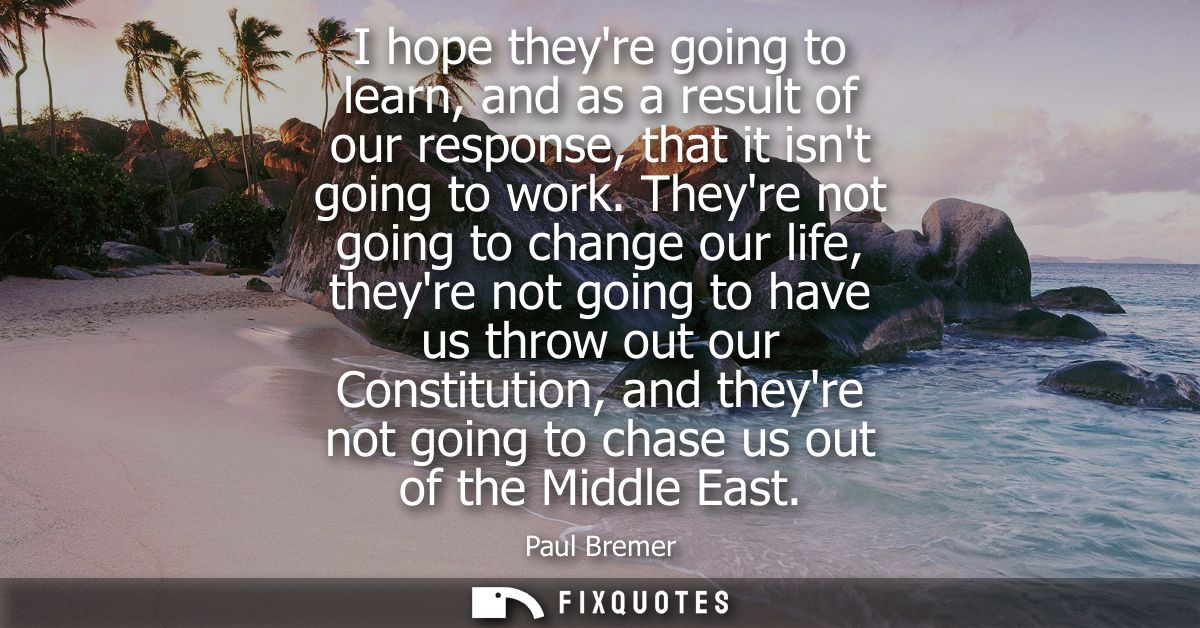
"I hope they're going to learn, and as a result of our response that it isn't going to work. They're not going to change our life, they're not going to have us throw out our Constitution, and they're not going to chase us out of the Middle East"
About this Quote
The intent is twofold. First, deterrence-by-declaration: make the adversary “learn” that attacking the United States is futile. Second, reassurance: tell a rattled domestic audience that the fundamentals will hold - daily life, the Constitution, America’s strategic footprint. The phrase “throw out our Constitution” is doing heavy emotional work, invoking a familiar fear that terror forces democracies to betray themselves. It’s striking because the era’s actual policy story is tangled: the security state expanded, civil liberties debates intensified, and the Constitution became a battlefield of interpretation rather than a fixed shield.
The subtext sits in the geography of the final clause. “Chase us out of the Middle East” treats U.S. presence there as a given, a baseline entitlement rather than a contested choice - which is exactly why insurgents would target it. Bremer, as the U.S. administrator in Iraq, was speaking from inside an occupation that needed legitimacy and momentum. The repetition works because it mimics grit; it also reveals how much the project depended on saying “we won’t be moved” before anyone could point out how movable, in fact, empires are.
Quote Details
| Topic | Freedom |
|---|---|
| Source | Help us find the source |
| Cite |
Citation Formats
APA Style (7th ed.)
Bremer, Paul. (2026, February 16). I hope they're going to learn, and as a result of our response that it isn't going to work. They're not going to change our life, they're not going to have us throw out our Constitution, and they're not going to chase us out of the Middle East. FixQuotes. https://fixquotes.com/quotes/i-hope-theyre-going-to-learn-and-as-a-result-of-152903/
Chicago Style
Bremer, Paul. "I hope they're going to learn, and as a result of our response that it isn't going to work. They're not going to change our life, they're not going to have us throw out our Constitution, and they're not going to chase us out of the Middle East." FixQuotes. February 16, 2026. https://fixquotes.com/quotes/i-hope-theyre-going-to-learn-and-as-a-result-of-152903/.
MLA Style (9th ed.)
"I hope they're going to learn, and as a result of our response that it isn't going to work. They're not going to change our life, they're not going to have us throw out our Constitution, and they're not going to chase us out of the Middle East." FixQuotes, 16 Feb. 2026, https://fixquotes.com/quotes/i-hope-theyre-going-to-learn-and-as-a-result-of-152903/. Accessed 8 Apr. 2026.