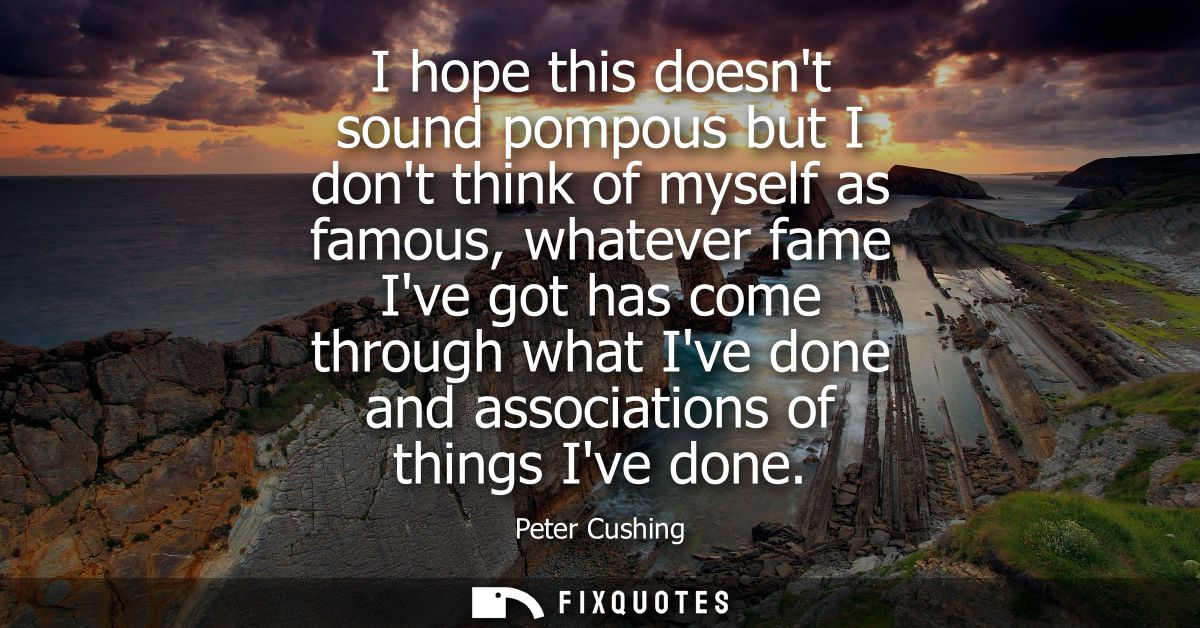
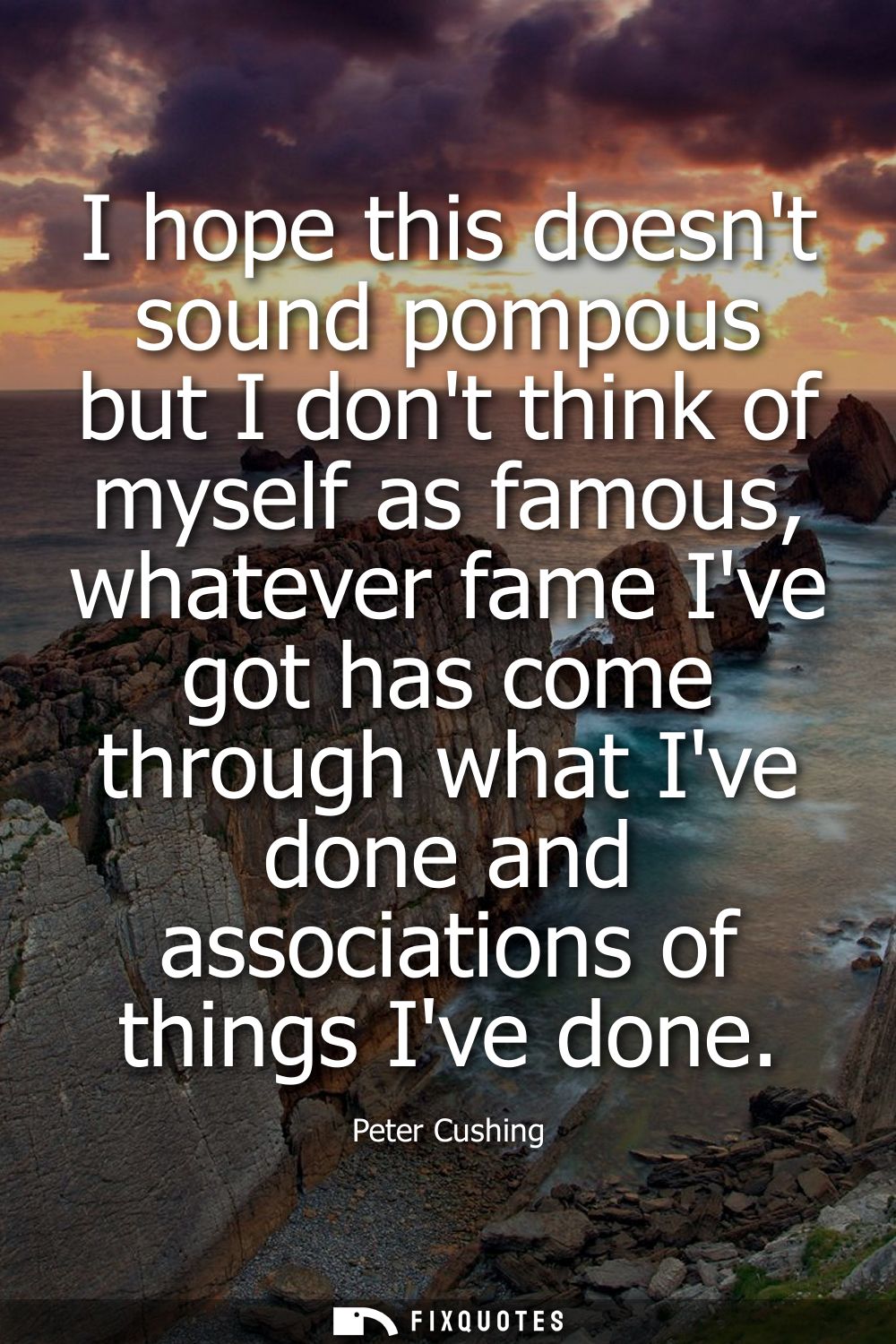
"I hope this doesn't sound pompous, but I don't think of myself as famous, whatever fame I've got has come through what I've done and associations of things I've done"
About this Quote
The real pivot is “associations.” Cushing isn’t claiming anonymity; he’s reframing celebrity as a network effect. People don’t “know” him, they know the characters, the films, the genres, the directors, the cultural furniture attached to his face. For an actor whose legacy is inseparable from Hammer horror and later the gravitational pull of Star Wars, that’s unusually clear-eyed. He’s describing fame as something that happens to an image, not to a self.
There’s also an older, craft-first ethic underneath it: the idea that the job is the point, and recognition is a byproduct you’re wise not to metabolize too deeply. Coming from a generation trained in repertory discipline and postwar restraint, Cushing’s line reads like a quiet refusal of celebrity as lifestyle. He makes his case without moralizing: I’m not “famous,” I’m employed - and the public is responding to the work, not to my private mythology. That boundary is the whole statement’s hidden thesis.
Quote Details
| Topic | Humility |
|---|---|
| Source | Help us find the source |
| Cite |
Citation Formats
APA Style (7th ed.)
Cushing, Peter. (2026, February 18). I hope this doesn't sound pompous, but I don't think of myself as famous, whatever fame I've got has come through what I've done and associations of things I've done. FixQuotes. https://fixquotes.com/quotes/i-hope-this-doesnt-sound-pompous-but-i-dont-think-85720/
Chicago Style
Cushing, Peter. "I hope this doesn't sound pompous, but I don't think of myself as famous, whatever fame I've got has come through what I've done and associations of things I've done." FixQuotes. February 18, 2026. https://fixquotes.com/quotes/i-hope-this-doesnt-sound-pompous-but-i-dont-think-85720/.
MLA Style (9th ed.)
"I hope this doesn't sound pompous, but I don't think of myself as famous, whatever fame I've got has come through what I've done and associations of things I've done." FixQuotes, 18 Feb. 2026, https://fixquotes.com/quotes/i-hope-this-doesnt-sound-pompous-but-i-dont-think-85720/. Accessed 2 Apr. 2026.