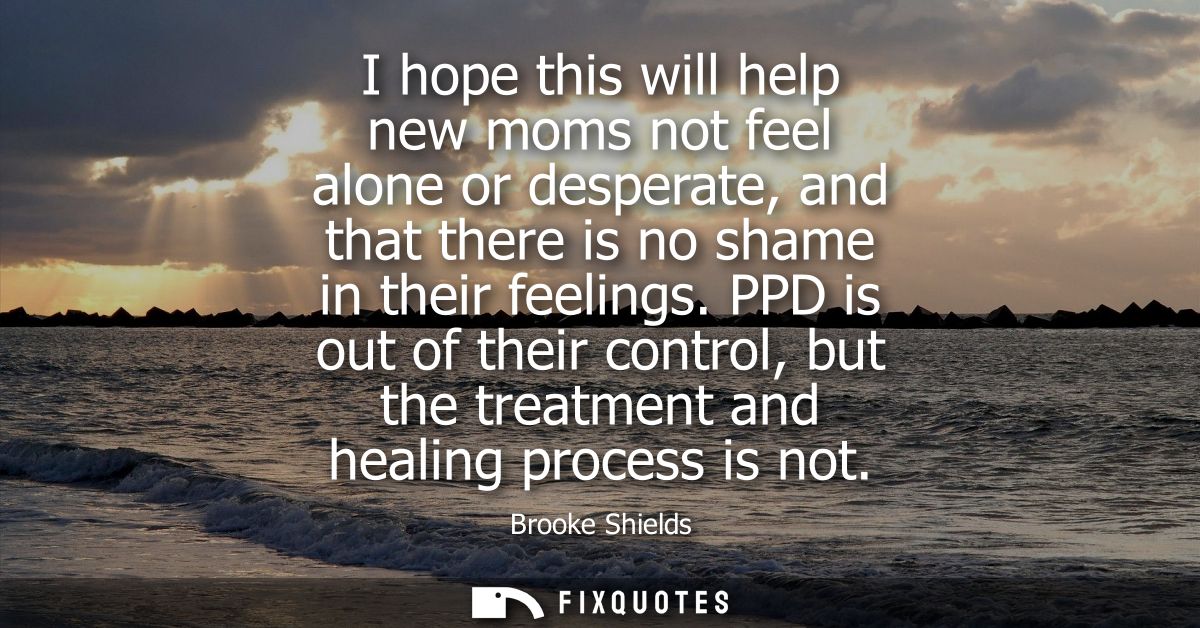
"I hope this will help new moms not feel alone or desperate, and that there is no shame in their feelings. PPD is out of their control, but the treatment and healing process is not"
About this Quote
The most pointed subtext is in the pivot: "PPD is out of their control, but the treatment and healing process is not". That’s a careful, almost legalistic sentence built to relieve guilt without stripping agency. Shields validates postpartum depression as an illness, not a character flaw, while still arguing for action - not willpower, but care. It’s a rebuttal to two equally toxic myths: that PPD is something you can just "think positive" away, and that having it makes you a failed mother.
Context matters. Shields has been public about her own postpartum depression, and as an actress whose body and image have long been treated as public property, her admission lands differently. She’s leveraging celebrity in a way that’s culturally useful: making a private crisis legible, then insisting that getting help isn’t weakness but a choice available to you. The intent isn’t inspiration; it’s permission, paired with a nudge toward treatment.
Quote Details
| Topic | New Mom |
|---|---|
| Source | Help us find the source |
| Cite |
Citation Formats
APA Style (7th ed.)
Shields, Brooke. (2026, January 15). I hope this will help new moms not feel alone or desperate, and that there is no shame in their feelings. PPD is out of their control, but the treatment and healing process is not. FixQuotes. https://fixquotes.com/quotes/i-hope-this-will-help-new-moms-not-feel-alone-or-168793/
Chicago Style
Shields, Brooke. "I hope this will help new moms not feel alone or desperate, and that there is no shame in their feelings. PPD is out of their control, but the treatment and healing process is not." FixQuotes. January 15, 2026. https://fixquotes.com/quotes/i-hope-this-will-help-new-moms-not-feel-alone-or-168793/.
MLA Style (9th ed.)
"I hope this will help new moms not feel alone or desperate, and that there is no shame in their feelings. PPD is out of their control, but the treatment and healing process is not." FixQuotes, 15 Jan. 2026, https://fixquotes.com/quotes/i-hope-this-will-help-new-moms-not-feel-alone-or-168793/. Accessed 21 Mar. 2026.