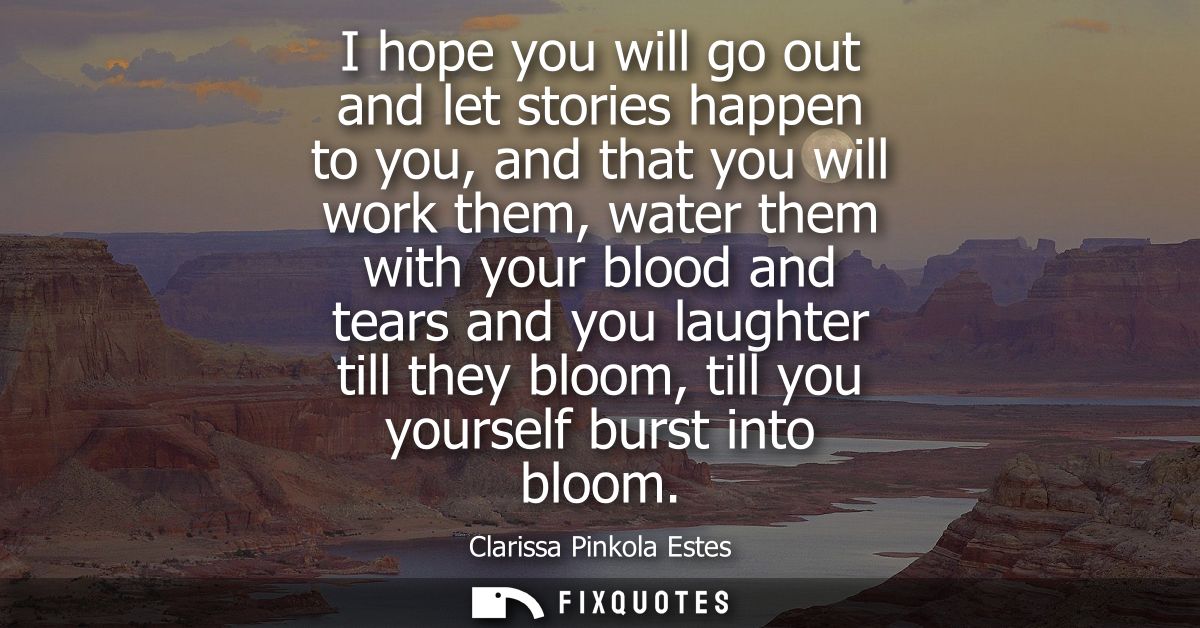
"I hope you will go out and let stories happen to you, and that you will work them, water them with your blood and tears and you laughter till they bloom, till you yourself burst into bloom"
About this Quote
The horticultural metaphor is doing sly work. "Work them" and "water them" acknowledges craft and discipline, but the irrigation she names is bodily: "blood and tears and...laughter". That list refuses the polite hierarchy of emotions. Pain doesn’t get to be the only credential; joy counts as labor too. Subtext: if your work feels sterile, it may be because you’re trying to produce art without paying the admission fee of feeling.
The line "till they bloom" sounds like a promise of payoff, then she swerves: "till you yourself burst into bloom". The story isn’t the product; you are. This is less MFA workshop and more mythic psychology, consistent with Estes's broader cultural role as a storyteller who treats narrative as medicine and initiation. She’s writing against a modern posture of ironic distance, the cool-person defense mechanism. Her rhetorical move is intimate and a little feral, insisting that creation is an embodied, messy, reciprocal process: you don’t harvest stories without being altered by them.
Contextually, it lands in a late-20th-century ecosystem of feminist and Jung-influenced spiritual writing that recast "the personal" as a source of authority rather than confession. The bloom is not prettiness; it’s transformation.
Quote Details
| Topic | Embrace Change |
|---|---|
| Source | Women Who Run with the Wolves: Myths and Stories of the Wild Woman Archetype, Clarissa Pinkola Estés, Ballantine Books, 1992 (passage commonly attributed to this book). |
| Cite |
Citation Formats
APA Style (7th ed.)
Estes, Clarissa Pinkola. (2026, January 16). I hope you will go out and let stories happen to you, and that you will work them, water them with your blood and tears and you laughter till they bloom, till you yourself burst into bloom. FixQuotes. https://fixquotes.com/quotes/i-hope-you-will-go-out-and-let-stories-happen-to-122374/
Chicago Style
Estes, Clarissa Pinkola. "I hope you will go out and let stories happen to you, and that you will work them, water them with your blood and tears and you laughter till they bloom, till you yourself burst into bloom." FixQuotes. January 16, 2026. https://fixquotes.com/quotes/i-hope-you-will-go-out-and-let-stories-happen-to-122374/.
MLA Style (9th ed.)
"I hope you will go out and let stories happen to you, and that you will work them, water them with your blood and tears and you laughter till they bloom, till you yourself burst into bloom." FixQuotes, 16 Jan. 2026, https://fixquotes.com/quotes/i-hope-you-will-go-out-and-let-stories-happen-to-122374/. Accessed 28 Mar. 2026.