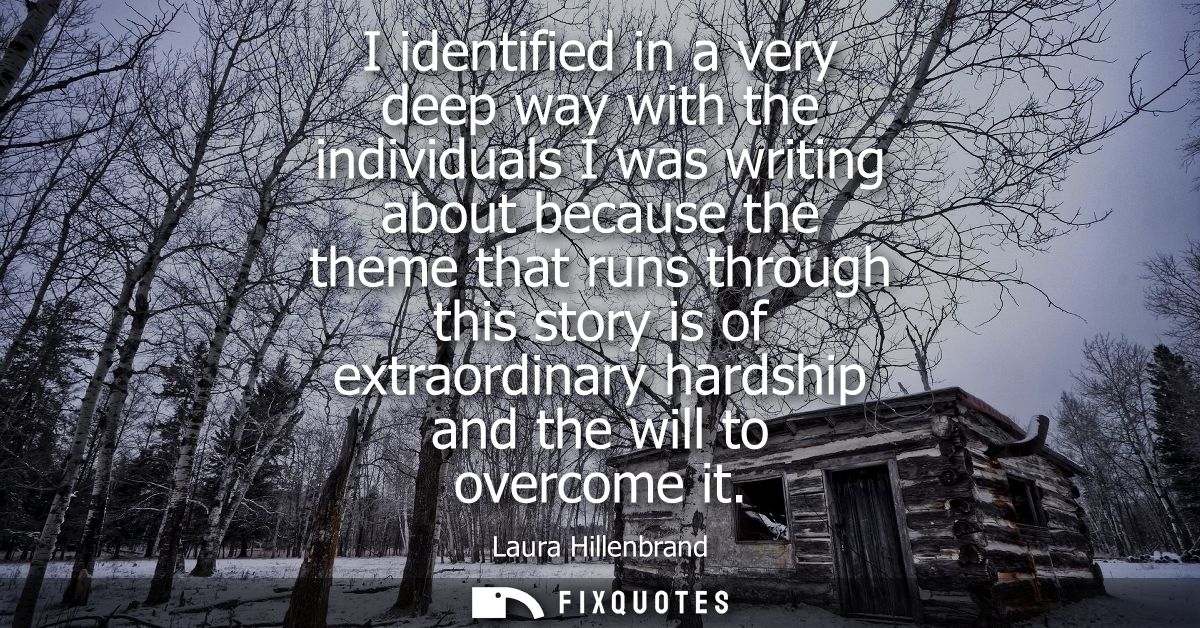
"I identified in a very deep way with the individuals I was writing about because the theme that runs through this story is of extraordinary hardship and the will to overcome it"
About this Quote
The key phrase is "the individuals I was writing about". Not heroes, not icons, not "inspirations" - individuals. That choice resists the easy packaging of suffering into a motivational commodity. It also hints at a writerly discipline: identification doesn't erase difference, it sharpens attention. She implies that to render hardship honestly you have to feel its pressure without stealing it.
The subtext is also personal. Hillenbrand is widely known for writing through severe chronic illness, which has kept her largely housebound. Without turning the line into autobiography, it's hard not to hear a coded fellowship: she recognizes endurance not as a cinematic montage but as a daily negotiation. That matters because her books (notably Seabiscuit and Unbroken) are often shelved as uplifting stories; she's nudging us to see the "will to overcome" as hard-earned, uneven, sometimes barely articulate.
In a culture that loves resilience as branding, Hillenbrand's intent is corrective: she romanticizes neither pain nor triumph. She makes the will itself the plot, and identification the engine that keeps it from becoming a slogan.
Quote Details
| Topic | Overcoming Obstacles |
|---|---|
| Source | Help us find the source |
| Cite |
Citation Formats
APA Style (7th ed.)
Hillenbrand, Laura. (2026, January 16). I identified in a very deep way with the individuals I was writing about because the theme that runs through this story is of extraordinary hardship and the will to overcome it. FixQuotes. https://fixquotes.com/quotes/i-identified-in-a-very-deep-way-with-the-126557/
Chicago Style
Hillenbrand, Laura. "I identified in a very deep way with the individuals I was writing about because the theme that runs through this story is of extraordinary hardship and the will to overcome it." FixQuotes. January 16, 2026. https://fixquotes.com/quotes/i-identified-in-a-very-deep-way-with-the-126557/.
MLA Style (9th ed.)
"I identified in a very deep way with the individuals I was writing about because the theme that runs through this story is of extraordinary hardship and the will to overcome it." FixQuotes, 16 Jan. 2026, https://fixquotes.com/quotes/i-identified-in-a-very-deep-way-with-the-126557/. Accessed 29 Mar. 2026.