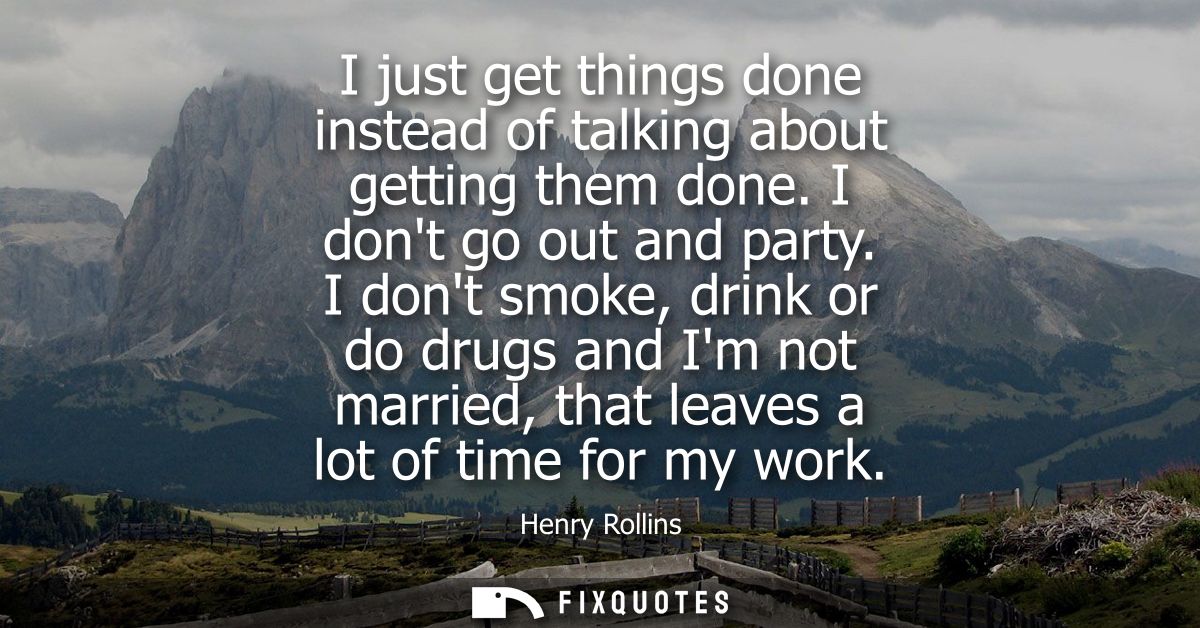
"I just get things done instead of talking about getting them done. I don't go out and party. I don't smoke, drink or do drugs and I'm not married, that leaves a lot of time for my work"
About this Quote
The intent is twofold. First, he’s asserting credibility in a culture (punk, hardcore, touring life) where authenticity gets policed and self-mythologizing is a survival skill. Second, he’s making busyness into identity: work isn’t what he does; work is what he is, and everything else is a tax on the mission. That’s why the list includes marriage alongside drugs - both are rendered as distractions, obligations, emotional entropy.
Subtext: this is a rebuttal to the stereotype of the self-destructive rock guy, but it’s also an admission of what the routine costs. The austerity reads less like saintliness than like a controlled environment. By defining freedom as the absence of attachments, Rollins implies that intimacy and leisure are compromises he can’t afford, or doesn’t trust. It’s productivity as self-defense, and it lands because it’s simultaneously admirable and a little alarming.
Quote Details
| Topic | Work Ethic |
|---|---|
| Source | Help us find the source |
| Cite |
Citation Formats
APA Style (7th ed.)
Rollins, Henry. (2026, January 17). I just get things done instead of talking about getting them done. I don't go out and party. I don't smoke, drink or do drugs and I'm not married, that leaves a lot of time for my work. FixQuotes. https://fixquotes.com/quotes/i-just-get-things-done-instead-of-talking-about-31459/
Chicago Style
Rollins, Henry. "I just get things done instead of talking about getting them done. I don't go out and party. I don't smoke, drink or do drugs and I'm not married, that leaves a lot of time for my work." FixQuotes. January 17, 2026. https://fixquotes.com/quotes/i-just-get-things-done-instead-of-talking-about-31459/.
MLA Style (9th ed.)
"I just get things done instead of talking about getting them done. I don't go out and party. I don't smoke, drink or do drugs and I'm not married, that leaves a lot of time for my work." FixQuotes, 17 Jan. 2026, https://fixquotes.com/quotes/i-just-get-things-done-instead-of-talking-about-31459/. Accessed 5 Apr. 2026.