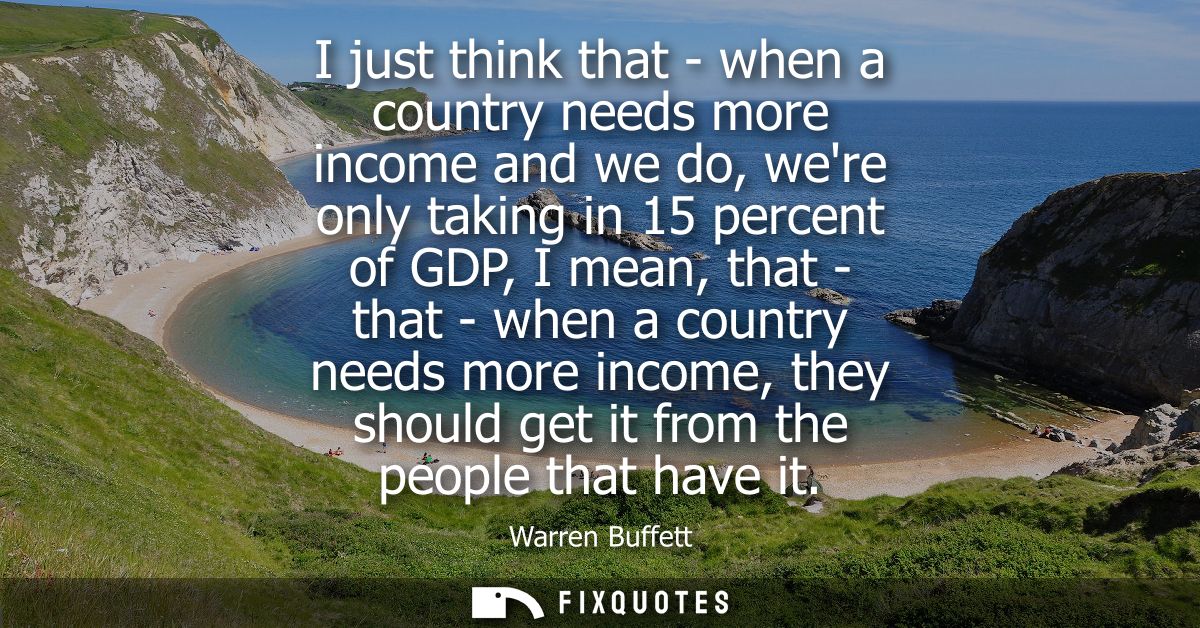
"I just think that - when a country needs more income and we do, we're only taking in 15 percent of GDP, I mean, that - that - when a country needs more income, they should get it from the people that have it"
About this Quote
The wonky backbone is the GDP line. “We’re only taking in 15 percent” is meant to feel like an objective red flag, a national revenue problem stated with the calm of a balance sheet. The stumbles and repetitions (“that - that -”) matter, too: they read as plainspoken sincerity rather than a rehearsed talking point, a folksy cadence that keeps the argument from sounding ideological. It’s a billionaire trying to sound like a neighbor who’s annoyed the group dinner bill is being split unfairly.
Contextually, this sits in the post-crisis era when deficits became a moral drama and austerity got marketed as maturity. Buffett’s subtext pushes back: if you accept the premise that the country “needs more income,” the real debate is who pays. He reframes taxation as ability-to-pay triage, not punishment. Also implicit is a critique of a system that lets capital income ride lighter than wages; his own famously low effective tax rate becomes the exhibit, not an embarrassment. The intent isn’t to romanticize government, but to make the status quo look fiscally unserious: if you want solvency, stop pretending the wealthy are tapped out.
Quote Details
| Topic | Wealth |
|---|---|
| Source | Help us find the source |
| Cite |
Citation Formats
APA Style (7th ed.)
Buffett, Warren. (2026, January 18). I just think that - when a country needs more income and we do, we're only taking in 15 percent of GDP, I mean, that - that - when a country needs more income, they should get it from the people that have it. FixQuotes. https://fixquotes.com/quotes/i-just-think-that-when-a-country-needs-more-18366/
Chicago Style
Buffett, Warren. "I just think that - when a country needs more income and we do, we're only taking in 15 percent of GDP, I mean, that - that - when a country needs more income, they should get it from the people that have it." FixQuotes. January 18, 2026. https://fixquotes.com/quotes/i-just-think-that-when-a-country-needs-more-18366/.
MLA Style (9th ed.)
"I just think that - when a country needs more income and we do, we're only taking in 15 percent of GDP, I mean, that - that - when a country needs more income, they should get it from the people that have it." FixQuotes, 18 Jan. 2026, https://fixquotes.com/quotes/i-just-think-that-when-a-country-needs-more-18366/. Accessed 11 Mar. 2026.