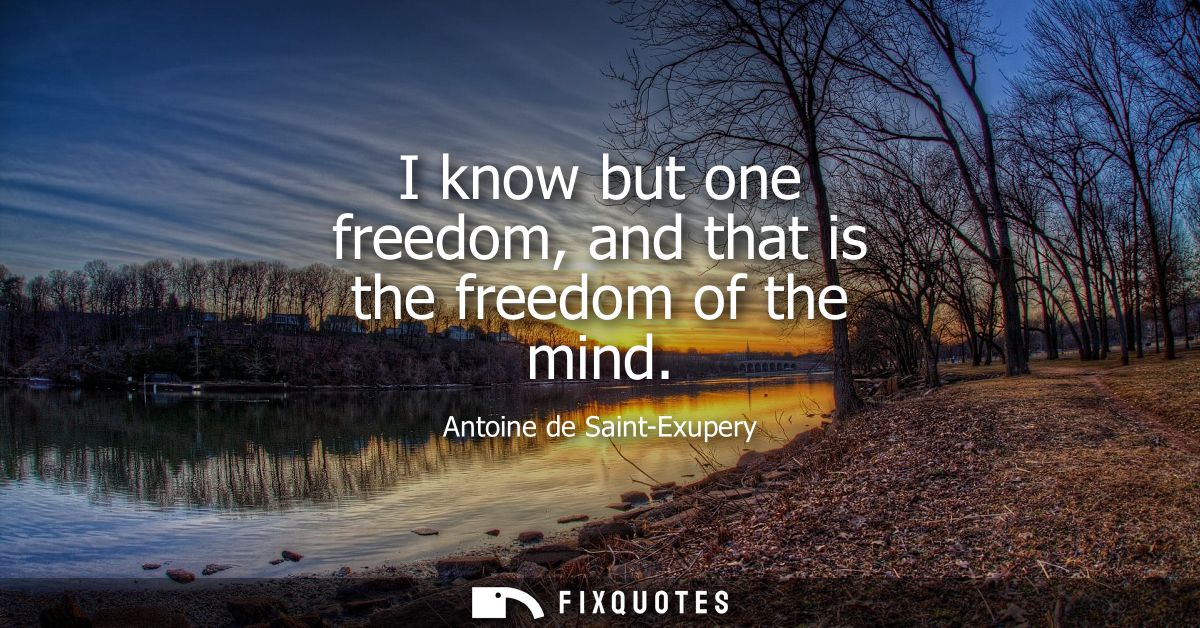
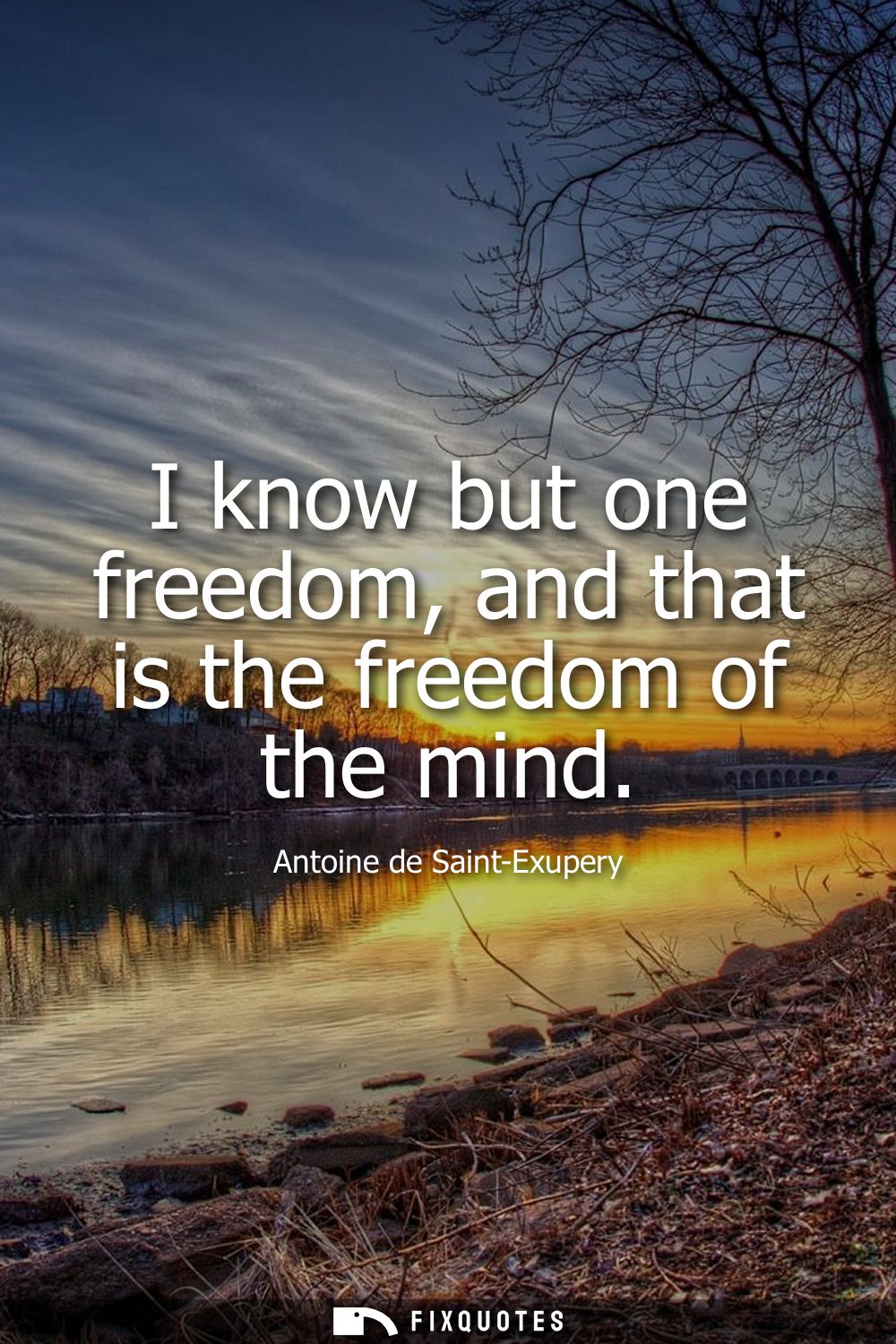
"I know but one freedom, and that is the freedom of the mind"
About this Quote
Freedom gets stripped down here to something almost annoyingly private: not a flag, not a vote, not even a right you can litigate, but the one territory no border guard can reliably police. Saint-Exupery’s line works because it refuses the grand, crowd-pleasing definitions of liberty and instead stakes everything on an interior frontier. The absolutism of “but one” is the point. It’s not that other freedoms don’t matter; it’s that they’re fragile, contingent, easily revoked. The mind is the last redoubt.
The subtext is shaped by a life lived under pressure. Saint-Exupery wasn’t a salon philosopher; he was an aviator and a witness to Europe’s slide into catastrophe. Writing in the shadow of fascism and war, he understood how quickly “freedom” becomes propaganda, how institutions can be captured, how slogans can be weaponized. Against that, he offers a defiant minimalism: if the world can take your movement, your speech, even your safety, it still has to work to take your judgment.
There’s also a moral demand embedded in the romance of the phrase. “Freedom of the mind” isn’t daydreaming; it’s discipline: the ability to see clearly, resist mass hypnosis, and remain responsible when fear is the dominant currency. Coming from a novelist, it doubles as an argument for imagination as civic infrastructure. Tyranny doesn’t just restrict bodies; it colonizes perception. Saint-Exupery is drawing the battle line where it actually gets won.
The subtext is shaped by a life lived under pressure. Saint-Exupery wasn’t a salon philosopher; he was an aviator and a witness to Europe’s slide into catastrophe. Writing in the shadow of fascism and war, he understood how quickly “freedom” becomes propaganda, how institutions can be captured, how slogans can be weaponized. Against that, he offers a defiant minimalism: if the world can take your movement, your speech, even your safety, it still has to work to take your judgment.
There’s also a moral demand embedded in the romance of the phrase. “Freedom of the mind” isn’t daydreaming; it’s discipline: the ability to see clearly, resist mass hypnosis, and remain responsible when fear is the dominant currency. Coming from a novelist, it doubles as an argument for imagination as civic infrastructure. Tyranny doesn’t just restrict bodies; it colonizes perception. Saint-Exupery is drawing the battle line where it actually gets won.
Quote Details
| Topic | Freedom |
|---|---|
| Source | Help us find the source |
| Cite |
Citation Formats
APA Style (7th ed.)
Saint-Exupery, Antoine de. (2026, January 17). I know but one freedom, and that is the freedom of the mind. FixQuotes. https://fixquotes.com/quotes/i-know-but-one-freedom-and-that-is-the-freedom-of-29907/
Chicago Style
Saint-Exupery, Antoine de. "I know but one freedom, and that is the freedom of the mind." FixQuotes. January 17, 2026. https://fixquotes.com/quotes/i-know-but-one-freedom-and-that-is-the-freedom-of-29907/.
MLA Style (9th ed.)
"I know but one freedom, and that is the freedom of the mind." FixQuotes, 17 Jan. 2026, https://fixquotes.com/quotes/i-know-but-one-freedom-and-that-is-the-freedom-of-29907/. Accessed 20 Mar. 2026.
More Quotes by Antoine
Add to List