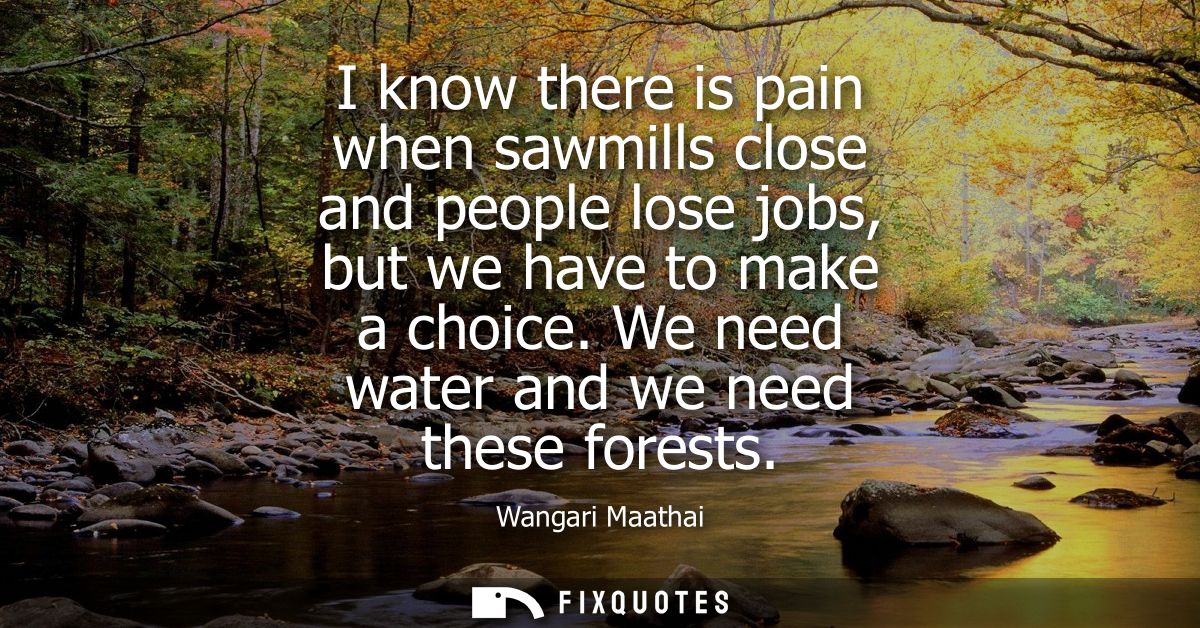
"I know there is pain when sawmills close and people lose jobs, but we have to make a choice. We need water and we need these forests"
About this Quote
The subtext is a rebuke to the usual development script, where forests are “resources” until they’re gone and water becomes a crisis headline. By pairing “water” with “these forests,” Maathai compresses an entire ecological argument into a commonsense syllogism: forests aren’t scenery, they’re infrastructure. They hold soil, regulate rainfall, protect watersheds. In other words, you can’t bargain for jobs with a future that has no reliable water supply.
Context sharpens the stakes. As the founder of Kenya’s Green Belt Movement, Maathai fought deforestation tied to patronage, land grabs, and state-backed exploitation. So “choice” also points at power: who benefits from logging, who pays when rivers dry up, who gets to define “development.” The rhetorical force lies in refusing to let short-term employment be used as a moral shield for long-term extraction. She’s asking listeners to accept a political reality many leaders avoid saying out loud: real sustainability isn’t painless, but collapse is worse and far less democratic.
Quote Details
| Topic | Nature |
|---|---|
| Source | Help us find the source |
| Cite |
Citation Formats
APA Style (7th ed.)
Maathai, Wangari. (2026, January 17). I know there is pain when sawmills close and people lose jobs, but we have to make a choice. We need water and we need these forests. FixQuotes. https://fixquotes.com/quotes/i-know-there-is-pain-when-sawmills-close-and-66212/
Chicago Style
Maathai, Wangari. "I know there is pain when sawmills close and people lose jobs, but we have to make a choice. We need water and we need these forests." FixQuotes. January 17, 2026. https://fixquotes.com/quotes/i-know-there-is-pain-when-sawmills-close-and-66212/.
MLA Style (9th ed.)
"I know there is pain when sawmills close and people lose jobs, but we have to make a choice. We need water and we need these forests." FixQuotes, 17 Jan. 2026, https://fixquotes.com/quotes/i-know-there-is-pain-when-sawmills-close-and-66212/. Accessed 30 Mar. 2026.