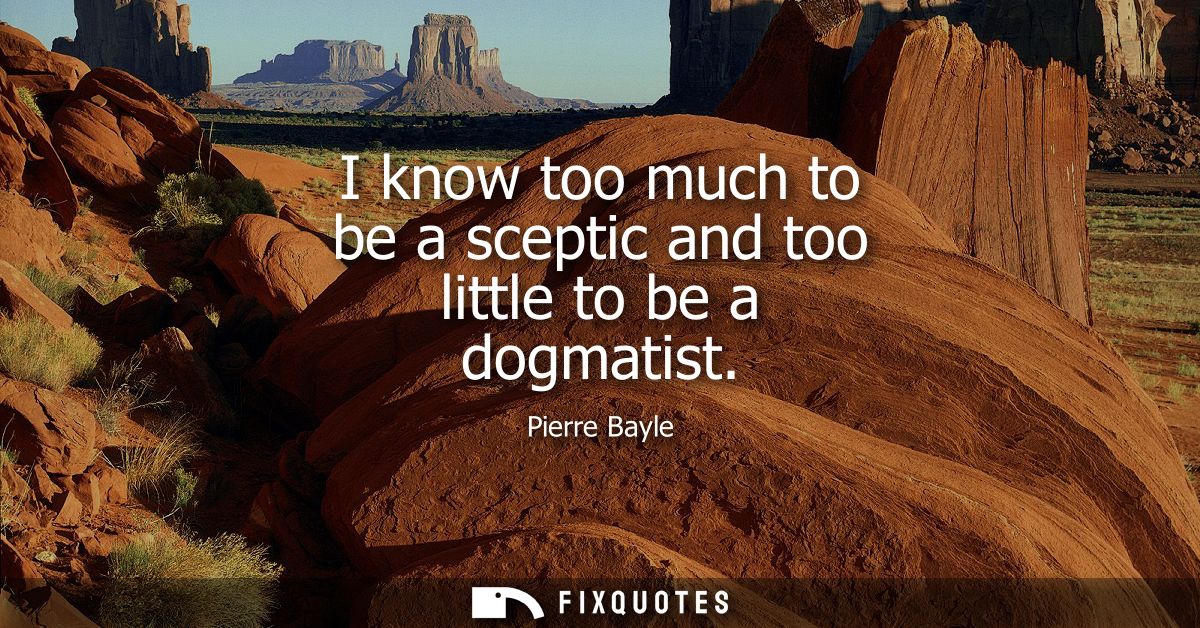
"I know too much to be a sceptic and too little to be a dogmatist"
About this Quote
Bayle’s line lands like a dagger aimed at two easy poses: the fashionable cynic and the swaggering certainty merchant. “I know too much to be a sceptic” isn’t a humblebrag; it’s a rebuke to the idea that doubt is simply the default posture of an intelligent person. Bayle had read the archives of human error closely enough to see that radical skepticism can become its own lazy creed, a way to avoid judgment while still enjoying the prestige of “seeing through” everything. Knowledge, in his view, doesn’t only unravel beliefs; it also forces you to admit where arguments genuinely bite.
Then comes the sharper turn: “too little to be a dogmatist.” Here Bayle is writing from inside the early modern crisis of authority, when religious wars, confessional fragmentation, and the rise of critical scholarship made inherited certainties look less like bedrock and more like well-defended habit. The subtext is methodological: every claim you feel tempted to nail down as final is shadowed by counterexamples, historical variability, and the sheer limits of evidence. Bayle’s own work in the Historical and Critical Dictionary thrives on this pressure, cataloging contradictions not to gloat, but to discipline the mind.
The intent is a moral stance disguised as an epistemic one. Bayle makes ignorance and knowledge share the same room: enough learning to resist nihilism, enough restraint to resist tyranny. It’s an argument for intellectual adulthood, where you live without the comfort of absolutes but also without the theatrics of perpetual doubt.
Then comes the sharper turn: “too little to be a dogmatist.” Here Bayle is writing from inside the early modern crisis of authority, when religious wars, confessional fragmentation, and the rise of critical scholarship made inherited certainties look less like bedrock and more like well-defended habit. The subtext is methodological: every claim you feel tempted to nail down as final is shadowed by counterexamples, historical variability, and the sheer limits of evidence. Bayle’s own work in the Historical and Critical Dictionary thrives on this pressure, cataloging contradictions not to gloat, but to discipline the mind.
The intent is a moral stance disguised as an epistemic one. Bayle makes ignorance and knowledge share the same room: enough learning to resist nihilism, enough restraint to resist tyranny. It’s an argument for intellectual adulthood, where you live without the comfort of absolutes but also without the theatrics of perpetual doubt.
Quote Details
| Topic | Wisdom |
|---|---|
| Source | Help us find the source |
| Cite |
Citation Formats
APA Style (7th ed.)
Bayle, Pierre. (2026, January 18). I know too much to be a sceptic and too little to be a dogmatist. FixQuotes. https://fixquotes.com/quotes/i-know-too-much-to-be-a-sceptic-and-too-little-to-22634/
Chicago Style
Bayle, Pierre. "I know too much to be a sceptic and too little to be a dogmatist." FixQuotes. January 18, 2026. https://fixquotes.com/quotes/i-know-too-much-to-be-a-sceptic-and-too-little-to-22634/.
MLA Style (9th ed.)
"I know too much to be a sceptic and too little to be a dogmatist." FixQuotes, 18 Jan. 2026, https://fixquotes.com/quotes/i-know-too-much-to-be-a-sceptic-and-too-little-to-22634/. Accessed 4 Apr. 2026.
More Quotes by Pierre
Add to List