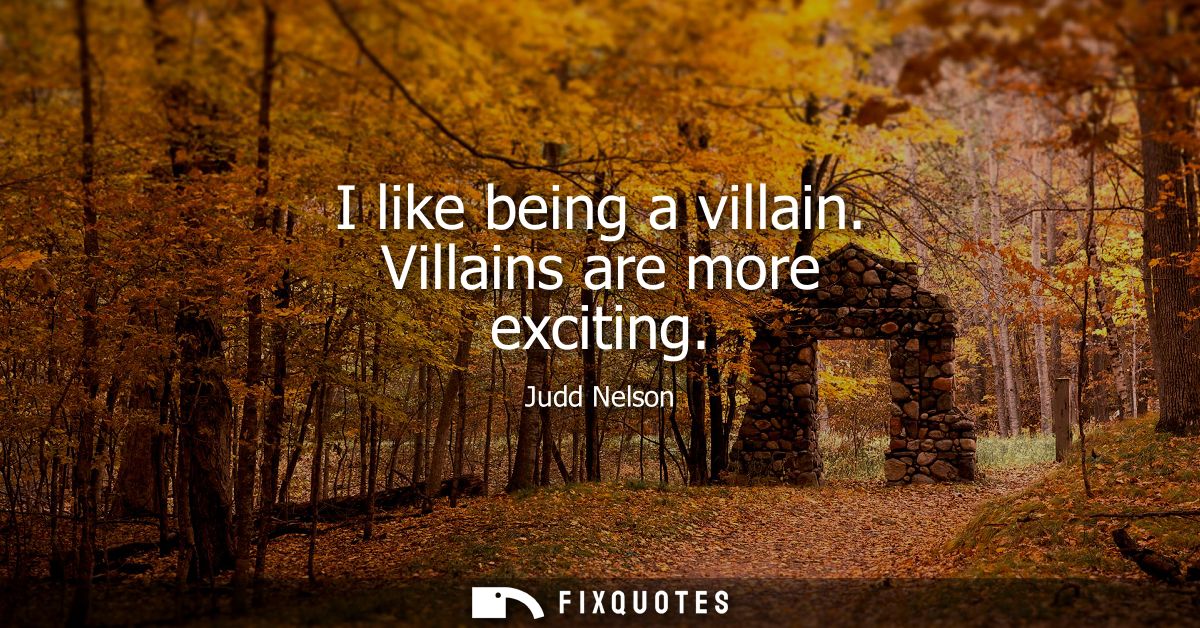
"I like being a villain. Villains are more exciting"
About this Quote
There is a particular swagger in admitting you want the black hat, especially from an actor whose most famous persona came wrapped in teenage defiance. Judd Nelson’s line doesn’t plead for sympathy or moral nuance; it treats “villain” as a creative advantage, a place where the performance gets to be loud, sharp-edged, and slightly dangerous. It’s a statement about craft disguised as a provocation.
The intent is practical: villains usually get better lines, clearer objectives, and fewer obligations to be likable. Heroes are often written as virtues with legs; villains get to be contradictions. Saying they’re “more exciting” is also a sly critique of how mainstream storytelling works: audiences claim to want goodness, but they reward volatility. The villain is where desire, anger, vanity, and humor can all live in the same scene without the script apologizing for it.
Subtext-wise, it’s also about agency. Playing “good” can feel like being managed by the plot, a dutiful vessel for triumph. A villain drives the story by refusing consensus. Even when they lose, they’ve bent the movie’s gravity around themselves. Nelson’s phrasing is blunt because it’s meant to puncture the prestige culture that treats niceness as seriousness.
Context matters: an actor coming out of the 1980s star-making machine knows the value of an image that bites back. “Villain” here isn’t just evil; it’s the permission slip to be unforgettable.
The intent is practical: villains usually get better lines, clearer objectives, and fewer obligations to be likable. Heroes are often written as virtues with legs; villains get to be contradictions. Saying they’re “more exciting” is also a sly critique of how mainstream storytelling works: audiences claim to want goodness, but they reward volatility. The villain is where desire, anger, vanity, and humor can all live in the same scene without the script apologizing for it.
Subtext-wise, it’s also about agency. Playing “good” can feel like being managed by the plot, a dutiful vessel for triumph. A villain drives the story by refusing consensus. Even when they lose, they’ve bent the movie’s gravity around themselves. Nelson’s phrasing is blunt because it’s meant to puncture the prestige culture that treats niceness as seriousness.
Context matters: an actor coming out of the 1980s star-making machine knows the value of an image that bites back. “Villain” here isn’t just evil; it’s the permission slip to be unforgettable.
Quote Details
| Topic | Witty One-Liners |
|---|---|
| Source | Help us find the source |
| Cite |
Citation Formats
APA Style (7th ed.)
Nelson, Judd. (2026, January 15). I like being a villain. Villains are more exciting. FixQuotes. https://fixquotes.com/quotes/i-like-being-a-villain-villains-are-more-exciting-165282/
Chicago Style
Nelson, Judd. "I like being a villain. Villains are more exciting." FixQuotes. January 15, 2026. https://fixquotes.com/quotes/i-like-being-a-villain-villains-are-more-exciting-165282/.
MLA Style (9th ed.)
"I like being a villain. Villains are more exciting." FixQuotes, 15 Jan. 2026, https://fixquotes.com/quotes/i-like-being-a-villain-villains-are-more-exciting-165282/. Accessed 1 Apr. 2026.
More Quotes by Judd
Add to List