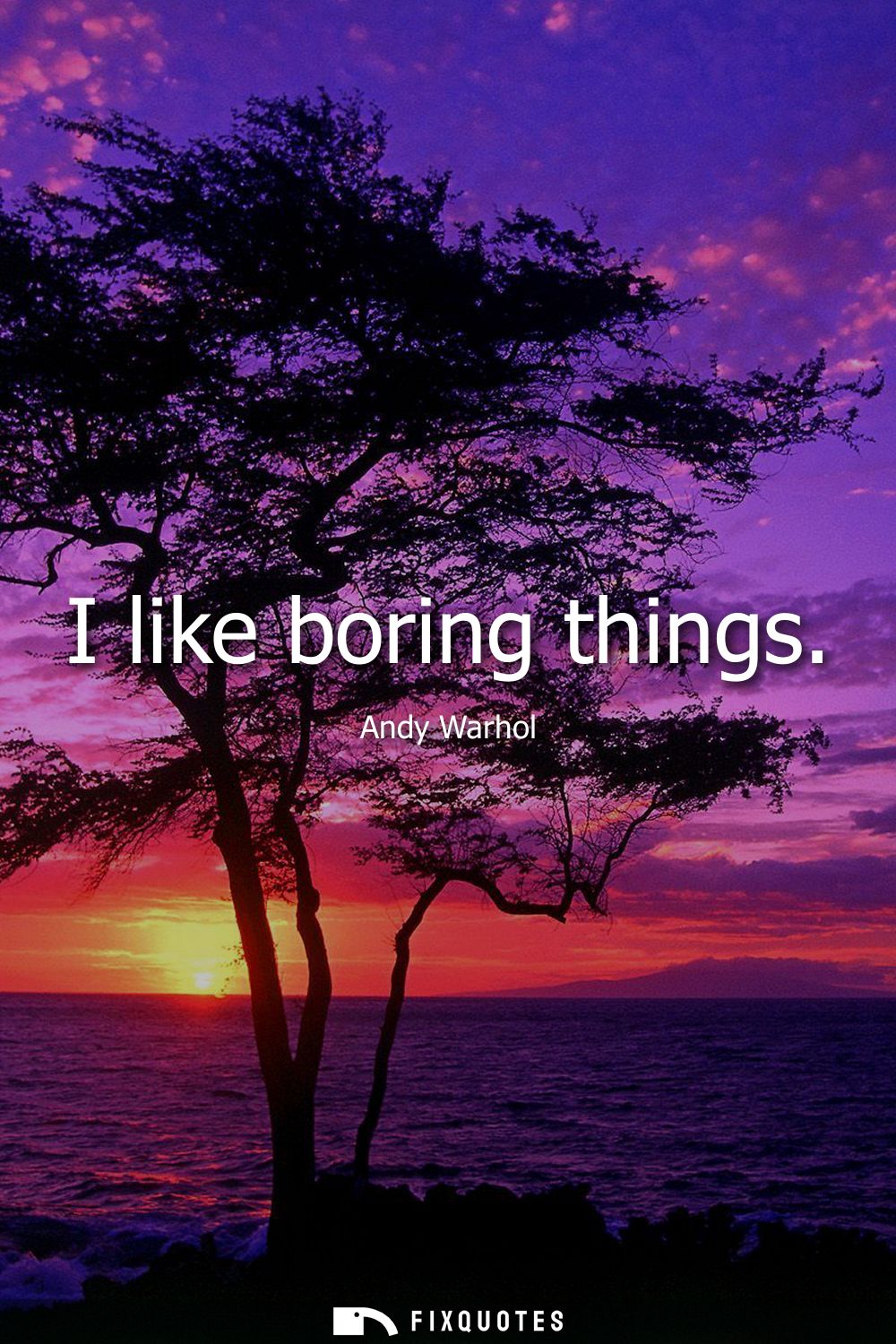
"I like boring things"
About this Quote
Warhol’s “I like boring things” is a dare disguised as a shrug. It’s the deadpan credo of an artist who understood that modern life isn’t defined by singular masterpieces so much as by repetition: the same faces, the same products, the same images, endlessly refreshed and endlessly identical. He doesn’t praise boredom as a moral virtue; he treats it as the native language of consumer culture, then forces you to notice how hypnotic that language can be.
The intent is strategic misdirection. By claiming “boring” as a preference, Warhol sidesteps the heroic mythology of the tortured genius and swaps it for the affect of a machine: cool, neutral, unbothered. That posture is doing real work. It lets him mirror mass production without pretending to be above it. Soup cans, screenprints, celebrity headshots: the point isn’t that they’re profound objects, but that they’ve already colonized our attention. Warhol’s flatness is a kind of pressure test: if you’re still looking after the third, tenth, hundredth iteration, what are you actually consuming - the image, the brand, or your own craving for significance?
The subtext is also a quiet accusation. Calling something “boring” is often a way to declare yourself superior to it; Warhol flips that into an admission of complicity. Context matters: mid-century America’s boom economy, TV’s rise, advertising’s glossy churn. “Boring” becomes a portal into the real spectacle: not novelty, but sameness, perfected, sold back to us as desire.
The intent is strategic misdirection. By claiming “boring” as a preference, Warhol sidesteps the heroic mythology of the tortured genius and swaps it for the affect of a machine: cool, neutral, unbothered. That posture is doing real work. It lets him mirror mass production without pretending to be above it. Soup cans, screenprints, celebrity headshots: the point isn’t that they’re profound objects, but that they’ve already colonized our attention. Warhol’s flatness is a kind of pressure test: if you’re still looking after the third, tenth, hundredth iteration, what are you actually consuming - the image, the brand, or your own craving for significance?
The subtext is also a quiet accusation. Calling something “boring” is often a way to declare yourself superior to it; Warhol flips that into an admission of complicity. Context matters: mid-century America’s boom economy, TV’s rise, advertising’s glossy churn. “Boring” becomes a portal into the real spectacle: not novelty, but sameness, perfected, sold back to us as desire.
Quote Details
| Topic | Art |
|---|---|
| Source | Help us find the source |
| Cite |
Citation Formats
APA Style (7th ed.)
Warhol, Andy. (2026, January 15). I like boring things. FixQuotes. https://fixquotes.com/quotes/i-like-boring-things-29835/
Chicago Style
Warhol, Andy. "I like boring things." FixQuotes. January 15, 2026. https://fixquotes.com/quotes/i-like-boring-things-29835/.
MLA Style (9th ed.)
"I like boring things." FixQuotes, 15 Jan. 2026, https://fixquotes.com/quotes/i-like-boring-things-29835/. Accessed 25 Mar. 2026.
More Quotes by Andy
Add to List