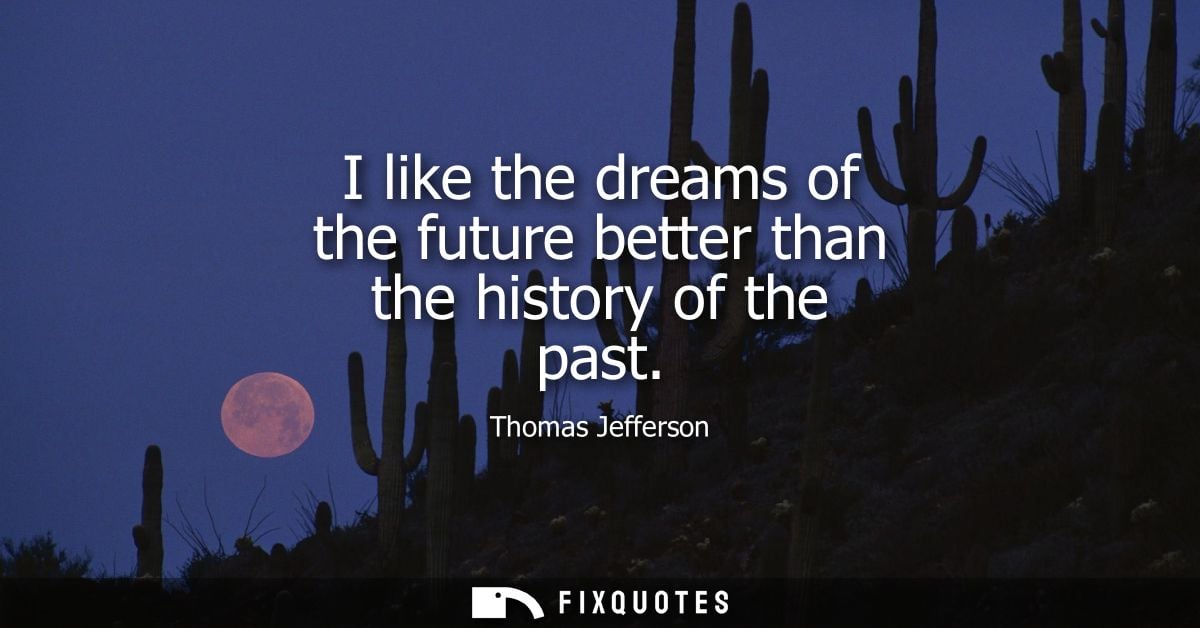
"I like the dreams of the future better than the history of the past"
About this Quote
Jefferson’s line is a pocket-sized manifesto for a young nation trying to outrun its own contradictions. As a president and founding theorist, he wasn’t merely praising optimism; he was staking a political preference: legitimacy should come from what a society can become, not what it has been. In the early American context, that’s combustible. The Revolution required a break with “history” as inherited authority - monarchy, aristocracy, church-sanctioned hierarchy - and Jefferson supplies the emotional logic for that rupture. If the past is a chain of precedents, the future is a blank check.
The phrasing matters. “Dreams” signals imagination and moral aspiration, not policy white papers. It’s deliberately soft, almost tender, a way of smuggling radical change in under the banner of hope. “History,” by contrast, is treated as static record, a museum you can admire without living in. Jefferson frames the choice as aesthetic taste (“I like”), which lowers the temperature while still directing the reader toward reform. It’s persuasion by posture: the reasonable person simply prefers progress.
The subtext, though, is also self-protective. Loving “the dreams of the future” lets a leader step around the awkward inventory of the past - including the one Jefferson personally embodied, as a slavery-owning apostle of liberty. The future-facing glow can be inspiring, but it can also function as a rhetorical solvent, dissolving responsibility into possibility. That tension is why the line still lands: it captures America’s most powerful habit, dreaming forward fast enough to avoid looking back too closely.
The phrasing matters. “Dreams” signals imagination and moral aspiration, not policy white papers. It’s deliberately soft, almost tender, a way of smuggling radical change in under the banner of hope. “History,” by contrast, is treated as static record, a museum you can admire without living in. Jefferson frames the choice as aesthetic taste (“I like”), which lowers the temperature while still directing the reader toward reform. It’s persuasion by posture: the reasonable person simply prefers progress.
The subtext, though, is also self-protective. Loving “the dreams of the future” lets a leader step around the awkward inventory of the past - including the one Jefferson personally embodied, as a slavery-owning apostle of liberty. The future-facing glow can be inspiring, but it can also function as a rhetorical solvent, dissolving responsibility into possibility. That tension is why the line still lands: it captures America’s most powerful habit, dreaming forward fast enough to avoid looking back too closely.
Quote Details
| Topic | Optimism |
|---|---|
| Source | Help us find the source |
More Quotes by Thomas
Add to List