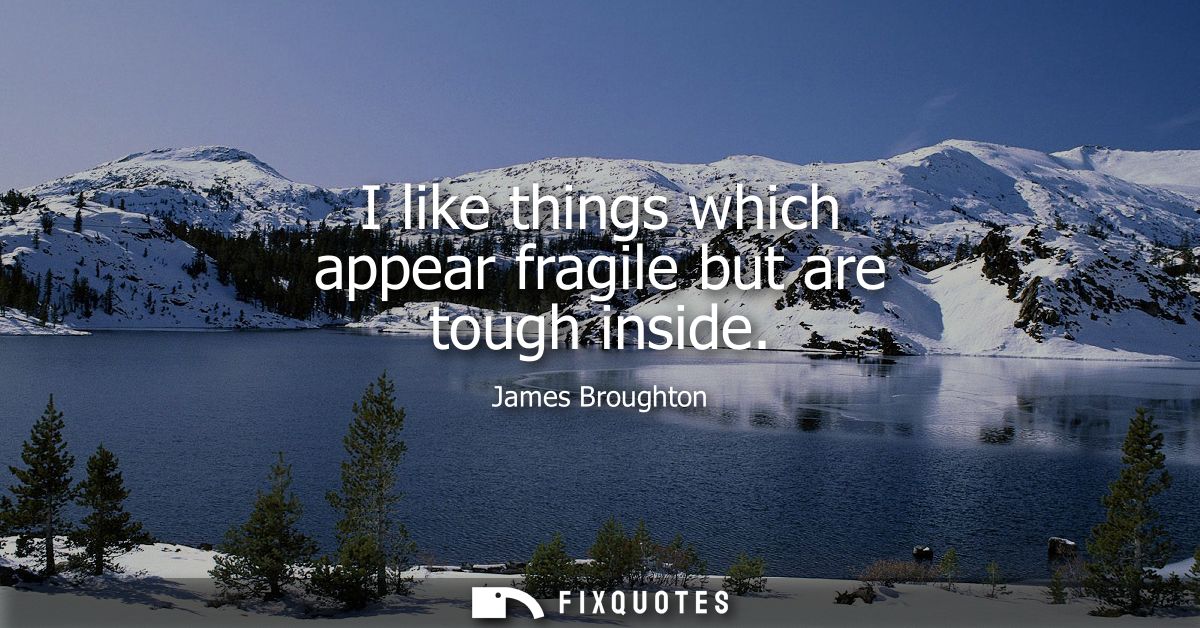
"I like things which appear fragile but are tough inside"
About this Quote
A soft shell with a hidden spine: Broughton’s line reads like an aesthetic manifesto smuggled into a flirtation. Coming from a filmmaker-poet who lived on the margins of midcentury American respectability, it’s less about taste than about survival. “Appear fragile” nods to the way bodies, art, and even identities get misread when they don’t perform hardness. The phrase accepts the reality of the gaze: the world often meets what looks delicate with condescension, pity, or predation. Then comes the reversal - “tough inside” - not as macho bravado, but as a private fact that doesn’t need to advertise itself.
The intent is curatorial. Broughton is naming what he seeks in images and people: surfaces that invite intimacy, interiors that resist exploitation. It’s also a sly rebuke to the mid-century cult of stoicism. Hollywood and postwar culture prized the uncrackable exterior; Broughton prefers resilience that doesn’t cosplay as invulnerability. That preference tracks with an artist associated with avant-garde cinema and a queer sensibility that learned, early, that “toughness” often has to be portable and discreet.
Subtextually, the quote argues for a kind of strength that’s legible only up close. Fragility becomes a strategy: a way to draw attention, to disarm, to create room for tenderness - while the real durability sits underneath, doing the unglamorous work of enduring. It’s an ethic of making, too: art that looks light, playful, even breakable, yet survives because its core is rigor, conviction, and craft.
The intent is curatorial. Broughton is naming what he seeks in images and people: surfaces that invite intimacy, interiors that resist exploitation. It’s also a sly rebuke to the mid-century cult of stoicism. Hollywood and postwar culture prized the uncrackable exterior; Broughton prefers resilience that doesn’t cosplay as invulnerability. That preference tracks with an artist associated with avant-garde cinema and a queer sensibility that learned, early, that “toughness” often has to be portable and discreet.
Subtextually, the quote argues for a kind of strength that’s legible only up close. Fragility becomes a strategy: a way to draw attention, to disarm, to create room for tenderness - while the real durability sits underneath, doing the unglamorous work of enduring. It’s an ethic of making, too: art that looks light, playful, even breakable, yet survives because its core is rigor, conviction, and craft.
Quote Details
| Topic | Resilience |
|---|---|
| Source | Help us find the source |
| Cite |
Citation Formats
APA Style (7th ed.)
Broughton, James. (2026, January 16). I like things which appear fragile but are tough inside. FixQuotes. https://fixquotes.com/quotes/i-like-things-which-appear-fragile-but-are-tough-85448/
Chicago Style
Broughton, James. "I like things which appear fragile but are tough inside." FixQuotes. January 16, 2026. https://fixquotes.com/quotes/i-like-things-which-appear-fragile-but-are-tough-85448/.
MLA Style (9th ed.)
"I like things which appear fragile but are tough inside." FixQuotes, 16 Jan. 2026, https://fixquotes.com/quotes/i-like-things-which-appear-fragile-but-are-tough-85448/. Accessed 8 Apr. 2026.
More Quotes by James
Add to List