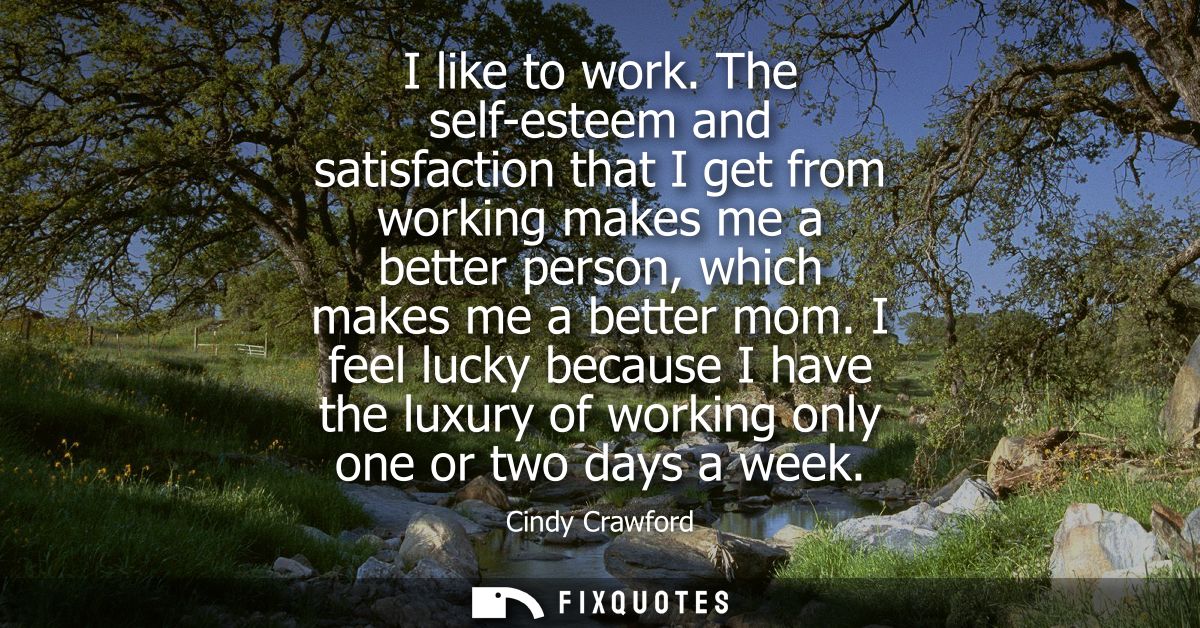
"I like to work. The self-esteem and satisfaction that I get from working makes me a better person, which makes me a better mom. I feel lucky because I have the luxury of working only one or two days a week"
About this Quote
The subtext, though, is where the real cultural voltage lives. Crawford doesn’t pretend the choice is universally available; she names it as “luxury.” Working “only one or two days a week” is both admission and insulation: it signals she’s not abandoning motherhood, while also acknowledging the economic scaffolding that makes this balance possible. It’s an unusually candid nod to class, especially coming from a celebrity whose brand was built in an era when supermodels were sold as both aspirational and oddly “relatable.”
Context matters: Crawford is a Gen X icon who navigated the 1990s “having it all” mythology and the tabloid-era scrutiny of women’s bodies, marriages, and parenting. Her quote lands as a calibrated middle path between two caricatures: the sainted stay-at-home mom and the villainized working mother. It’s grounded, almost domestic in its language, yet it quietly asserts that a mother’s interior life matters. The point isn’t that work makes her worthy; it’s that she refuses to apologize for needing a self beyond the role.
Quote Details
| Topic | Work-Life Balance |
|---|---|
| Source | Help us find the source |
| Cite |
Citation Formats
APA Style (7th ed.)
Crawford, Cindy. (2026, January 15). I like to work. The self-esteem and satisfaction that I get from working makes me a better person, which makes me a better mom. I feel lucky because I have the luxury of working only one or two days a week. FixQuotes. https://fixquotes.com/quotes/i-like-to-work-the-self-esteem-and-satisfaction-140684/
Chicago Style
Crawford, Cindy. "I like to work. The self-esteem and satisfaction that I get from working makes me a better person, which makes me a better mom. I feel lucky because I have the luxury of working only one or two days a week." FixQuotes. January 15, 2026. https://fixquotes.com/quotes/i-like-to-work-the-self-esteem-and-satisfaction-140684/.
MLA Style (9th ed.)
"I like to work. The self-esteem and satisfaction that I get from working makes me a better person, which makes me a better mom. I feel lucky because I have the luxury of working only one or two days a week." FixQuotes, 15 Jan. 2026, https://fixquotes.com/quotes/i-like-to-work-the-self-esteem-and-satisfaction-140684/. Accessed 12 Feb. 2026.