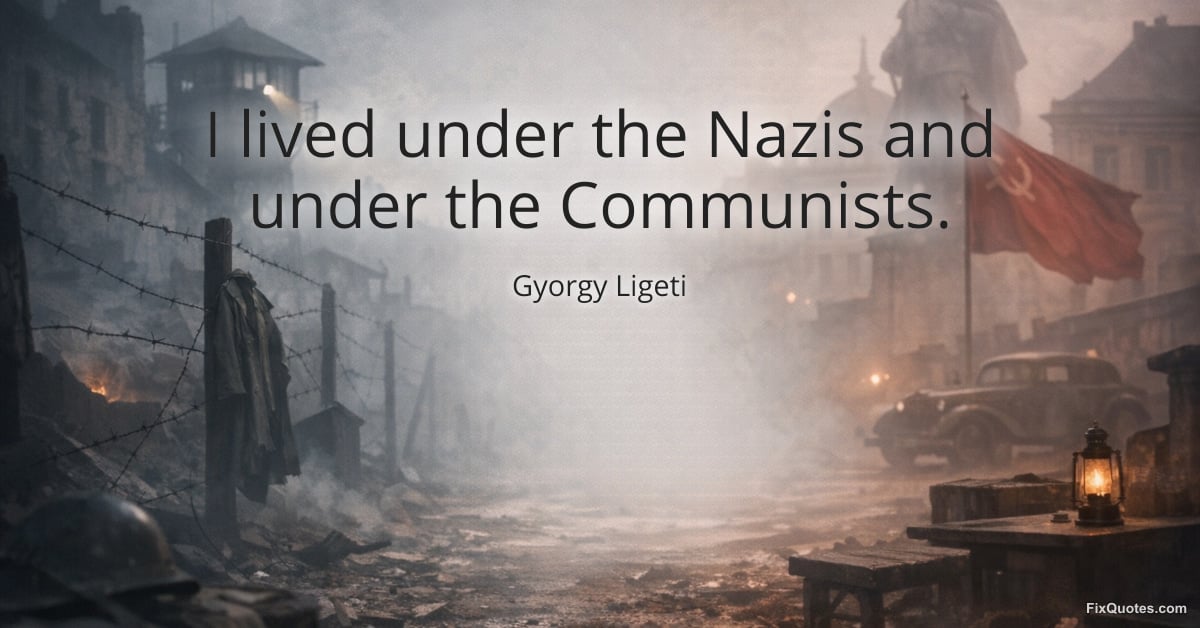
"I lived under the Nazis and under the Communists"
About this Quote
The line lands like a passport stamp, not a confession: a compressed credential that says, with brutal efficiency, I know what power does to the human nervous system. Ligeti isn’t reaching for melodrama. He’s staking out authority in a century that tried to turn art into a civil-service function. “Under the Nazis and under the Communists” is deliberately symmetrical, the repetition doing the work of indictment. Two regimes, different slogans, same demand: obedience, simplification, the policing of ambiguity. For a composer obsessed with texture, density, and the freedom to let sound behave unpredictably, that pressure wasn’t abstract politics; it was an attack on the very premise of his craft.
The subtext is also defensive. Postwar European culture loved neat moral categories: fascism as ultimate evil, communism as complicated aspiration. Ligeti’s phrasing refuses that comforting hierarchy. He doesn’t equate ideologies so much as describe lived reality: the experience of being governed by systems that treat individuals as material. Coming from a Hungarian Jewish survivor who endured the Nazi period and later escaped communist Hungary after 1956, the sentence carries the weight of someone who has watched “history” become an alibi for cruelty.
Artistically, it reads as a warning against compulsory meaning. Both regimes preferred music that could be read like propaganda: heroic, legible, uplifting on command. Ligeti’s later work, with its swarming micropolyphony and evasive tonality, can be heard as a refusal to be easily translated into slogans. The intent is clear: don’t ask me to romanticize your utopia. I’ve already heard what it sounds like when the state conducts.
The subtext is also defensive. Postwar European culture loved neat moral categories: fascism as ultimate evil, communism as complicated aspiration. Ligeti’s phrasing refuses that comforting hierarchy. He doesn’t equate ideologies so much as describe lived reality: the experience of being governed by systems that treat individuals as material. Coming from a Hungarian Jewish survivor who endured the Nazi period and later escaped communist Hungary after 1956, the sentence carries the weight of someone who has watched “history” become an alibi for cruelty.
Artistically, it reads as a warning against compulsory meaning. Both regimes preferred music that could be read like propaganda: heroic, legible, uplifting on command. Ligeti’s later work, with its swarming micropolyphony and evasive tonality, can be heard as a refusal to be easily translated into slogans. The intent is clear: don’t ask me to romanticize your utopia. I’ve already heard what it sounds like when the state conducts.
Quote Details
| Topic | Human Rights |
|---|---|
| Source | Evidence:
... I lived under the Nazis and under the Communists . They were both eager for my life . When the chance came I escaped . Those were very difficult years . I know what it is to need help and not to find help . It makes me hap- py that now ... |
| Cite |
Citation Formats
APA Style (7th ed.)
Ligeti, Gyorgy. (2026, March 26). I lived under the Nazis and under the Communists. FixQuotes. https://fixquotes.com/quotes/i-lived-under-the-nazis-and-under-the-communists-111951/
Chicago Style
Ligeti, Gyorgy. "I lived under the Nazis and under the Communists." FixQuotes. March 26, 2026. https://fixquotes.com/quotes/i-lived-under-the-nazis-and-under-the-communists-111951/.
MLA Style (9th ed.)
"I lived under the Nazis and under the Communists." FixQuotes, 26 Mar. 2026, https://fixquotes.com/quotes/i-lived-under-the-nazis-and-under-the-communists-111951/. Accessed 31 Mar. 2026.
More Quotes by Gyorgy
Add to List