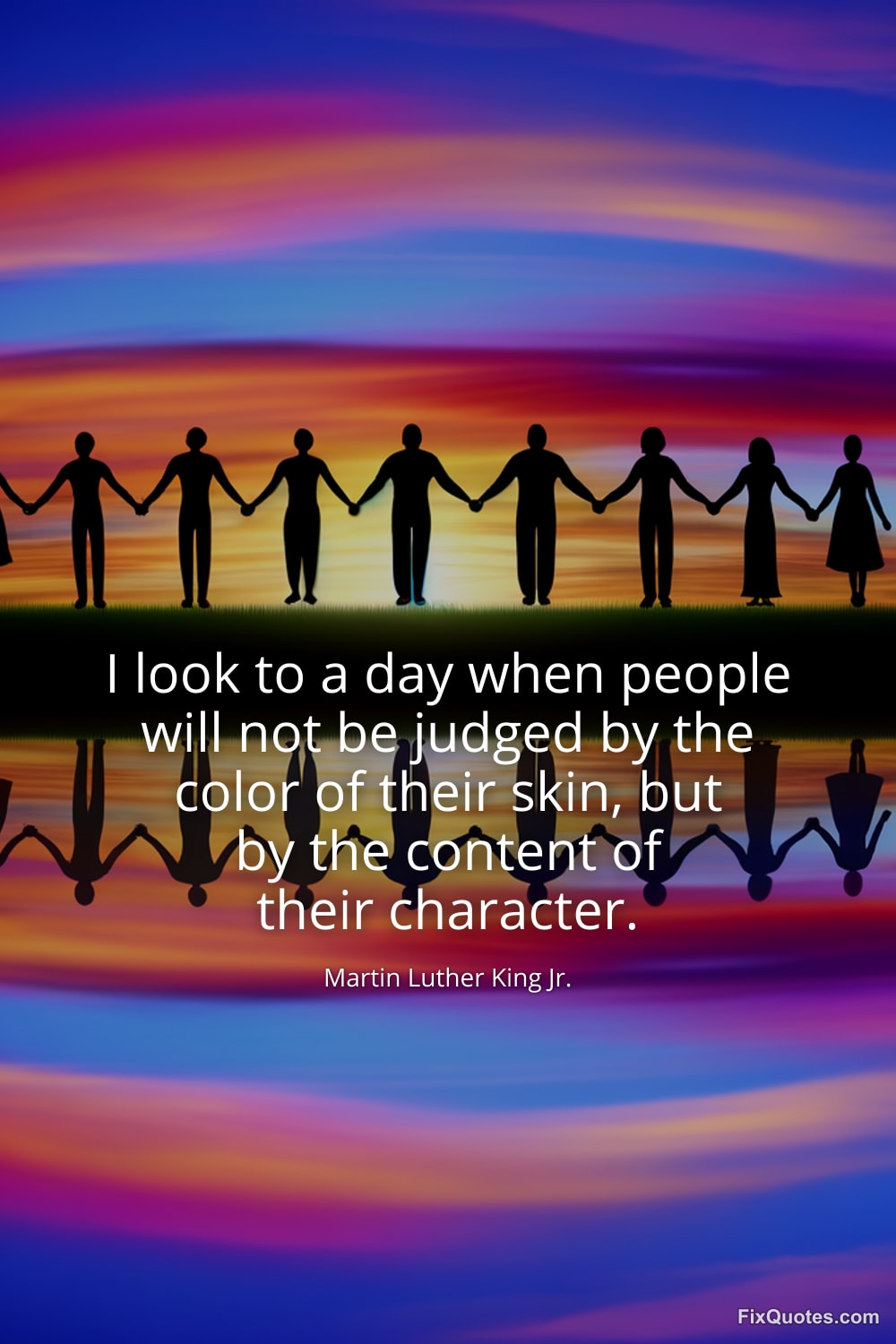
"I look to a day when people will not be judged by the color of their skin, but by the content of their character"
About this Quote
The line’s power is its clean contrast. “Color of their skin” is concrete, immediate, the visible pretext America used to sort human value. “Content of their character” shifts the terms from biology to ethics, from inherited trait to chosen conduct. King isn’t just arguing for tolerance; he’s demanding a new standard of legitimacy. The subtext is pointed: a society that claims to prize character yet organizes opportunity around skin color is caught in its own hypocrisy.
Context matters because this wasn’t a polite seminar on prejudice; it was the March on Washington in 1963, delivered amid voter suppression, segregation, police violence, and a federal government moving too slowly. By invoking character, King ties civil rights to the nation’s self-image, echoing civic creeds about equality and merit. It’s an invitation to white moderates to see themselves as allies without surrendering moral urgency, and a rebuke to the system that forces Black Americans to prove “character” to receive rights that should be automatic.
The brilliance is that it sounds inclusive while remaining accusatory: America, live up to what you say you are.
Quote Details
| Topic | Equality |
|---|---|
| Source | Later attribution: Police Under Fire (Aubrey A. Baker, 2016) modern compilation
Evidence: ... Martin Luther King Jr. was a great man. I believe if he were alive today, he would be greatly confused and ... I look to a day when people will not be judged by the color of their skin but by the content of their character.” I ... Other candidates (2) Martin Luther King Jr. (Martin Luther King Jr.) compilation75.0% hildren will one day live in a nation where they will not be judged by the color of their skin but by the content of ... The Martin Luther King, Jr. Day, 1995, Memorial Issue (Various) primary42.0% rather than worse that the people were not being educated away from themselves but with their elevation the condition... |
| Featured | This quote was our Quote of the Day on March 14, 2025 |
| Cite |
Citation Formats
APA Style (7th ed.)
Jr., Martin Luther King. (2026, February 7). I look to a day when people will not be judged by the color of their skin, but by the content of their character. FixQuotes. https://fixquotes.com/quotes/i-look-to-a-day-when-people-will-not-be-judged-by-33831/
Chicago Style
Jr., Martin Luther King. "I look to a day when people will not be judged by the color of their skin, but by the content of their character." FixQuotes. February 7, 2026. https://fixquotes.com/quotes/i-look-to-a-day-when-people-will-not-be-judged-by-33831/.
MLA Style (9th ed.)
"I look to a day when people will not be judged by the color of their skin, but by the content of their character." FixQuotes, 7 Feb. 2026, https://fixquotes.com/quotes/i-look-to-a-day-when-people-will-not-be-judged-by-33831/. Accessed 1 Apr. 2026.