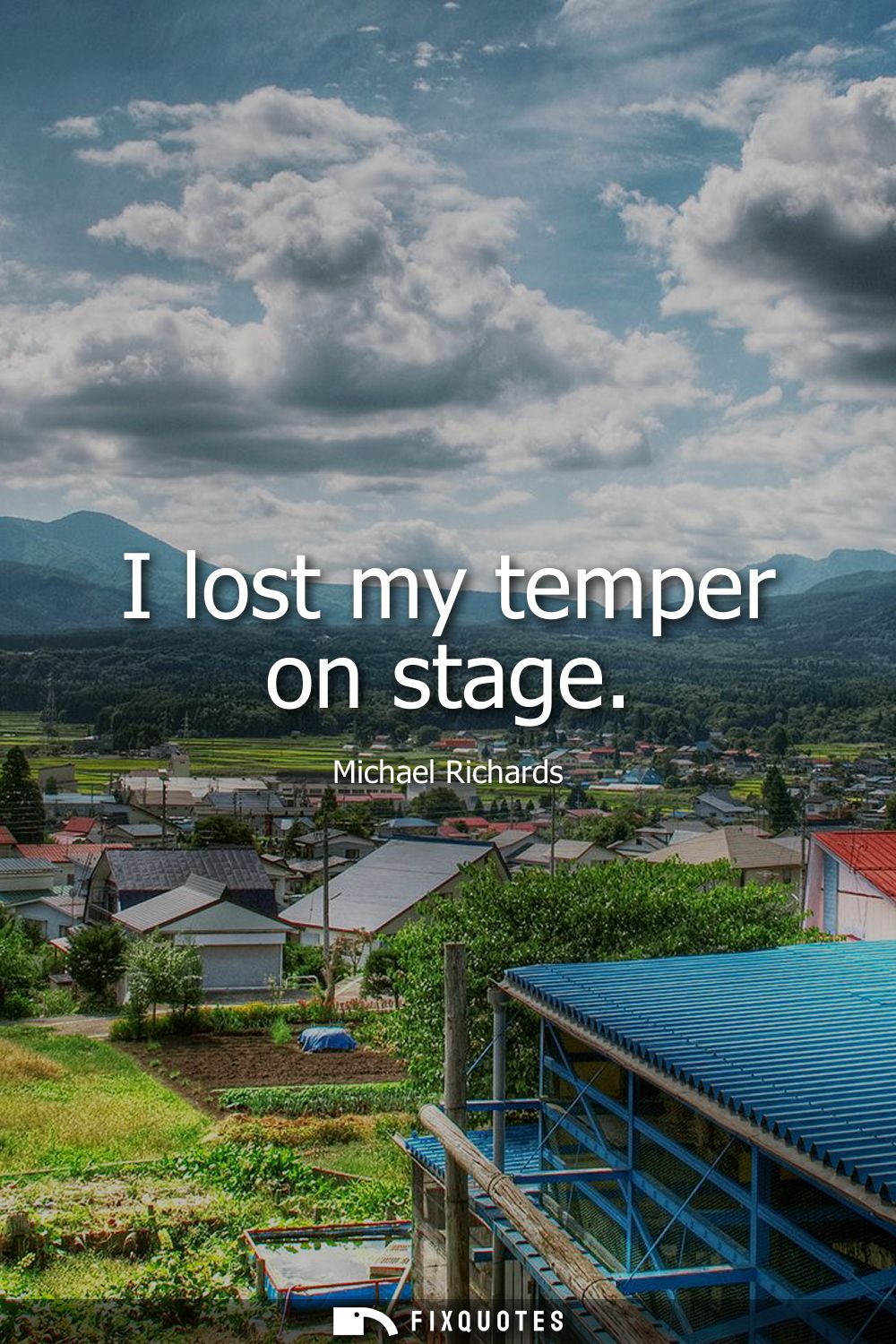
"I lost my temper on stage"
About this Quote
Three words that sound like a confession and a cover story at the same time. When Michael Richards says, "I lost my temper on stage", he reaches for the oldest narrative in show business: the performer as a victim of the moment. It frames what happened as an emotional accident, not a set of choices. Temper becomes the protagonist, and Richards becomes the guy who got swept up in it.
The context does the heavy lifting. Richards wasnt talking about a missed cue or a heckler who got under his skin in the abstract; he was responding to the 2006 Laugh Factory incident, when his onstage meltdown included repeated racial slurs and threats. In that light, the line functions less as explanation than as damage control: a quick pivot from moral language (racism, harm, accountability) to therapeutic language (anger, loss of control, regret). "On stage" matters, too. It hints at performance, at the idea that a comic persona can be separated from the real person, even when the material is coming out of the real mouth.
The subtext is anxious and strategic: Please read this as a breakdown, not a worldview. Please believe the man behind Kramer is still salvageable. It also reveals a cultural bargain we keep renegotiating: comedy as a space where transgression is permitted, until it isnt. Richards tries to tuck his behavior inside the mythology of live entertainment, where anything can "get away" from you. The problem is that slurs arent a prop. They dont appear by accident; they arrive preloaded with history.
The context does the heavy lifting. Richards wasnt talking about a missed cue or a heckler who got under his skin in the abstract; he was responding to the 2006 Laugh Factory incident, when his onstage meltdown included repeated racial slurs and threats. In that light, the line functions less as explanation than as damage control: a quick pivot from moral language (racism, harm, accountability) to therapeutic language (anger, loss of control, regret). "On stage" matters, too. It hints at performance, at the idea that a comic persona can be separated from the real person, even when the material is coming out of the real mouth.
The subtext is anxious and strategic: Please read this as a breakdown, not a worldview. Please believe the man behind Kramer is still salvageable. It also reveals a cultural bargain we keep renegotiating: comedy as a space where transgression is permitted, until it isnt. Richards tries to tuck his behavior inside the mythology of live entertainment, where anything can "get away" from you. The problem is that slurs arent a prop. They dont appear by accident; they arrive preloaded with history.
Quote Details
| Topic | Anger |
|---|---|
| Source | Help us find the source |
| Cite |
Citation Formats
APA Style (7th ed.)
Richards, Michael. (2026, January 16). I lost my temper on stage. FixQuotes. https://fixquotes.com/quotes/i-lost-my-temper-on-stage-84997/
Chicago Style
Richards, Michael. "I lost my temper on stage." FixQuotes. January 16, 2026. https://fixquotes.com/quotes/i-lost-my-temper-on-stage-84997/.
MLA Style (9th ed.)
"I lost my temper on stage." FixQuotes, 16 Jan. 2026, https://fixquotes.com/quotes/i-lost-my-temper-on-stage-84997/. Accessed 27 Mar. 2026.
More Quotes by Michael
Add to List