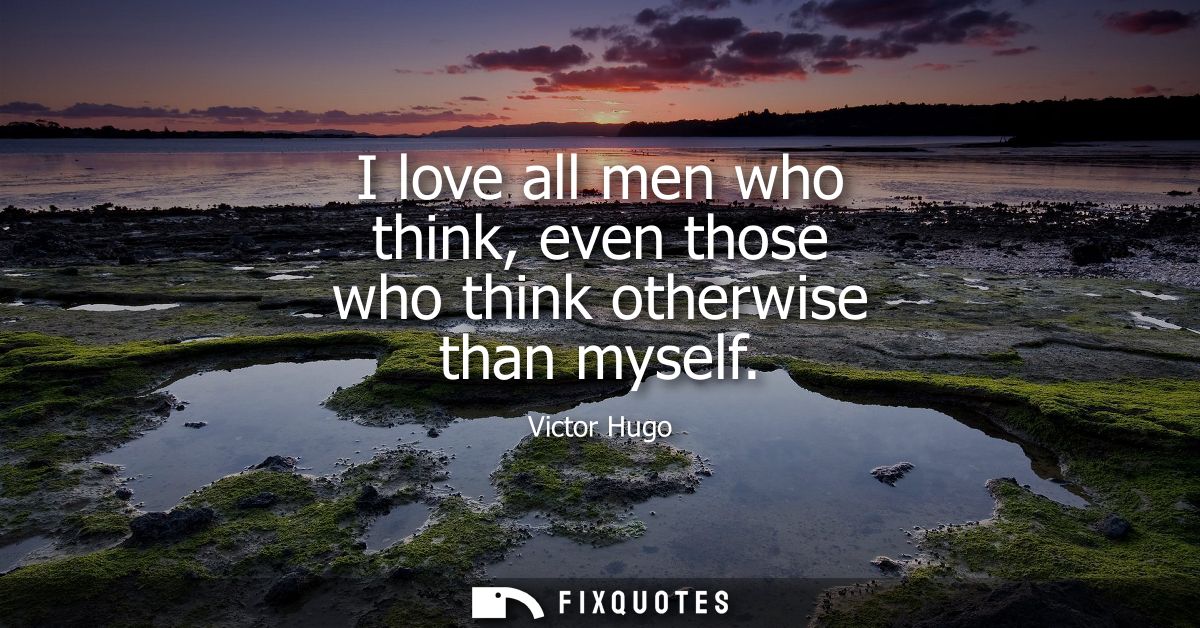
"I love all men who think, even those who think otherwise than myself"
About this Quote
A generous line with a steel spine: Hugo isn’t praising politeness, he’s drawing a boundary around what deserves respect. The key word isn’t “love,” it’s “think.” In a century when France ricocheted between monarchy, empire, and republic, “thinking” wasn’t a lifestyle choice; it was an assertion of civic agency. Hugo, the celebrated novelist who also became a combative public intellectual and political exile under Napoleon III, knew how quickly regimes learn to fear independent minds.
The sentence works because it offers tolerance without surrender. “Even those who think otherwise than myself” sounds like open-mindedness, but it’s also a quiet hierarchy. Hugo is not saying every opinion is equally valid. He’s saying that the act of reasoning, of having a mind in motion, is what earns kinship. The subtext: disagreement is not the enemy; unthinking obedience is. That’s a liberal ideal with an edge, aimed at both dogmatists and cynics: the former because they confuse certainty with virtue, the latter because they treat conviction as naivete.
There’s also a rhetorical gamble here. By framing respect as love, Hugo pushes past the cold neutrality of “tolerance,” which can sound like coexistence through gritted teeth. Love implies investment: I care enough about your humanity to argue with you, to let your dissent exist without needing to crush it. In Hugo’s world, that stance isn’t sentimental. It’s resistance.
The sentence works because it offers tolerance without surrender. “Even those who think otherwise than myself” sounds like open-mindedness, but it’s also a quiet hierarchy. Hugo is not saying every opinion is equally valid. He’s saying that the act of reasoning, of having a mind in motion, is what earns kinship. The subtext: disagreement is not the enemy; unthinking obedience is. That’s a liberal ideal with an edge, aimed at both dogmatists and cynics: the former because they confuse certainty with virtue, the latter because they treat conviction as naivete.
There’s also a rhetorical gamble here. By framing respect as love, Hugo pushes past the cold neutrality of “tolerance,” which can sound like coexistence through gritted teeth. Love implies investment: I care enough about your humanity to argue with you, to let your dissent exist without needing to crush it. In Hugo’s world, that stance isn’t sentimental. It’s resistance.
Quote Details
| Topic | Respect |
|---|---|
| Source | Help us find the source |
| Cite |
Citation Formats
APA Style (7th ed.)
Hugo, Victor. (2026, January 17). I love all men who think, even those who think otherwise than myself. FixQuotes. https://fixquotes.com/quotes/i-love-all-men-who-think-even-those-who-think-36323/
Chicago Style
Hugo, Victor. "I love all men who think, even those who think otherwise than myself." FixQuotes. January 17, 2026. https://fixquotes.com/quotes/i-love-all-men-who-think-even-those-who-think-36323/.
MLA Style (9th ed.)
"I love all men who think, even those who think otherwise than myself." FixQuotes, 17 Jan. 2026, https://fixquotes.com/quotes/i-love-all-men-who-think-even-those-who-think-36323/. Accessed 4 Apr. 2026.
More Quotes by Victor
Add to List