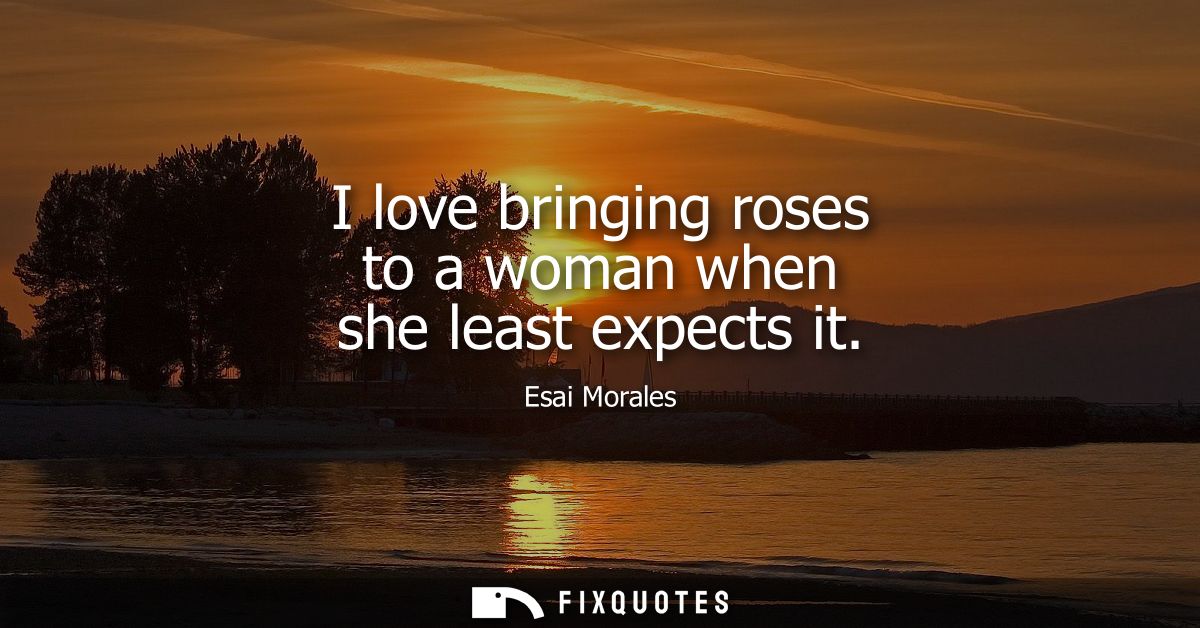
"I love bringing roses to a woman when she least expects it"
About this Quote
Romance, in Esai Morales's line, isn’t staged; it’s timed. “When she least expects it” shifts the gesture from generic gallantry to emotional strategy: the rose matters less as a symbol than as a disruption. It’s not Valentine’s Day love, pre-scheduled and socially enforced. It’s everyday-life love that barges in, interrupts routine, and briefly rewrites the mood in the room.
The intent reads as both affectionate and performative in the best way: an actor’s understanding that feelings land harder when the audience isn’t braced for them. Morales frames intimacy as a small piece of theater done offstage, with surprise as the special effect. That makes the gift feel personal, not dutiful. A rose on an expected date can look like compliance; a rose on a random Tuesday looks like attention.
There’s subtext, too, about control and care. Surprise can signal thoughtfulness: “I’ve been thinking about you when you weren’t watching.” It can also signal a desire to be remembered, to create a moment that lingers and recalibrates how the recipient sees the relationship. The “least expects it” clause hints at romance as maintenance, not just celebration: a way to keep affection from calcifying into routine.
Culturally, this lands in a modern sweet spot where traditional gestures are still appealing, but only if they’re freed from cliché. Morales keeps the old-school prop (roses) and updates the script (spontaneity), making romance feel less like a holiday product and more like an ongoing choice.
The intent reads as both affectionate and performative in the best way: an actor’s understanding that feelings land harder when the audience isn’t braced for them. Morales frames intimacy as a small piece of theater done offstage, with surprise as the special effect. That makes the gift feel personal, not dutiful. A rose on an expected date can look like compliance; a rose on a random Tuesday looks like attention.
There’s subtext, too, about control and care. Surprise can signal thoughtfulness: “I’ve been thinking about you when you weren’t watching.” It can also signal a desire to be remembered, to create a moment that lingers and recalibrates how the recipient sees the relationship. The “least expects it” clause hints at romance as maintenance, not just celebration: a way to keep affection from calcifying into routine.
Culturally, this lands in a modern sweet spot where traditional gestures are still appealing, but only if they’re freed from cliché. Morales keeps the old-school prop (roses) and updates the script (spontaneity), making romance feel less like a holiday product and more like an ongoing choice.
Quote Details
| Topic | Romantic |
|---|---|
| Source | Help us find the source |
| Cite |
Citation Formats
APA Style (7th ed.)
Morales, Esai. (2026, January 17). I love bringing roses to a woman when she least expects it. FixQuotes. https://fixquotes.com/quotes/i-love-bringing-roses-to-a-woman-when-she-least-52650/
Chicago Style
Morales, Esai. "I love bringing roses to a woman when she least expects it." FixQuotes. January 17, 2026. https://fixquotes.com/quotes/i-love-bringing-roses-to-a-woman-when-she-least-52650/.
MLA Style (9th ed.)
"I love bringing roses to a woman when she least expects it." FixQuotes, 17 Jan. 2026, https://fixquotes.com/quotes/i-love-bringing-roses-to-a-woman-when-she-least-52650/. Accessed 26 Mar. 2026.
More Quotes by Esai
Add to List