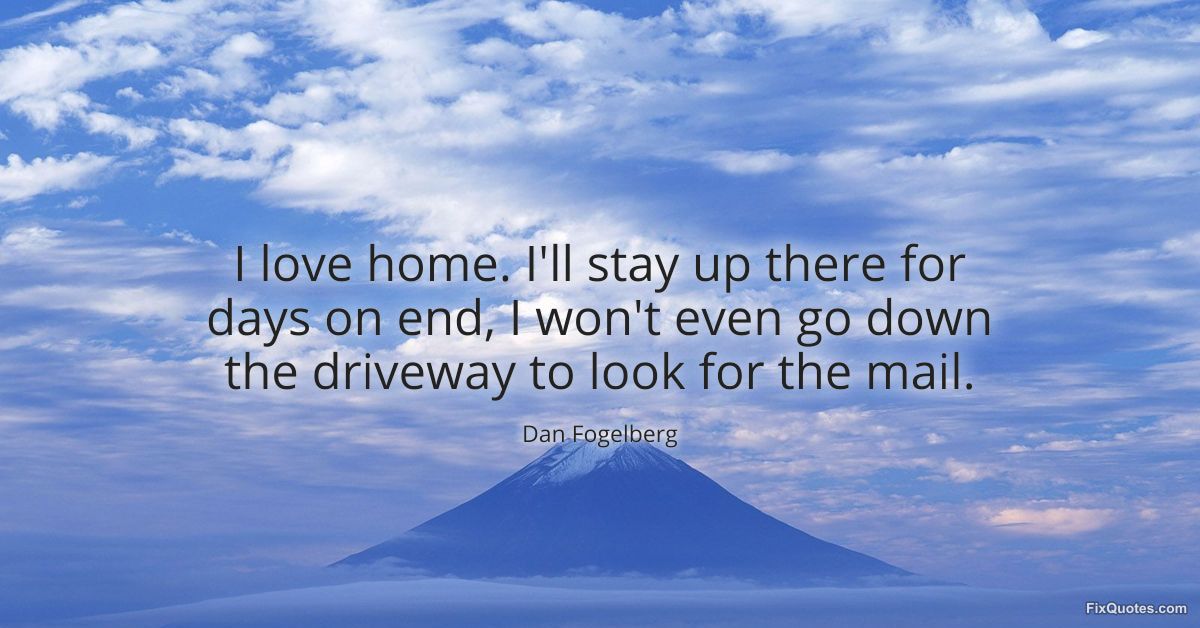
"I love home. I'll stay up there for days on end, I won't even go down the driveway to look for the mail"
About this Quote
The intent reads less like bragging and more like self-portrait. Fogelberg, whose songs often traffic in memory, interior weather, and the ache of distance, leans into the domestic as sanctuary. The exaggeration (“days on end”) gives it a wink: he knows it’s extreme, and that’s the point. He’s dramatizing the desire to disappear for a while, to let the world keep spinning without him.
Subtext: fame turns ordinary contact into noise. For a touring musician, “home” isn’t just a place; it’s the rare zone where you’re not performing a version of yourself. Even the driveway becomes a threshold between private life and public life, and he’s choosing not to cross it. In a culture that treats productivity and availability as moral virtues, Fogelberg’s line blesses the opposite impulse: to be unreachable, unbothered, and unashamed of wanting that.
Quote Details
| Topic | Contentment |
|---|---|
| Source | Help us find the source |
| Cite |
Citation Formats
APA Style (7th ed.)
Fogelberg, Dan. (2026, January 15). I love home. I'll stay up there for days on end, I won't even go down the driveway to look for the mail. FixQuotes. https://fixquotes.com/quotes/i-love-home-ill-stay-up-there-for-days-on-end-i-167249/
Chicago Style
Fogelberg, Dan. "I love home. I'll stay up there for days on end, I won't even go down the driveway to look for the mail." FixQuotes. January 15, 2026. https://fixquotes.com/quotes/i-love-home-ill-stay-up-there-for-days-on-end-i-167249/.
MLA Style (9th ed.)
"I love home. I'll stay up there for days on end, I won't even go down the driveway to look for the mail." FixQuotes, 15 Jan. 2026, https://fixquotes.com/quotes/i-love-home-ill-stay-up-there-for-days-on-end-i-167249/. Accessed 2 Apr. 2026.