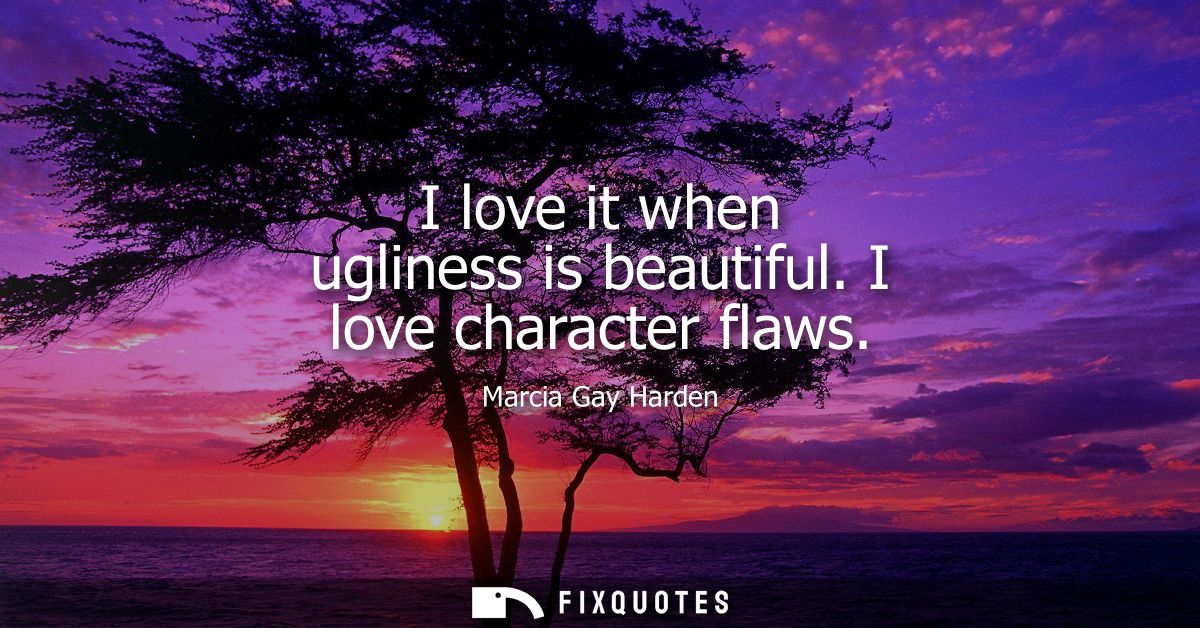
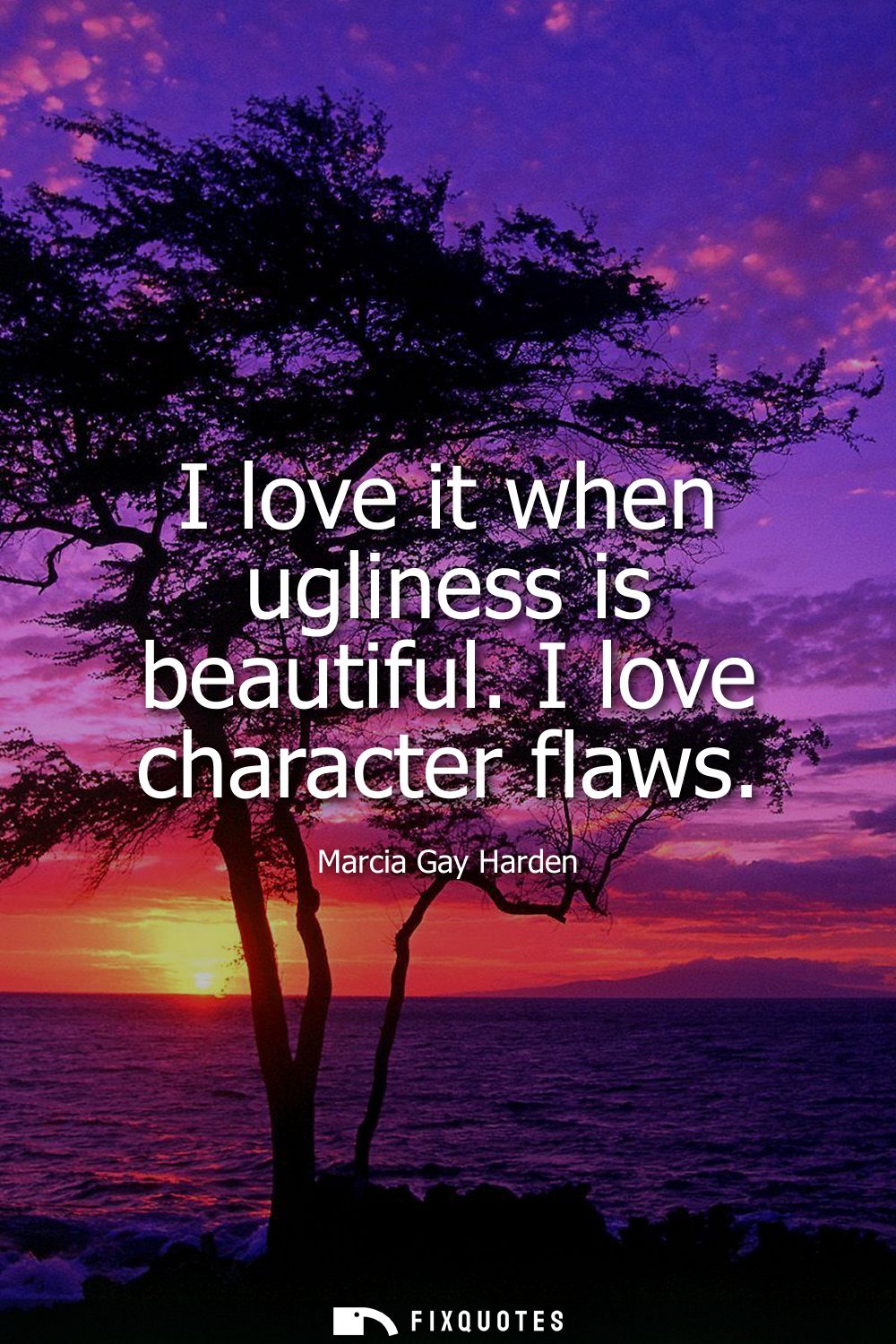
"I love it when ugliness is beautiful. I love character flaws"
About this Quote
Marcia Gay Harden is voicing a working actor's crush on imperfection, and it lands because it pushes back against the most boring tyranny in Hollywood: polish. "I love it when ugliness is beautiful" isn't about celebrating literal ugliness; it's about the moment a face, a body, a voice, or a choice that doesn't "sell" in a conventional way suddenly becomes magnetic on camera. The word "when" matters. She's talking about transformation, alchemy: how a story can reframe what we think we're seeing, and how performance can turn a blemish into a signature.
The subtext is a quiet indictment of the industry's default settings. Casting often treats attractiveness as a prerequisite and flawlessness as safety. Harden, who built a career playing complicated women with sharp edges and lived-in contradictions, is arguing for the opposite: that character emerges from friction. "Character flaws" in her mouth aren't cute quirks; they're moral smudges, blind spots, appetites, and bruises. They're the ingredients that make a role playable, because perfection is static and therefore dramatically dead.
Contextually, this reads like an artist defending craft over branding. It's also a cultural statement in an era of Instagram smoothness and cosmetic sameness: the most radical thing an actor can do is insist that the audience can handle, even crave, mess. Harden isn't romanticizing pain; she's insisting on specificity. Ugliness becomes beautiful when it tells the truth and refuses to apologize for being human.
The subtext is a quiet indictment of the industry's default settings. Casting often treats attractiveness as a prerequisite and flawlessness as safety. Harden, who built a career playing complicated women with sharp edges and lived-in contradictions, is arguing for the opposite: that character emerges from friction. "Character flaws" in her mouth aren't cute quirks; they're moral smudges, blind spots, appetites, and bruises. They're the ingredients that make a role playable, because perfection is static and therefore dramatically dead.
Contextually, this reads like an artist defending craft over branding. It's also a cultural statement in an era of Instagram smoothness and cosmetic sameness: the most radical thing an actor can do is insist that the audience can handle, even crave, mess. Harden isn't romanticizing pain; she's insisting on specificity. Ugliness becomes beautiful when it tells the truth and refuses to apologize for being human.
Quote Details
| Topic | Self-Love |
|---|---|
| Source | Help us find the source |
| Cite |
Citation Formats
APA Style (7th ed.)
Harden, Marcia Gay. (2026, January 16). I love it when ugliness is beautiful. I love character flaws. FixQuotes. https://fixquotes.com/quotes/i-love-it-when-ugliness-is-beautiful-i-love-129908/
Chicago Style
Harden, Marcia Gay. "I love it when ugliness is beautiful. I love character flaws." FixQuotes. January 16, 2026. https://fixquotes.com/quotes/i-love-it-when-ugliness-is-beautiful-i-love-129908/.
MLA Style (9th ed.)
"I love it when ugliness is beautiful. I love character flaws." FixQuotes, 16 Jan. 2026, https://fixquotes.com/quotes/i-love-it-when-ugliness-is-beautiful-i-love-129908/. Accessed 24 Mar. 2026.
More Quotes by Marcia
Add to List