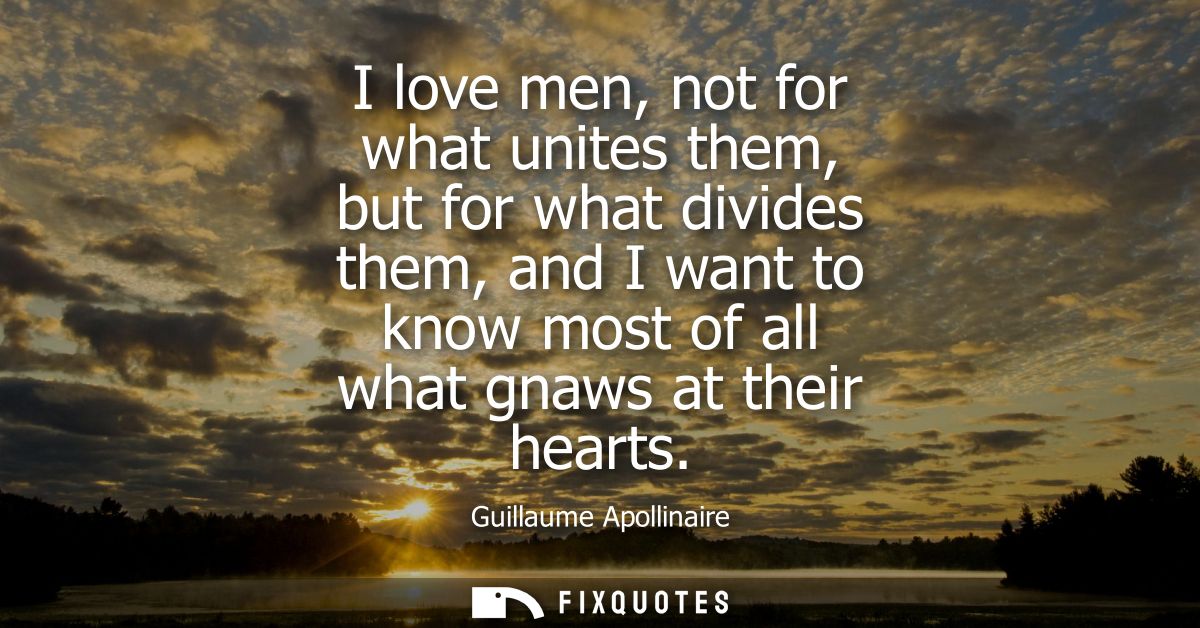
"I love men, not for what unites them, but for what divides them, and I want to know most of all what gnaws at their hearts"
About this Quote
The subtext is artistic method as much as worldview. As a modernist in the thick of early 20th-century Paris, Apollinaire is surrounded by movements obsessed with breaking forms apart and reassembling them: Cubism, collage, the poetry that would soon be called surreal. Loving “what divides them” echoes that aesthetic. Fragments reveal structure; contradictions generate energy. A person, like a painting, becomes interesting at the seam where it doesn’t quite fit together.
There’s also an ethical provocation here. To prefer division risks fetishizing conflict, turning other people’s suffering into material. Yet Apollinaire frames it as care: “I want to know.” He isn’t cheering for discord; he’s rejecting the sentimental lie that humans are most truthful when they agree. Given his era’s looming violence and his own wartime trajectory, the line reads like a premonition: what gnaws at hearts eventually gnaws at nations. The quote works because it refuses comfort while insisting on closeness, making curiosity feel like both love and trespass.
Quote Details
| Topic | Deep |
|---|---|
| Source | Help us find the source |
| Cite |
Citation Formats
APA Style (7th ed.)
Apollinaire, Guillaume. (2026, January 18). I love men, not for what unites them, but for what divides them, and I want to know most of all what gnaws at their hearts. FixQuotes. https://fixquotes.com/quotes/i-love-men-not-for-what-unites-them-but-for-what-15278/
Chicago Style
Apollinaire, Guillaume. "I love men, not for what unites them, but for what divides them, and I want to know most of all what gnaws at their hearts." FixQuotes. January 18, 2026. https://fixquotes.com/quotes/i-love-men-not-for-what-unites-them-but-for-what-15278/.
MLA Style (9th ed.)
"I love men, not for what unites them, but for what divides them, and I want to know most of all what gnaws at their hearts." FixQuotes, 18 Jan. 2026, https://fixquotes.com/quotes/i-love-men-not-for-what-unites-them-but-for-what-15278/. Accessed 3 Apr. 2026.