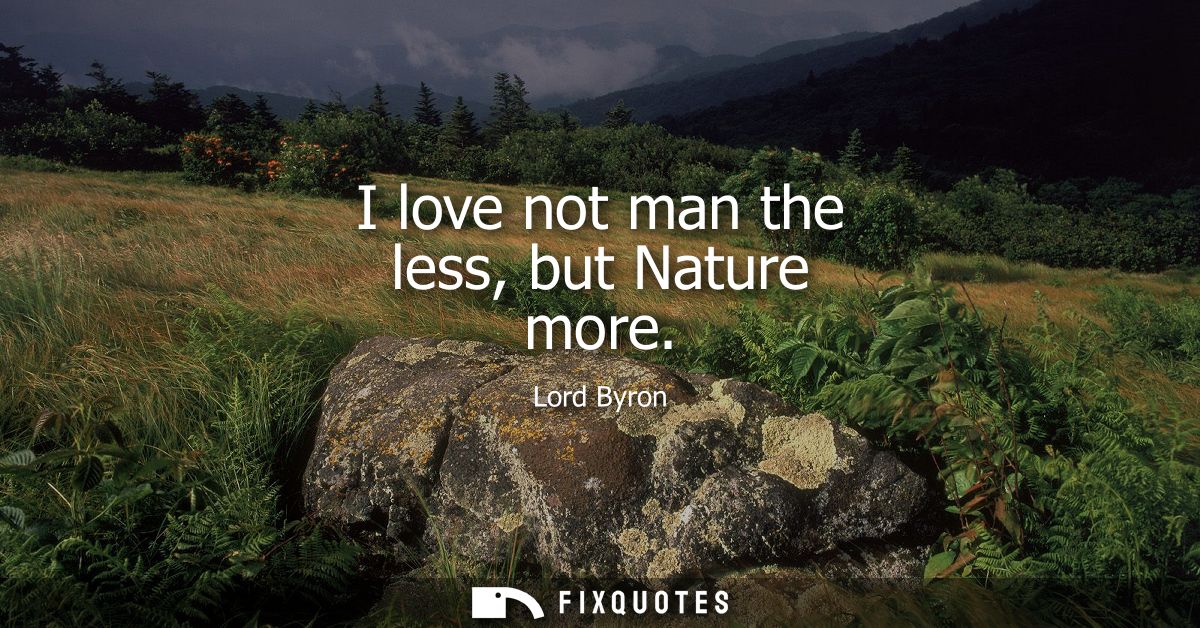
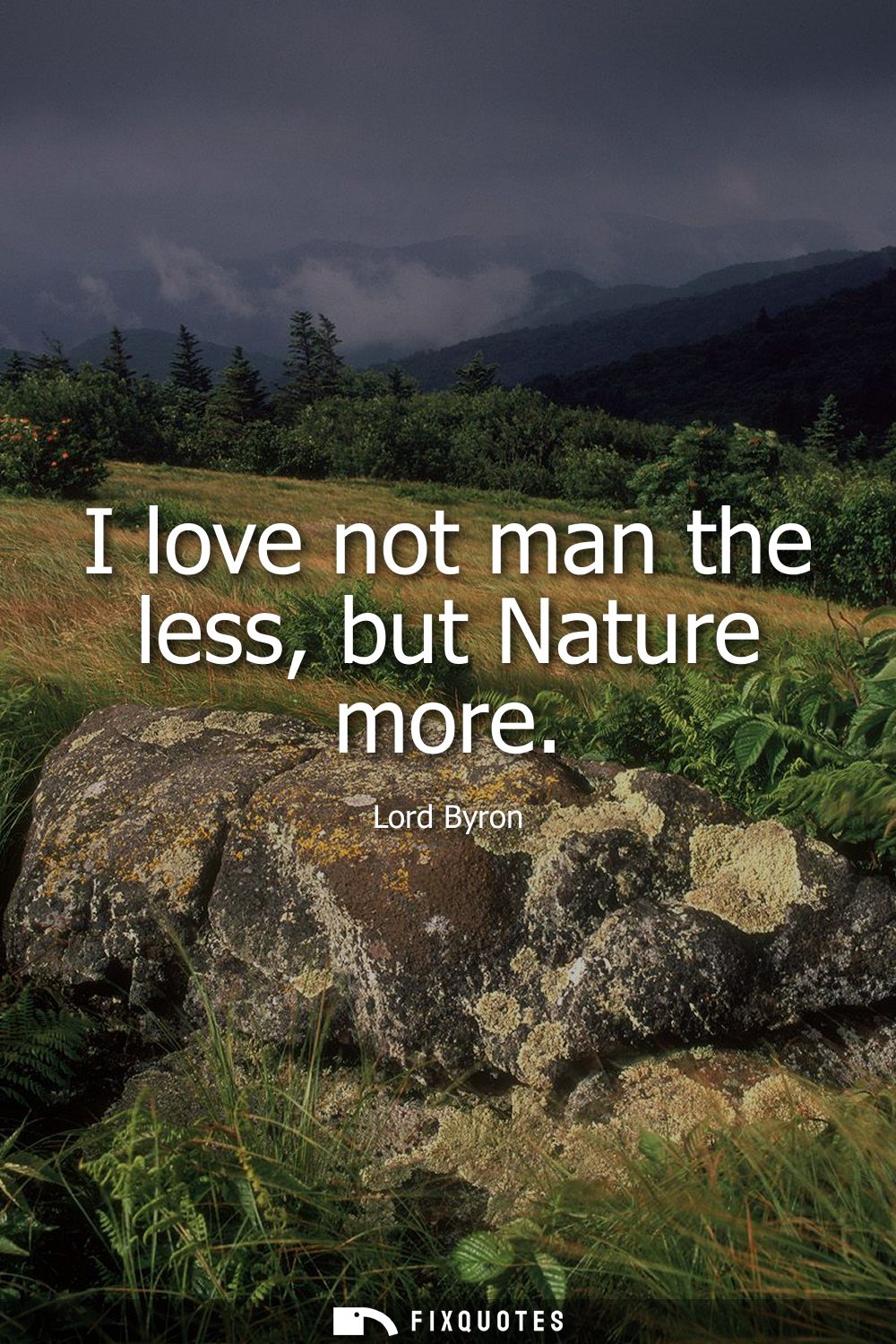
"I love not man the less, but Nature more"
About this Quote
Byron’s line is a romantic mic drop that sounds like retreat and reads like indictment. “I love not man the less” is a sly preemptive defense against the obvious charge: misanthropy. He’s not claiming to hate people; he’s claiming people have made themselves harder to love. The real pivot is “but Nature more,” where “Nature” becomes both refuge and rebuke. If humanity is politics, gossip, war, and hypocrisy, Nature is the one realm that doesn’t demand performance.
The phrasing is doing quiet rhetorical work. Byron keeps “man” singular, a type rather than a person, which lets him critique society without naming names. “Nature,” capitalized, arrives as a rival sovereign - not scenery, but an alternate moral order. It’s also a classic Byronic move: the speaker as proud outsider, too sensitive (or too impatient) for the crowd, choosing solitude that doubles as superiority. The pose is melancholic, but it carries an edge: you can hear the contempt for social piety, the suspicion that “civilization” is a costume for cruelty.
Context matters. Byron writes out of the Romantic era’s backlash to industrial modernity and post-revolutionary disillusionment, when Europe’s talk of progress often cashed out as conquest and repression. For Byron personally, scandal and self-exile sharpened the appeal of mountains, oceans, and storms as emotional alibis. Nature doesn’t gossip; it doesn’t prosecute. Loving it “more” becomes a way to stay tender without staying fooled.
The phrasing is doing quiet rhetorical work. Byron keeps “man” singular, a type rather than a person, which lets him critique society without naming names. “Nature,” capitalized, arrives as a rival sovereign - not scenery, but an alternate moral order. It’s also a classic Byronic move: the speaker as proud outsider, too sensitive (or too impatient) for the crowd, choosing solitude that doubles as superiority. The pose is melancholic, but it carries an edge: you can hear the contempt for social piety, the suspicion that “civilization” is a costume for cruelty.
Context matters. Byron writes out of the Romantic era’s backlash to industrial modernity and post-revolutionary disillusionment, when Europe’s talk of progress often cashed out as conquest and repression. For Byron personally, scandal and self-exile sharpened the appeal of mountains, oceans, and storms as emotional alibis. Nature doesn’t gossip; it doesn’t prosecute. Loving it “more” becomes a way to stay tender without staying fooled.
Quote Details
| Topic | Nature |
|---|---|
| Source | Verified source: Childe Harold's Pilgrimage (Lord Byron, 1818)
Evidence: I love not Man the less, but Nature more, (Canto IV, Stanza 178 (CLXXVIII); page 457 in Coleridge & Prothero ed., Works of Lord Byron, Vol. 2). Primary source is Byron’s narrative poem Childe Harold’s Pilgrimage. The quoted line appears in Canto IV, stanza 178 (CLXXVIII). Canto IV was first published in 1818 (the earlier cantos appeared earlier: I–II in 1812; III in 1816; IV in 1818). The Wikisource scan of Coleridge & Prothero’s edition of Byron’s Works shows the line on p. 457 (as printed in that edition). The same wording is also present in Project Gutenberg’s transcription of the poem at the stanza location cited. See also: Project Gutenberg text at lines around CLXXVIII. https://www.gutenberg.org/files/5131/5131-h/5131-h.htm Other candidates (1) Poetry of Byron (George Gordon Byron Baron Byron, 1895) compilation95.0% ... I love not man the less , but Nature more , From these our interviews , in which I steal From all I may be , or h... |
| Cite |
Citation Formats
APA Style (7th ed.)
Byron, Lord. (2026, February 9). I love not man the less, but Nature more. FixQuotes. https://fixquotes.com/quotes/i-love-not-man-the-less-but-nature-more-41617/
Chicago Style
Byron, Lord. "I love not man the less, but Nature more." FixQuotes. February 9, 2026. https://fixquotes.com/quotes/i-love-not-man-the-less-but-nature-more-41617/.
MLA Style (9th ed.)
"I love not man the less, but Nature more." FixQuotes, 9 Feb. 2026, https://fixquotes.com/quotes/i-love-not-man-the-less-but-nature-more-41617/. Accessed 12 Feb. 2026.
More Quotes by Lord
Add to List