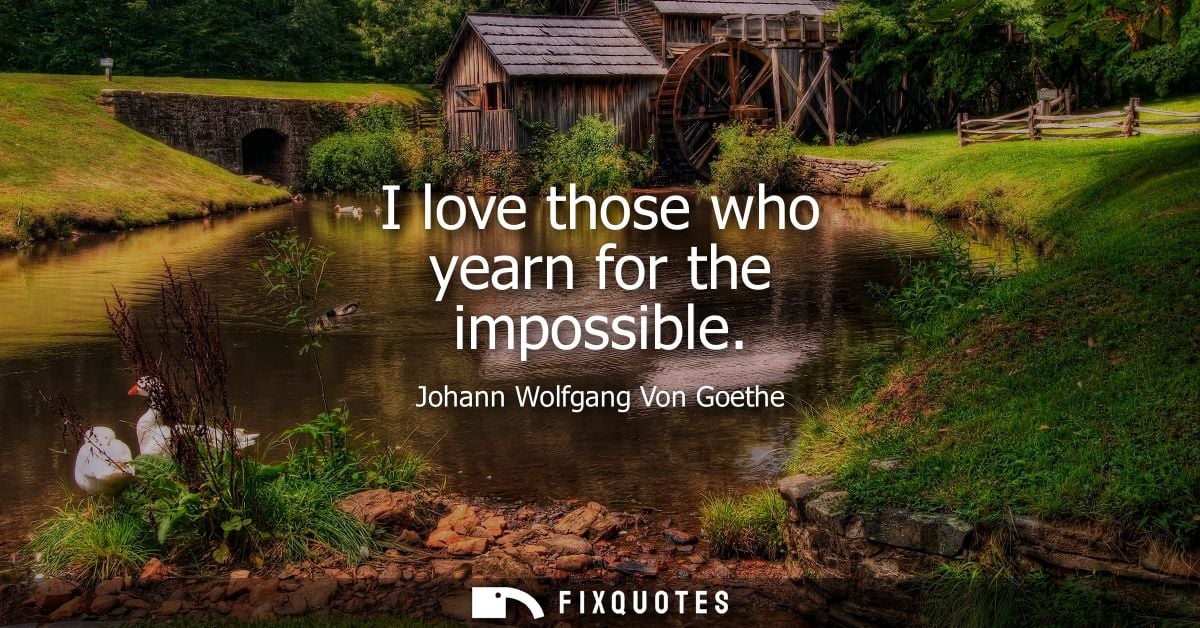
"I love those who yearn for the impossible"
About this Quote
Goethe’s line flatters a dangerous appetite: the hunger for what cannot be had, proved, or finished. “Love” does a lot of covert work here. It’s not admiration at a distance; it’s an elective kinship, a declaration that the most compelling people are the ones who refuse the sensible perimeter of life. “Yearn” sharpens it further. This isn’t casual ambition or productive goal-setting. It’s longing with pain in it, a restless erotic energy aimed at the horizon.
The impossible, in Goethe’s world, isn’t just a physics problem. It’s the unreachable ideal: total knowledge, perfect beauty, moral purity, a life that doesn’t corrode under time. That’s the emotional engine of Sturm und Drang and early Romanticism, which treated intensity as a form of truth and exalted striving over settled contentment. In that cultural moment, yearning wasn’t a symptom to be managed; it was evidence you were alive.
The subtext is a subtle defense of the striver against the bourgeois ethic of “be realistic.” Goethe is blessing the person who will look irrational, unwell, even socially disruptive because they keep wanting more than the world can responsibly offer. There’s also a quiet self-portrait here. Goethe’s great figures (think Faust’s appetite for infinity) aren’t admirable because they’re right; they’re magnetic because they’re incapable of accepting limits without a fight.
The line works because it dignifies failure. If you yearn for the impossible, you’re guaranteed to lose in practice, but you win in meaning: your life becomes an argument against smallness.
The impossible, in Goethe’s world, isn’t just a physics problem. It’s the unreachable ideal: total knowledge, perfect beauty, moral purity, a life that doesn’t corrode under time. That’s the emotional engine of Sturm und Drang and early Romanticism, which treated intensity as a form of truth and exalted striving over settled contentment. In that cultural moment, yearning wasn’t a symptom to be managed; it was evidence you were alive.
The subtext is a subtle defense of the striver against the bourgeois ethic of “be realistic.” Goethe is blessing the person who will look irrational, unwell, even socially disruptive because they keep wanting more than the world can responsibly offer. There’s also a quiet self-portrait here. Goethe’s great figures (think Faust’s appetite for infinity) aren’t admirable because they’re right; they’re magnetic because they’re incapable of accepting limits without a fight.
The line works because it dignifies failure. If you yearn for the impossible, you’re guaranteed to lose in practice, but you win in meaning: your life becomes an argument against smallness.
Quote Details
| Topic | Wisdom |
|---|---|
| Source | Verified source: Faust: Der Tragödie zweiter Teil (Johann Wolfgang Von Goethe, 1832)
Evidence:
Den lieb’ ich, der Unmögliches begehrt. (Act II ("Klassische Walpurgisnacht"), scene "Am unteren Peneios"; often indexed as Vers/line 7488; page 134 in the 1832 Tübingen printing). The English quote you gave (“I love those who yearn for the impossible”) is a loose translation/paraphrase of this line spoken by the character Manto in Goethe’s Faust II. A primary-text scan of the 1832 Tübingen edition on Wikisource shows the line in context, labeled with line numbers around 7480–7493; the quote itself appears as line 7488 on that page. This is the earliest *published* appearance in Goethe’s own work (Faust II was published in 1832, the year of Goethe’s death). |
| Cite |
Citation Formats
APA Style (7th ed.)
Goethe, Johann Wolfgang Von. (2026, March 2). I love those who yearn for the impossible. FixQuotes. https://fixquotes.com/quotes/i-love-those-who-yearn-for-the-impossible-7910/
Chicago Style
Goethe, Johann Wolfgang Von. "I love those who yearn for the impossible." FixQuotes. March 2, 2026. https://fixquotes.com/quotes/i-love-those-who-yearn-for-the-impossible-7910/.
MLA Style (9th ed.)
"I love those who yearn for the impossible." FixQuotes, 2 Mar. 2026, https://fixquotes.com/quotes/i-love-those-who-yearn-for-the-impossible-7910/. Accessed 7 Apr. 2026.
More Quotes by Johann
Add to List