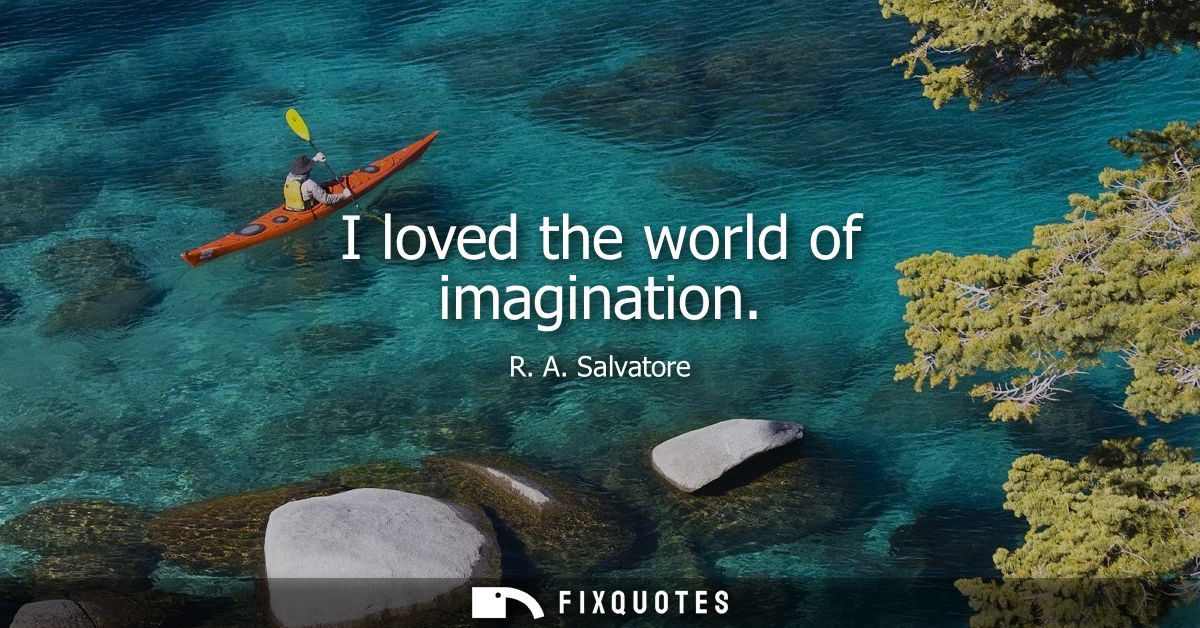
"I loved the world of imagination"
About this Quote
“I loved the world of imagination” lands with the deceptively simple clarity of a career thesis statement. In R. A. Salvatore’s case, it’s not a misty-eyed ode to daydreaming; it’s a quiet manifesto from a writer who helped turn fantasy from niche escapism into a mainstream engine for character-driven storytelling. The line is past tense, but it doesn’t read like nostalgia. It reads like origin myth: the moment a reader becomes a builder.
The intent is plainspoken devotion, and that plainness matters. Salvatore’s brand of fantasy has always treated invented worlds as places you can live in, argue in, bleed in. Saying he “loved” imagination frames it as a relationship, not a genre preference. The subtext is a defense against the old cultural sneer at fantasy as childish. Imagination isn’t here to avoid reality; it’s the tool for sharpening it, for staging moral choices at a scale realism sometimes can’t justify without sounding preachy.
Context does the heavy lifting. Salvatore rose alongside Dungeons & Dragons culture, tie-in novels, and the long boom of “secondary worlds” that trained generations to take elves and ethics seriously in the same sentence. Behind the line is the tacit claim that imaginary settings aren’t distractions; they’re laboratories. You can test loyalty, violence, belonging, and conscience there, then carry the results back into the real world, a little changed.
The intent is plainspoken devotion, and that plainness matters. Salvatore’s brand of fantasy has always treated invented worlds as places you can live in, argue in, bleed in. Saying he “loved” imagination frames it as a relationship, not a genre preference. The subtext is a defense against the old cultural sneer at fantasy as childish. Imagination isn’t here to avoid reality; it’s the tool for sharpening it, for staging moral choices at a scale realism sometimes can’t justify without sounding preachy.
Context does the heavy lifting. Salvatore rose alongside Dungeons & Dragons culture, tie-in novels, and the long boom of “secondary worlds” that trained generations to take elves and ethics seriously in the same sentence. Behind the line is the tacit claim that imaginary settings aren’t distractions; they’re laboratories. You can test loyalty, violence, belonging, and conscience there, then carry the results back into the real world, a little changed.
Quote Details
| Topic | Writing |
|---|---|
| Source | Help us find the source |
| Cite |
Citation Formats
APA Style (7th ed.)
Salvatore, R. A. (2026, January 15). I loved the world of imagination. FixQuotes. https://fixquotes.com/quotes/i-loved-the-world-of-imagination-149905/
Chicago Style
Salvatore, R. A. "I loved the world of imagination." FixQuotes. January 15, 2026. https://fixquotes.com/quotes/i-loved-the-world-of-imagination-149905/.
MLA Style (9th ed.)
"I loved the world of imagination." FixQuotes, 15 Jan. 2026, https://fixquotes.com/quotes/i-loved-the-world-of-imagination-149905/. Accessed 1 Apr. 2026.
More Quotes by A. Salvatore
Add to List