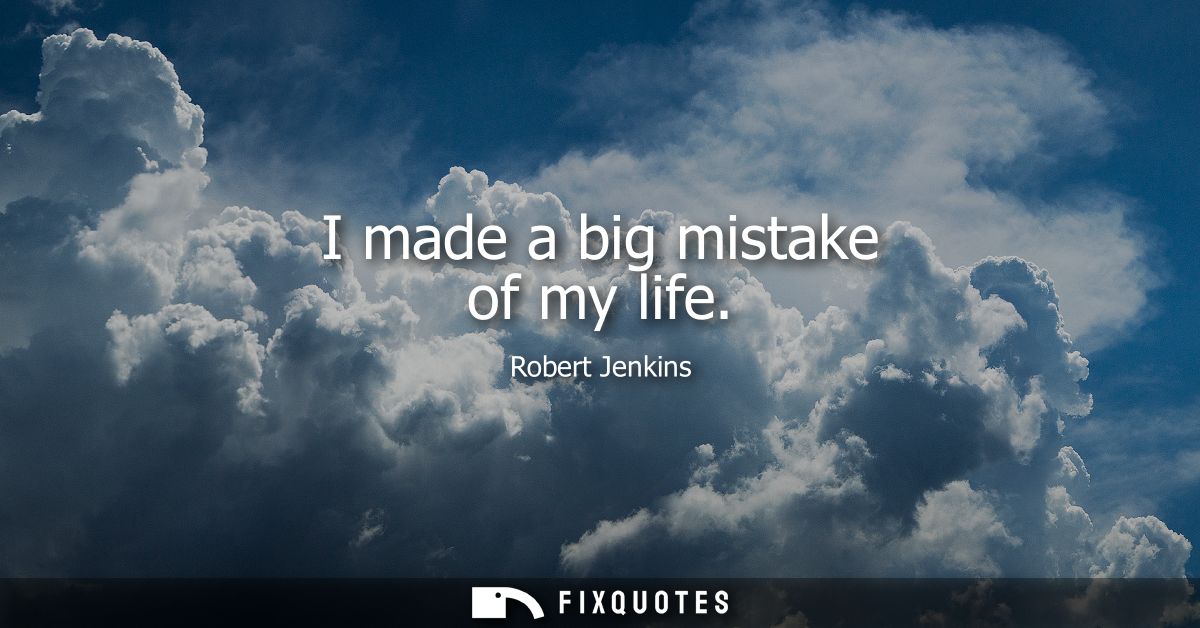
"I made a big mistake of my life"
About this Quote
"I made a big mistake of my life" lands with the bluntness you get from someone trained to minimize language and maximize consequence. As a soldier, Jenkins isn’t offering a neatly packaged lesson; he’s naming an event that likely refuses to stay in the past. The grammar itself gives it away. It’s not "the biggest mistake of my life" (a polished, retrospective ranking), and it’s not "a big mistake in my life" (which would tuck it among others). "Of my life" sounds possessive, almost fatalistic: the mistake isn’t merely something he did, it’s something that now belongs to him.
The intent reads as confession, but also as a warning. In military contexts, "mistake" often functions as a euphemism for choices that can’t be comfortably spoken aloud: a misread order, a split-second decision, a failure to act, an act that can’t be undone. The line’s vagueness isn’t evasive so much as procedural. Soldiers are conditioned by secrecy, chain of command, and the social fact that certain memories are too loaded for public specificity. Silence becomes part of the statement.
Subtext: he wants accountability without spectacle. There’s no villain named, no excuse offered, no redemption arc promised. Just the heavy, lonely clarity that consequences follow you home. Culturally, this kind of sentence resonates because it refuses the action-movie narrative of war. It makes room for the messier truth: the hardest battles often aren’t fought "over there", but in the private, recurring aftermath of one decision.
The intent reads as confession, but also as a warning. In military contexts, "mistake" often functions as a euphemism for choices that can’t be comfortably spoken aloud: a misread order, a split-second decision, a failure to act, an act that can’t be undone. The line’s vagueness isn’t evasive so much as procedural. Soldiers are conditioned by secrecy, chain of command, and the social fact that certain memories are too loaded for public specificity. Silence becomes part of the statement.
Subtext: he wants accountability without spectacle. There’s no villain named, no excuse offered, no redemption arc promised. Just the heavy, lonely clarity that consequences follow you home. Culturally, this kind of sentence resonates because it refuses the action-movie narrative of war. It makes room for the messier truth: the hardest battles often aren’t fought "over there", but in the private, recurring aftermath of one decision.
Quote Details
| Topic | Learning from Mistakes |
|---|---|
| Source | Help us find the source |
| Cite |
Citation Formats
APA Style (7th ed.)
Jenkins, Robert. (2026, January 18). I made a big mistake of my life. FixQuotes. https://fixquotes.com/quotes/i-made-a-big-mistake-of-my-life-17321/
Chicago Style
Jenkins, Robert. "I made a big mistake of my life." FixQuotes. January 18, 2026. https://fixquotes.com/quotes/i-made-a-big-mistake-of-my-life-17321/.
MLA Style (9th ed.)
"I made a big mistake of my life." FixQuotes, 18 Jan. 2026, https://fixquotes.com/quotes/i-made-a-big-mistake-of-my-life-17321/. Accessed 28 Mar. 2026.
More Quotes by Robert
Add to List