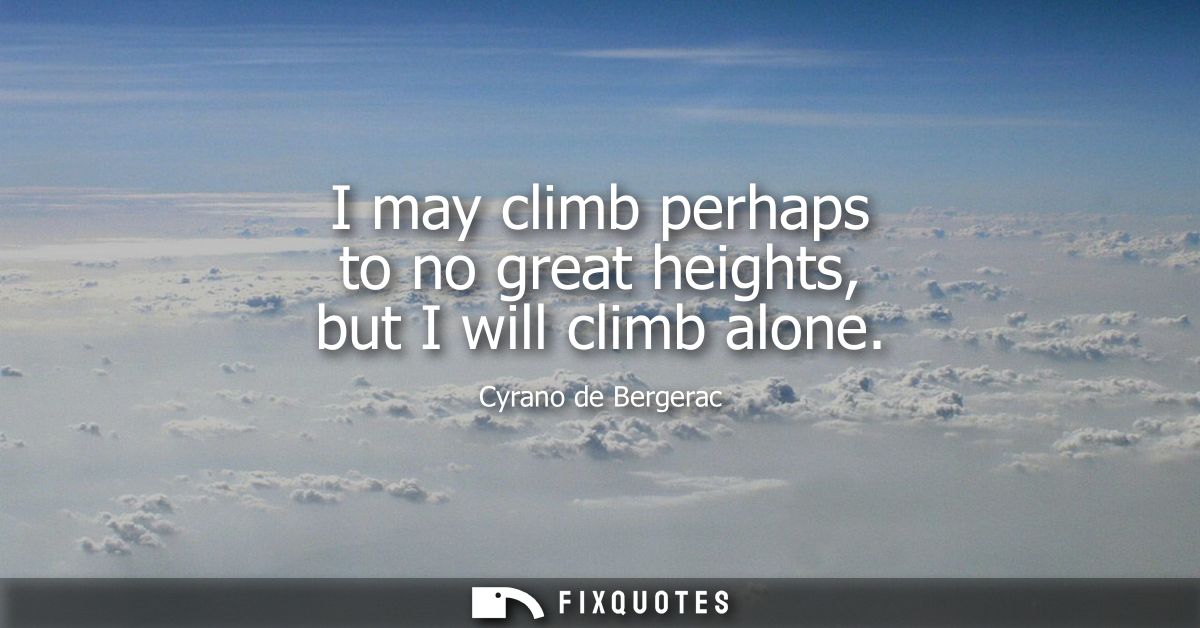
"I may climb perhaps to no great heights, but I will climb alone"
About this Quote
Ambition, here, gets stripped of its usual PR sheen and recast as an aesthetic choice: not victory, but posture. "I may climb perhaps to no great heights" is a pre-emptive deflation of the heroic arc, the kind of rhetorical shrug that keeps vanity at arm's length even as it announces a will to rise. Cyrano builds a paradoxical bravado by admitting probable failure and then insisting on the one outcome he can control: the terms of his ascent.
"I will climb alone" is the blade. In a culture of patronage, salons, and carefully traded favors, aloneness isn't just mood; it's defiance. Cyrano's refusal to be carried implies contempt for the machinery that manufactures greatness - the sponsors, flatterers, and strategic alliances that turn talent into reputation. The line carries the subtext of an insult: if the only way up is through compromise, then the summit isn't worth it.
As playwright and polemicist, Cyrano de Bergerac cultivated an image of the unruly intellectual, more interested in integrity than acceptability. That sensibility later becomes central to Edmond Rostand's romanticized Cyrano: the swordsman-poet who chooses panache over payoff. The quote works because it converts loneliness from a penalty into a credential. It offers a harsh consolation for anyone stuck outside the network: you might not win, but you won't be bought. In an era (and ours) addicted to proximity-as-success, that's a dangerously attractive ethic.
"I will climb alone" is the blade. In a culture of patronage, salons, and carefully traded favors, aloneness isn't just mood; it's defiance. Cyrano's refusal to be carried implies contempt for the machinery that manufactures greatness - the sponsors, flatterers, and strategic alliances that turn talent into reputation. The line carries the subtext of an insult: if the only way up is through compromise, then the summit isn't worth it.
As playwright and polemicist, Cyrano de Bergerac cultivated an image of the unruly intellectual, more interested in integrity than acceptability. That sensibility later becomes central to Edmond Rostand's romanticized Cyrano: the swordsman-poet who chooses panache over payoff. The quote works because it converts loneliness from a penalty into a credential. It offers a harsh consolation for anyone stuck outside the network: you might not win, but you won't be bought. In an era (and ours) addicted to proximity-as-success, that's a dangerously attractive ethic.
Quote Details
| Topic | Perseverance |
|---|---|
| Source | Help us find the source |
| Cite |
Citation Formats
APA Style (7th ed.)
Bergerac, Cyrano de. (2026, January 15). I may climb perhaps to no great heights, but I will climb alone. FixQuotes. https://fixquotes.com/quotes/i-may-climb-perhaps-to-no-great-heights-but-i-43100/
Chicago Style
Bergerac, Cyrano de. "I may climb perhaps to no great heights, but I will climb alone." FixQuotes. January 15, 2026. https://fixquotes.com/quotes/i-may-climb-perhaps-to-no-great-heights-but-i-43100/.
MLA Style (9th ed.)
"I may climb perhaps to no great heights, but I will climb alone." FixQuotes, 15 Jan. 2026, https://fixquotes.com/quotes/i-may-climb-perhaps-to-no-great-heights-but-i-43100/. Accessed 30 Mar. 2026.
More Quotes by Cyrano
Add to List