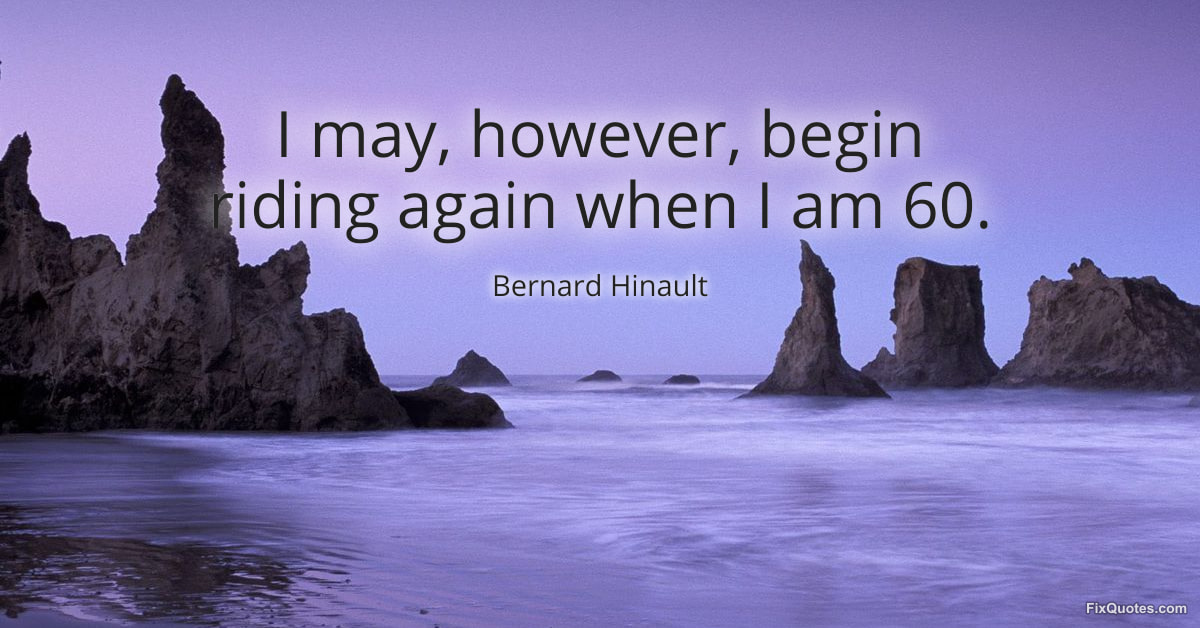
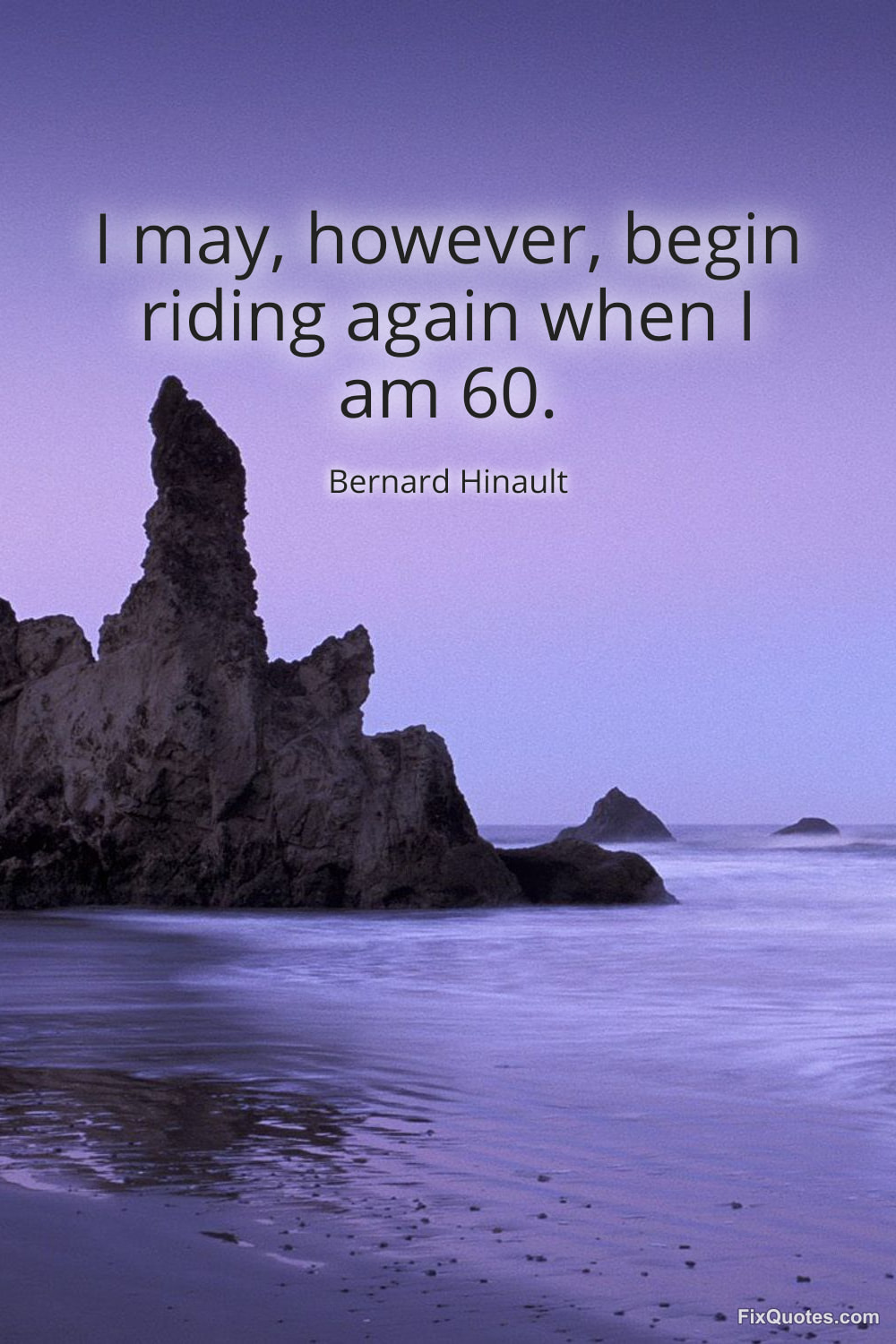
"I may, however, begin riding again when I am 60"
About this Quote
It lands like a throwaway line, but it’s really a flex disguised as restraint. Bernard Hinault isn’t daydreaming about a leisurely comeback; he’s reminding you that for riders of his era, cycling wasn’t a lifestyle brand, it was a totalizing identity you had to put down on purpose. The “however” does the heavy lifting: I’m done, but only because I choose to be done.
Hinault’s context matters. As a five-time Tour de France winner with a reputation for combative, all-or-nothing racing, he’s the opposite of the retired legend who can’t let go. His intent reads as control. By setting an arbitrary, distant age marker - 60 - he frames retirement as a pause in a long relationship with the bike, not a broken attachment. It’s also a subtle jab at the modern culture of perpetual training, where ex-pros are expected to keep performing on Strava, at gran fondos, in sponsored nostalgia laps. Hinault refuses that treadmill.
The subtext is bodily, too. For an athlete, “riding again” isn’t just exercise; it’s re-entering a world of pain, discipline, and comparison. Pushing it to 60 is a way of saying: I’m not chasing the old man version of myself. When he returns, it will be on his terms, when the ego has cooled and the bike can become pleasure again - or at least a different kind of proving ground.
Hinault’s context matters. As a five-time Tour de France winner with a reputation for combative, all-or-nothing racing, he’s the opposite of the retired legend who can’t let go. His intent reads as control. By setting an arbitrary, distant age marker - 60 - he frames retirement as a pause in a long relationship with the bike, not a broken attachment. It’s also a subtle jab at the modern culture of perpetual training, where ex-pros are expected to keep performing on Strava, at gran fondos, in sponsored nostalgia laps. Hinault refuses that treadmill.
The subtext is bodily, too. For an athlete, “riding again” isn’t just exercise; it’s re-entering a world of pain, discipline, and comparison. Pushing it to 60 is a way of saying: I’m not chasing the old man version of myself. When he returns, it will be on his terms, when the ego has cooled and the bike can become pleasure again - or at least a different kind of proving ground.
Quote Details
| Topic | Aging |
|---|---|
| Source | Help us find the source |
| Cite |
Citation Formats
APA Style (7th ed.)
Hinault, Bernard. (2026, January 17). I may, however, begin riding again when I am 60. FixQuotes. https://fixquotes.com/quotes/i-may-however-begin-riding-again-when-i-am-60-61160/
Chicago Style
Hinault, Bernard. "I may, however, begin riding again when I am 60." FixQuotes. January 17, 2026. https://fixquotes.com/quotes/i-may-however-begin-riding-again-when-i-am-60-61160/.
MLA Style (9th ed.)
"I may, however, begin riding again when I am 60." FixQuotes, 17 Jan. 2026, https://fixquotes.com/quotes/i-may-however-begin-riding-again-when-i-am-60-61160/. Accessed 30 Mar. 2026.
More Quotes by Bernard
Add to List