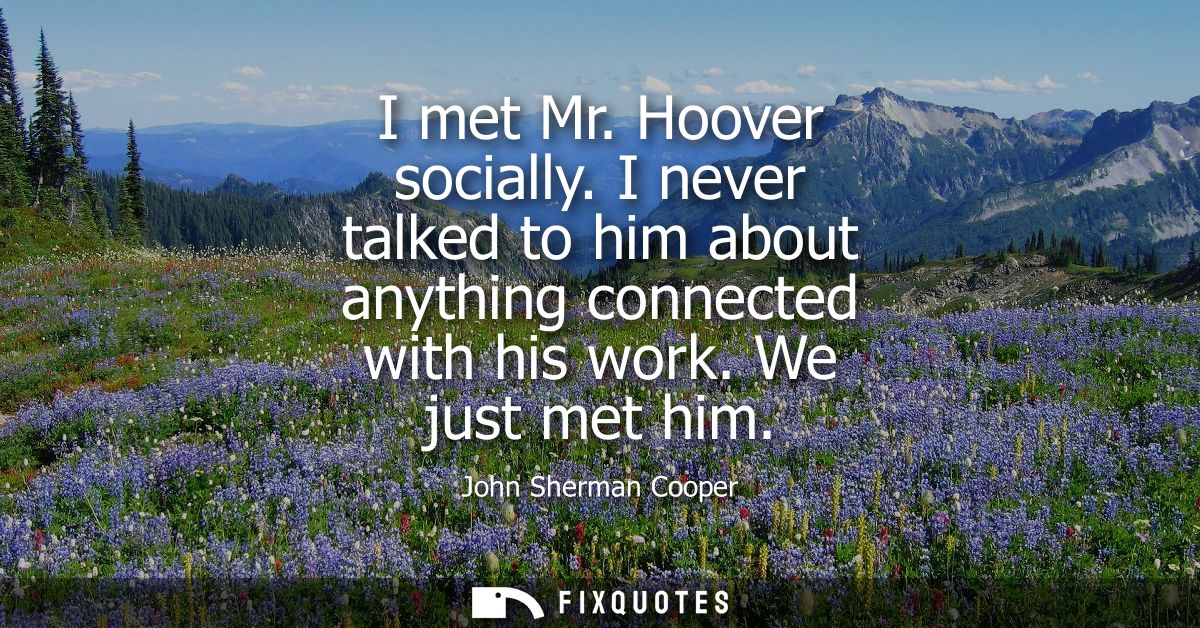
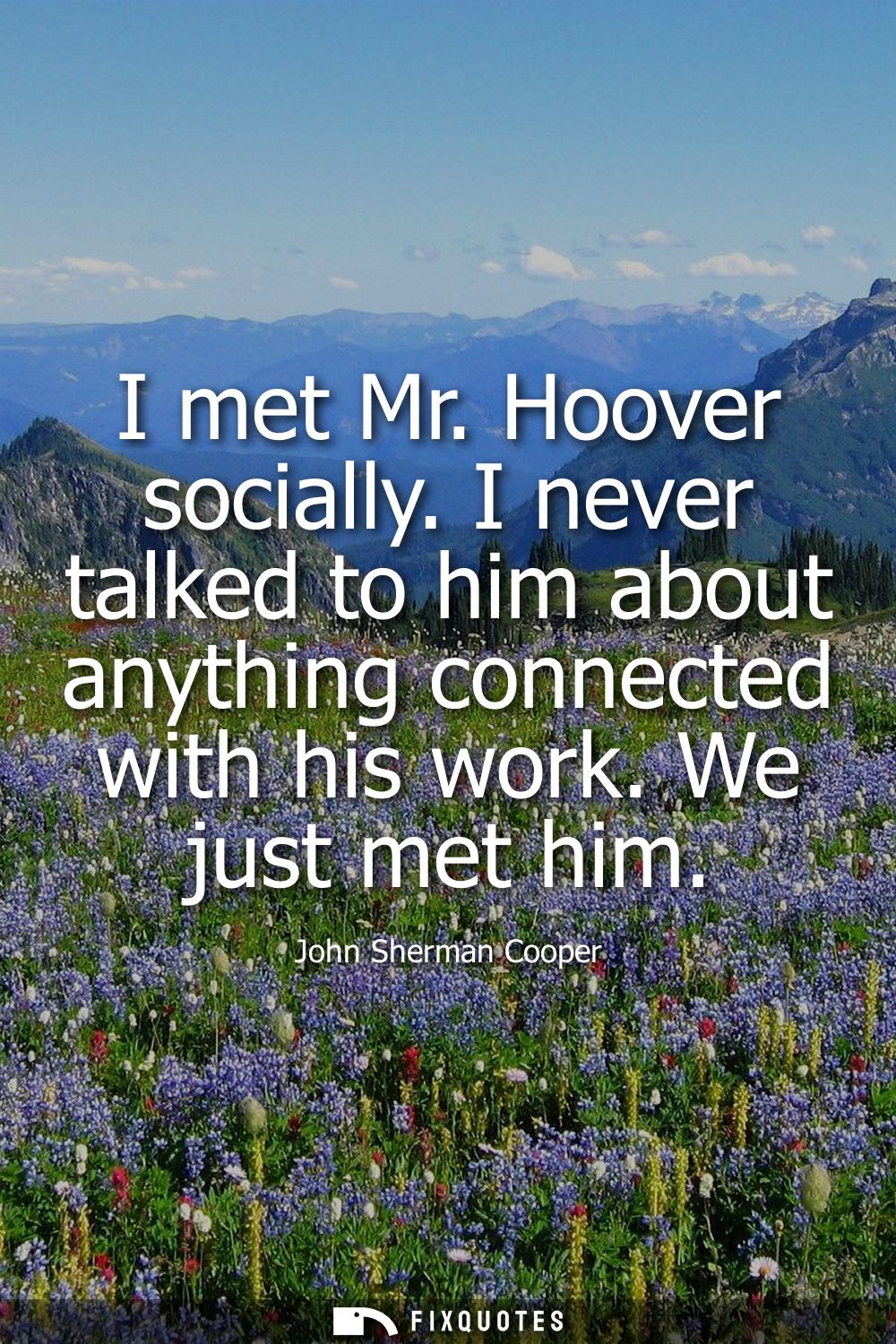
"I met Mr. Hoover socially. I never talked to him about anything connected with his work. We just met him"
About this Quote
The repetition and slight awkwardness - “We just met him” - is doing work, too. It’s not elegant because it’s defensive. Cooper is constructing plausible distance from J. Edgar Hoover, a figure whose name carried both the aura of national security and the stink of surveillance politics. To say you met Hoover was to flirt with implication: favors asked, files hinted at, careers nudged. Cooper’s phrasing turns the meeting into a social accident, drained of influence, stripped of intention.
Context matters: mid-century American politics was saturated with the fear that private relationships were public leverage. Hoover’s FBI wasn’t just an agency; it was a pressure system, famously intertwined with politicians who needed protection or feared exposure. Cooper’s statement signals a politician navigating that ecosystem: acknowledging proximity to power while swearing he didn’t touch the live wire. It’s less a memory than a boundary-setting maneuver, designed to sound boring because boring is safe.
Quote Details
| Topic | Friendship |
|---|---|
| Source | Help us find the source |
| Cite |
Citation Formats
APA Style (7th ed.)
Cooper, John Sherman. (2026, January 15). I met Mr. Hoover socially. I never talked to him about anything connected with his work. We just met him. FixQuotes. https://fixquotes.com/quotes/i-met-mr-hoover-socially-i-never-talked-to-him-151837/
Chicago Style
Cooper, John Sherman. "I met Mr. Hoover socially. I never talked to him about anything connected with his work. We just met him." FixQuotes. January 15, 2026. https://fixquotes.com/quotes/i-met-mr-hoover-socially-i-never-talked-to-him-151837/.
MLA Style (9th ed.)
"I met Mr. Hoover socially. I never talked to him about anything connected with his work. We just met him." FixQuotes, 15 Jan. 2026, https://fixquotes.com/quotes/i-met-mr-hoover-socially-i-never-talked-to-him-151837/. Accessed 17 Mar. 2026.