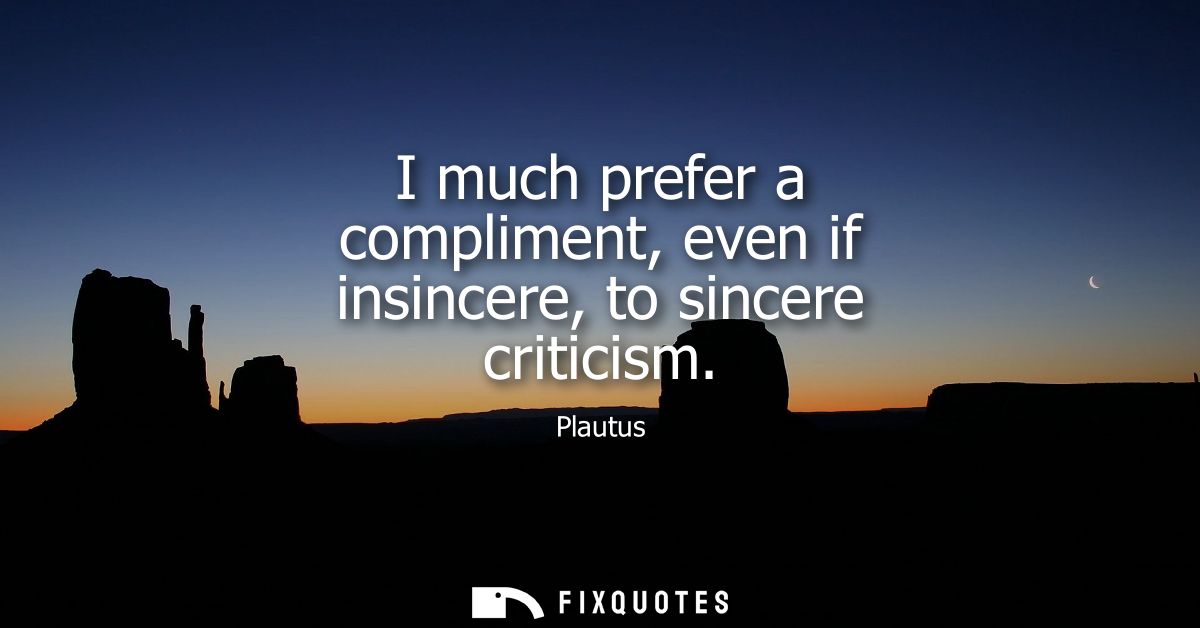
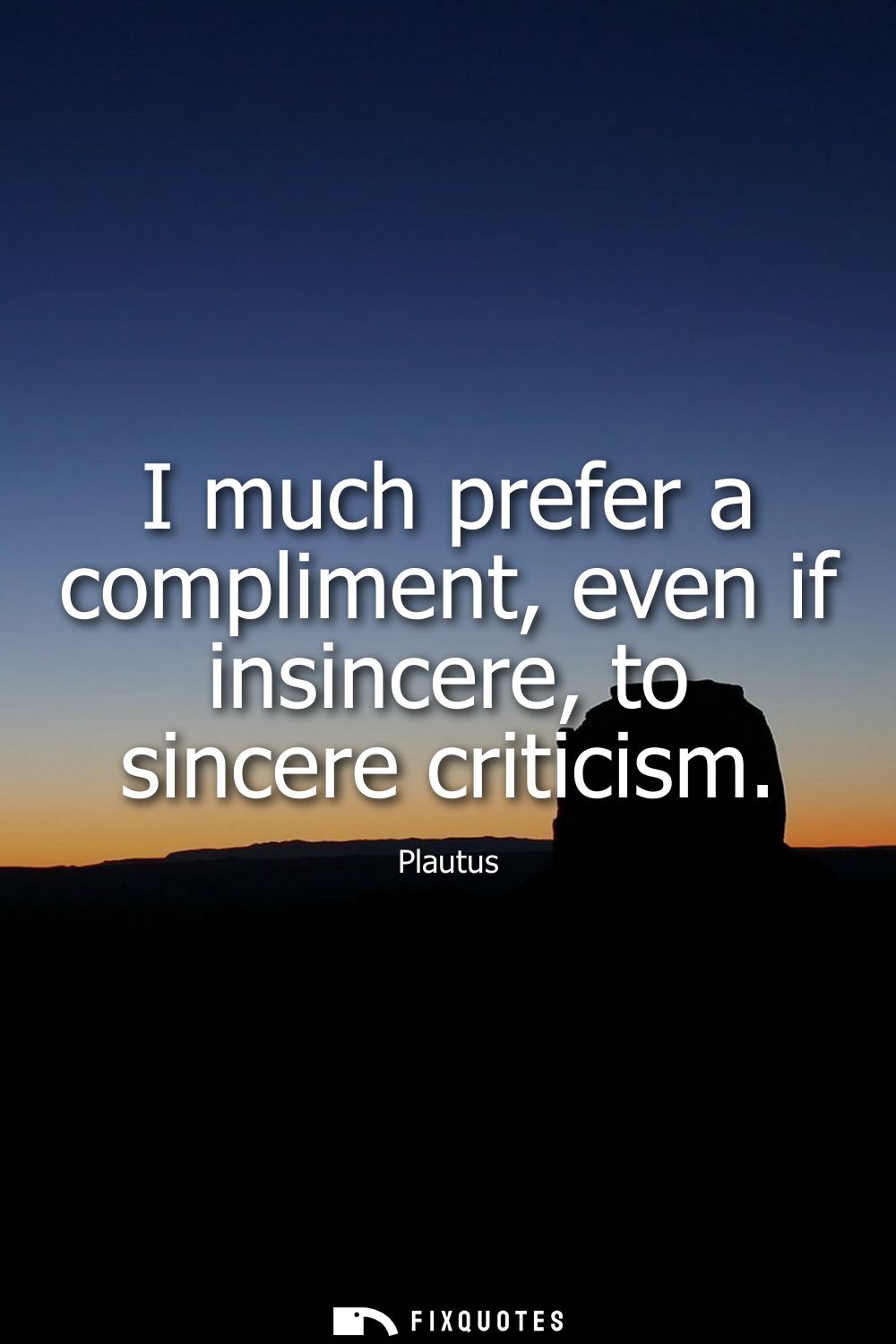
"I much prefer a compliment, even if insincere, to sincere criticism"
About this Quote
A compliment, even a fake one, is a social lubricant; sincere criticism is sand in the gears. Plautus, a playwright who made his living by turning human weakness into stagecraft, understands that most people don’t actually want truth as much as they want smoothness. The line isn’t a tender confession so much as a wink at the audience: of course we say we value honesty, but watch how fast we flinch when honesty shows up without a gift wrap.
The intent is comic and tactical. In Plautine comedy, characters survive by managing appearances: flattering the powerful, hustling for advantage, keeping the mood light enough to avoid consequences. An “insincere” compliment is useful precisely because it’s negotiable. Everyone can pretend it’s real, nobody has to change, and the relationship stays intact. “Sincere criticism,” by contrast, demands accountability. It implies the critic has standing, that your flaws are public, and that you should do something about them. That’s not just uncomfortable; it’s destabilizing.
Subtextually, Plautus is sketching an early map of what we now call performative civility. He’s not endorsing deception as much as exposing the bargain society often makes: we trade accuracy for harmony, especially in hierarchical worlds where blunt feedback can cost you status or safety. The joke lands because it’s not merely about vanity. It’s about risk management. Compliments, even counterfeit ones, feel like protection. Criticism, even loving and correct, feels like a threat.
The intent is comic and tactical. In Plautine comedy, characters survive by managing appearances: flattering the powerful, hustling for advantage, keeping the mood light enough to avoid consequences. An “insincere” compliment is useful precisely because it’s negotiable. Everyone can pretend it’s real, nobody has to change, and the relationship stays intact. “Sincere criticism,” by contrast, demands accountability. It implies the critic has standing, that your flaws are public, and that you should do something about them. That’s not just uncomfortable; it’s destabilizing.
Subtextually, Plautus is sketching an early map of what we now call performative civility. He’s not endorsing deception as much as exposing the bargain society often makes: we trade accuracy for harmony, especially in hierarchical worlds where blunt feedback can cost you status or safety. The joke lands because it’s not merely about vanity. It’s about risk management. Compliments, even counterfeit ones, feel like protection. Criticism, even loving and correct, feels like a threat.
Quote Details
| Topic | Witty One-Liners |
|---|---|
| Source | Help us find the source |
| Cite |
Citation Formats
APA Style (7th ed.)
Plautus. (2026, January 18). I much prefer a compliment, even if insincere, to sincere criticism. FixQuotes. https://fixquotes.com/quotes/i-much-prefer-a-compliment-even-if-insincere-to-6745/
Chicago Style
Plautus. "I much prefer a compliment, even if insincere, to sincere criticism." FixQuotes. January 18, 2026. https://fixquotes.com/quotes/i-much-prefer-a-compliment-even-if-insincere-to-6745/.
MLA Style (9th ed.)
"I much prefer a compliment, even if insincere, to sincere criticism." FixQuotes, 18 Jan. 2026, https://fixquotes.com/quotes/i-much-prefer-a-compliment-even-if-insincere-to-6745/. Accessed 9 Feb. 2026.
More Quotes by Plautus
Add to List