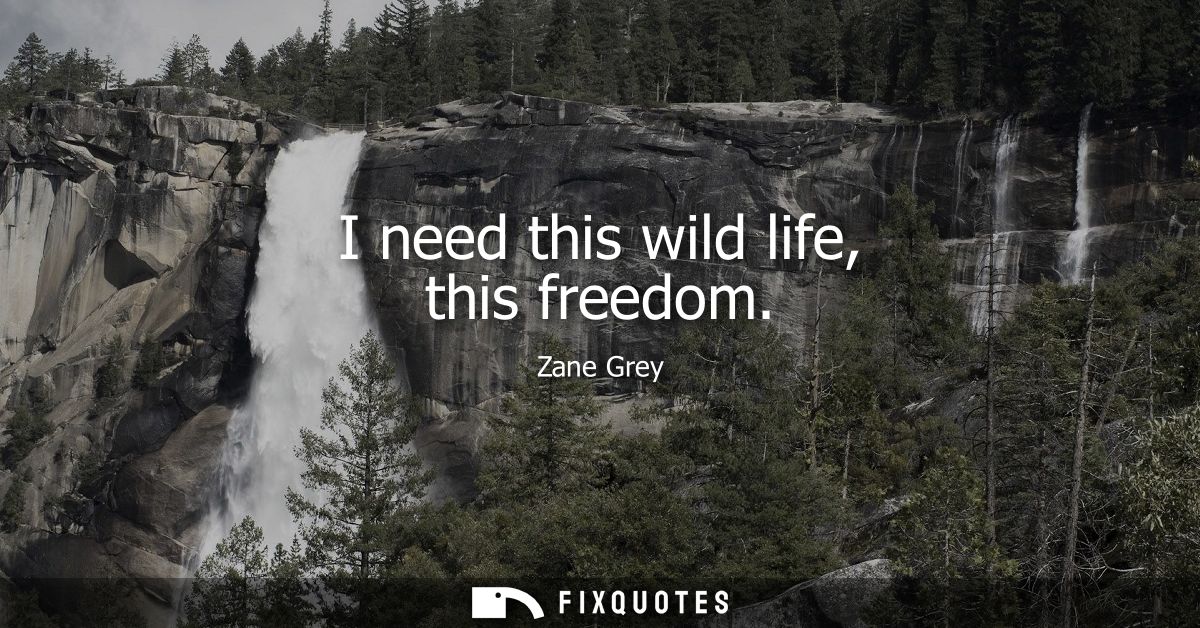
"I need this wild life, this freedom"
About this Quote
A line like this doesn’t just romanticize the outdoors; it stages an escape plan. Zane Grey built a career turning the American West into both a physical landscape and a moral argument, and "I need this wild life, this freedom" reads like the private engine behind his public mythmaking. The verb "need" is the tell: not want, not prefer, but require. Wilderness becomes a kind of oxygen, a corrective to whatever feels suffocating on the other side of the horizon.
Grey was writing in an era when the frontier was already closing into nostalgia and real estate. Rail lines, towns, and industry were making the West legible, ownable, domestic. Against that backdrop, his insistence on "wild life" isn’t nature worship so much as resistance to modern containment: schedules, institutions, social roles. "Freedom" here isn’t abstract civic liberty; it’s bodily and immediate, the freedom to move, to be unobserved, to be harder to categorize.
The phrase also does subtle PR work. Grey’s West is never only scenery; it’s a character-making machine where men are tested and purified, where the self can be remade without witnesses. That’s the subtext: wilderness as therapy, wilderness as alibi. By claiming necessity, the speaker absolves himself of compromise. He’s not fleeing responsibility; he’s answering a deeper call. In Grey’s world, that’s how myth becomes personal: a craving dressed up as destiny.
Grey was writing in an era when the frontier was already closing into nostalgia and real estate. Rail lines, towns, and industry were making the West legible, ownable, domestic. Against that backdrop, his insistence on "wild life" isn’t nature worship so much as resistance to modern containment: schedules, institutions, social roles. "Freedom" here isn’t abstract civic liberty; it’s bodily and immediate, the freedom to move, to be unobserved, to be harder to categorize.
The phrase also does subtle PR work. Grey’s West is never only scenery; it’s a character-making machine where men are tested and purified, where the self can be remade without witnesses. That’s the subtext: wilderness as therapy, wilderness as alibi. By claiming necessity, the speaker absolves himself of compromise. He’s not fleeing responsibility; he’s answering a deeper call. In Grey’s world, that’s how myth becomes personal: a craving dressed up as destiny.
Quote Details
| Topic | Freedom |
|---|---|
| Source | Help us find the source |
| Cite |
Citation Formats
APA Style (7th ed.)
Grey, Zane. (2026, January 16). I need this wild life, this freedom. FixQuotes. https://fixquotes.com/quotes/i-need-this-wild-life-this-freedom-113298/
Chicago Style
Grey, Zane. "I need this wild life, this freedom." FixQuotes. January 16, 2026. https://fixquotes.com/quotes/i-need-this-wild-life-this-freedom-113298/.
MLA Style (9th ed.)
"I need this wild life, this freedom." FixQuotes, 16 Jan. 2026, https://fixquotes.com/quotes/i-need-this-wild-life-this-freedom-113298/. Accessed 6 Apr. 2026.
More Quotes by Zane
Add to List