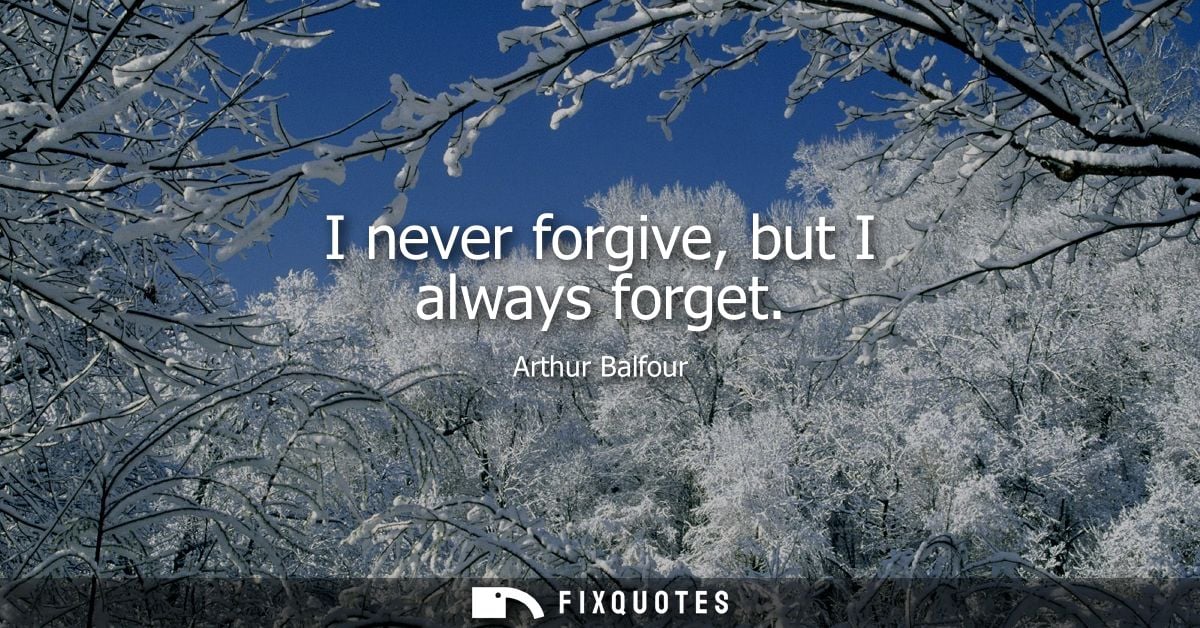
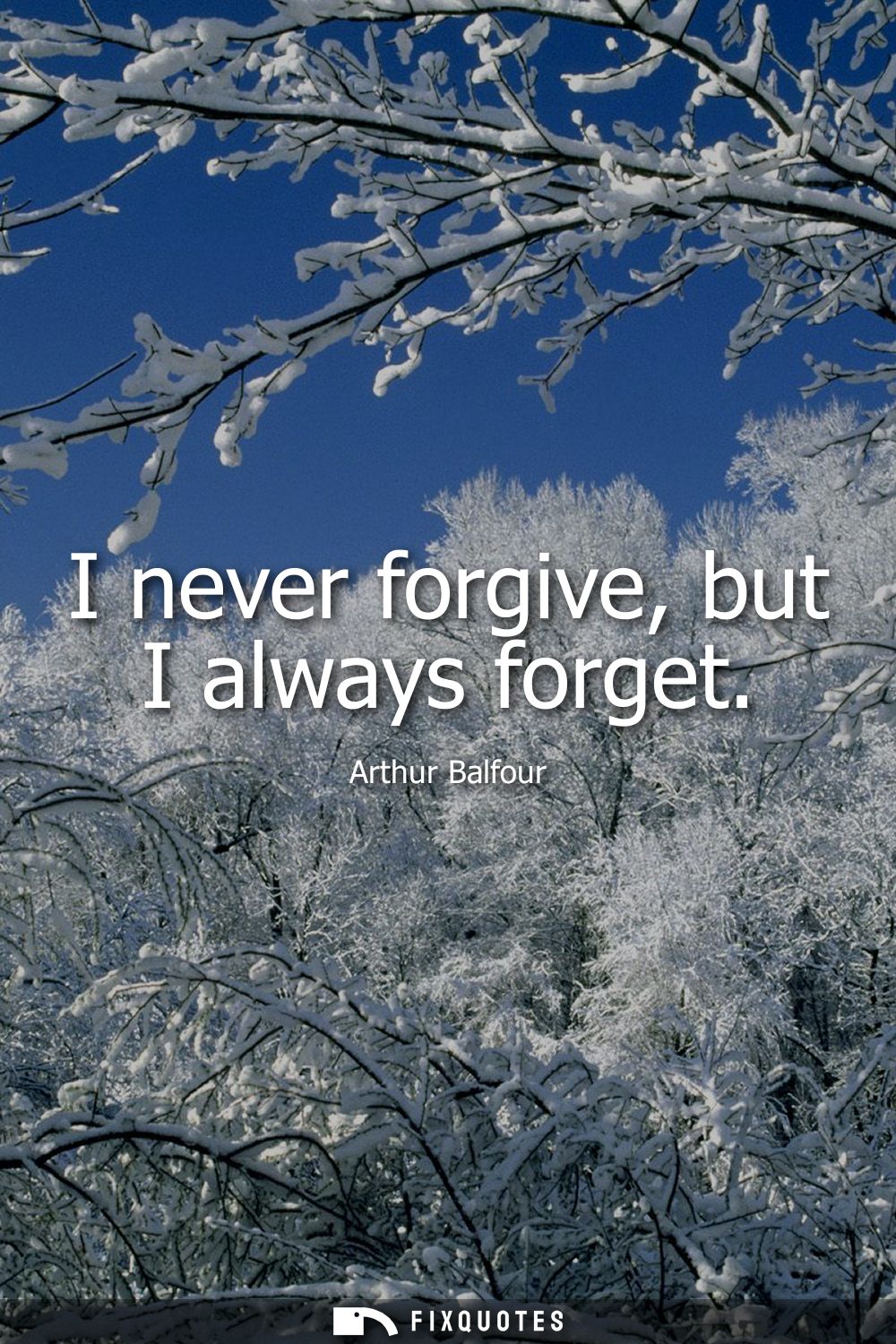
"I never forgive, but I always forget"
About this Quote
A statesman admitting he "never forgive[s], but... always forget[s]" is a masterclass in chilly self-description - and a glimpse of how power protects itself from sentiment. Forgiveness is moral theater: it requires acknowledging an injury, assigning meaning, then choosing to release it. Forgetting, by contrast, is administrative. It wipes the ledger without ever granting the other side the dignity of having been judged and absolved.
For Arthur Balfour, a late-Victorian and Edwardian operator whose career moved through Ireland, empire, and party intrigue, the line reads less like a personal quirk than a governing philosophy. "Never forgive" signals a refusal to validate anyone else's grievance or grant reconciliation on their terms. It's a warning: you won't get a cathartic handshake, a public mending, or a rewritten narrative. "Always forget" then undercuts the threat with a politician's pragmatism. He can drop a feud the moment it stops being useful, not because he's generous, but because he's busy - or because memory is a liability in a world built on shifting alliances.
The subtext is almost bureaucratically cruel: I won't carry your offense as an emotional burden, but I also won't perform mercy. It captures a certain elite British temperament of the era, where understatement doubles as dominance. The wit lies in the inversion of what we expect from civility: the humane act (forgiveness) is rejected, the convenient one (forgetting) embraced. It's not absolution; it's erasure.
For Arthur Balfour, a late-Victorian and Edwardian operator whose career moved through Ireland, empire, and party intrigue, the line reads less like a personal quirk than a governing philosophy. "Never forgive" signals a refusal to validate anyone else's grievance or grant reconciliation on their terms. It's a warning: you won't get a cathartic handshake, a public mending, or a rewritten narrative. "Always forget" then undercuts the threat with a politician's pragmatism. He can drop a feud the moment it stops being useful, not because he's generous, but because he's busy - or because memory is a liability in a world built on shifting alliances.
The subtext is almost bureaucratically cruel: I won't carry your offense as an emotional burden, but I also won't perform mercy. It captures a certain elite British temperament of the era, where understatement doubles as dominance. The wit lies in the inversion of what we expect from civility: the humane act (forgiveness) is rejected, the convenient one (forgetting) embraced. It's not absolution; it's erasure.
Quote Details
| Topic | Forgiveness |
|---|---|
| Source | Verified source: Oxford Treasury of Sayings and Quotations (Susan Ratcliffe, 2011)ISBN: 9780199609123 · ID: IYOcAQAAQBAJ
Evidence:
... I never forgive but I always forget . Arthur James Balfour 1848-1930 : R. Blake Conservative Party ( 1970 ) ; See FORGIVENESS 3 , FORGIVENESS 28 , FORGIVENESS 29 25 Every one says forgiveness is a lovely idea , until they have something ... |
| Cite |
Citation Formats
APA Style (7th ed.)
Balfour, Arthur. (2026, March 24). I never forgive, but I always forget. FixQuotes. https://fixquotes.com/quotes/i-never-forgive-but-i-always-forget-74573/
Chicago Style
Balfour, Arthur. "I never forgive, but I always forget." FixQuotes. March 24, 2026. https://fixquotes.com/quotes/i-never-forgive-but-i-always-forget-74573/.
MLA Style (9th ed.)
"I never forgive, but I always forget." FixQuotes, 24 Mar. 2026, https://fixquotes.com/quotes/i-never-forgive-but-i-always-forget-74573/. Accessed 8 Apr. 2026.
More Quotes by Arthur
Add to List