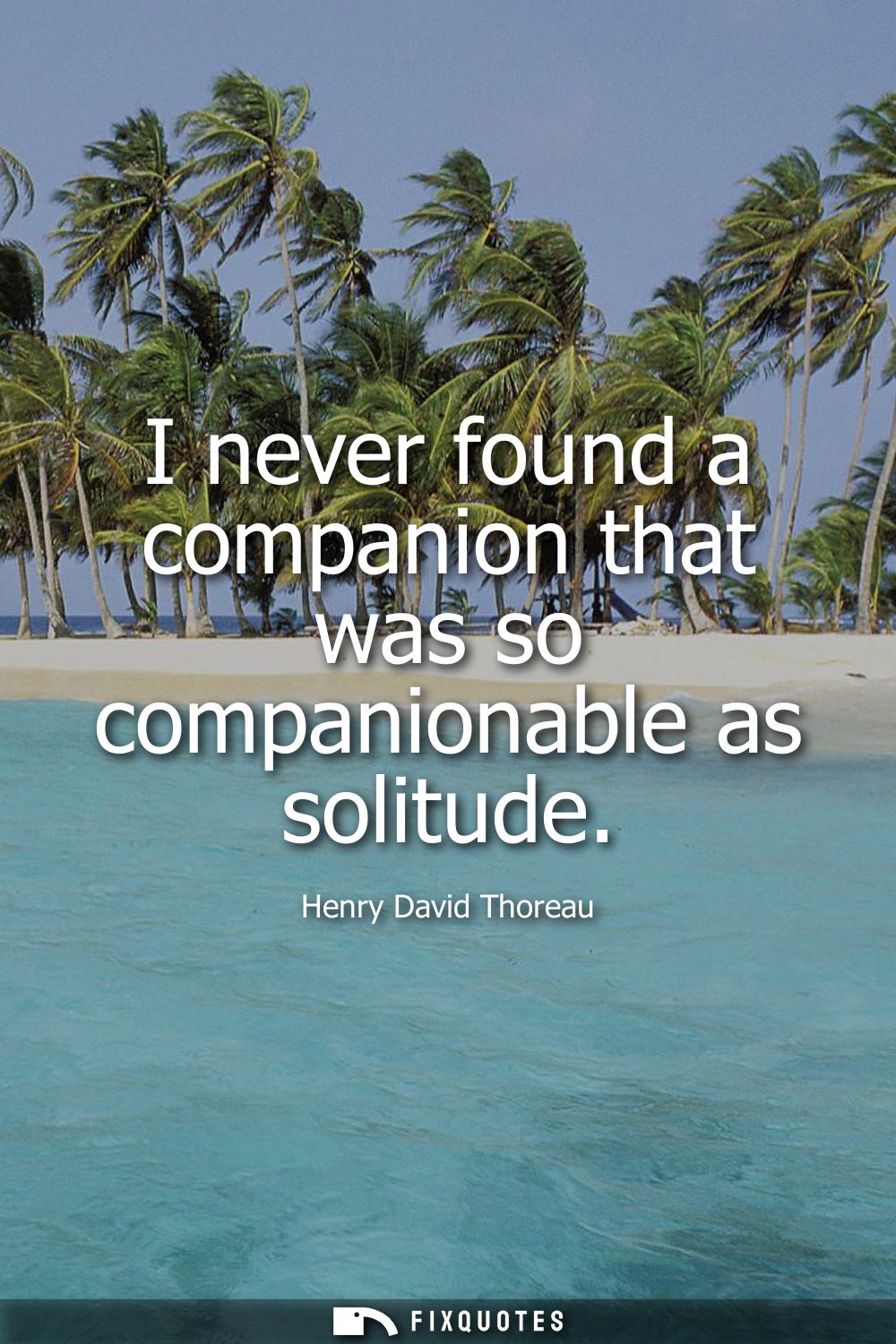
"I never found a companion that was so companionable as solitude"
About this Quote
Thoreau’s line is a sly reversal of social common sense: the best company, he suggests, is no company at all. The phrasing does the heavy lifting. “Companion” is repeated and then sharpened into “companionable,” turning a noun into a quality that people are supposed to provide. By letting solitude wear the costume of a friend, Thoreau doesn’t just praise being alone; he demotes much of what passes for companionship as noise, obligation, and performative sociability.
The intent is less misanthropy than refusal. Written in the orbit of Walden and the Transcendentalist project, it argues that the self isn’t a pathetic remainder when the room empties; it’s a site of attention. Solitude becomes “companionable” because it doesn’t demand small talk or compromise your inner tempo. In a culture already accelerating toward market life, gossip, and status, Thoreau’s solitude reads as a kind of civil disobedience: opting out of the social economy where you’re always being assessed, always spending yourself to be legible.
The subtext is also defensive, even tender. He’s not claiming he doesn’t need people; he’s claiming that most social arrangements aren’t built for genuine contact. Solitude, unlike a disappointing friend, doesn’t betray your best thoughts mid-sentence. It makes room for the only relationship Thoreau treats as non-negotiable: an honest one with your own mind, and by extension, with the natural world that can meet you without agenda.
The intent is less misanthropy than refusal. Written in the orbit of Walden and the Transcendentalist project, it argues that the self isn’t a pathetic remainder when the room empties; it’s a site of attention. Solitude becomes “companionable” because it doesn’t demand small talk or compromise your inner tempo. In a culture already accelerating toward market life, gossip, and status, Thoreau’s solitude reads as a kind of civil disobedience: opting out of the social economy where you’re always being assessed, always spending yourself to be legible.
The subtext is also defensive, even tender. He’s not claiming he doesn’t need people; he’s claiming that most social arrangements aren’t built for genuine contact. Solitude, unlike a disappointing friend, doesn’t betray your best thoughts mid-sentence. It makes room for the only relationship Thoreau treats as non-negotiable: an honest one with your own mind, and by extension, with the natural world that can meet you without agenda.
Quote Details
| Topic | Contentment |
|---|---|
| Source | Walden; or, Life in the Woods (1854), chapter 'Solitude' - contains the line 'I never found the companion that was so companionable as solitude'. |
| Cite |
Citation Formats
APA Style (7th ed.)
Thoreau, Henry David. (2026, January 17). I never found a companion that was so companionable as solitude. FixQuotes. https://fixquotes.com/quotes/i-never-found-a-companion-that-was-so-28720/
Chicago Style
Thoreau, Henry David. "I never found a companion that was so companionable as solitude." FixQuotes. January 17, 2026. https://fixquotes.com/quotes/i-never-found-a-companion-that-was-so-28720/.
MLA Style (9th ed.)
"I never found a companion that was so companionable as solitude." FixQuotes, 17 Jan. 2026, https://fixquotes.com/quotes/i-never-found-a-companion-that-was-so-28720/. Accessed 27 Mar. 2026.
More Quotes by Henry
Add to List