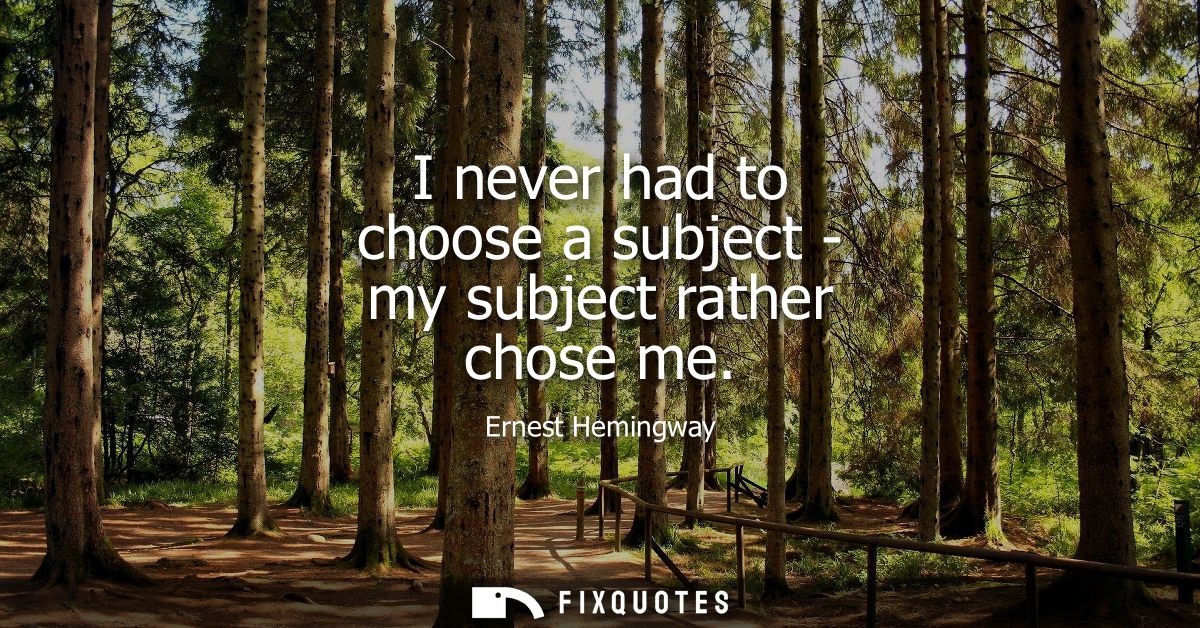
"I never had to choose a subject - my subject rather chose me"
About this Quote
Hemingway makes “subject” sound less like a topic and more like a force of nature: something that hunts you down, not something you pick off a menu. The line is a small act of mythmaking, consistent with his cultivated persona of the writer as tough-minded witness rather than delicate inventor. It’s also a sly defense against the suspicion that he chased sensational material (war, bullfights, big-game hunting) for glamour. No, he implies, the world delivered these experiences, and he had the discipline to record them.
The intent is partly aesthetic. Hemingway’s famous restraint depends on the premise that reality already contains the drama; the writer’s job is to remove editorial noise until the essential pressures show through. “My subject rather chose me” frames that restraint as destiny. It suggests a kind of artistic predestination: if the subject is chosen for you, you don’t get to indulge in moralizing, sentimentality, or elaborate plot machinery. You get to show up, pay attention, and write clean.
The subtext is harder-edged. It hints at compulsion, even burden. Hemingway’s recurrent fixations - courage under fire, stoicism, the cost of masculinity, the quiet humiliations people swallow - read like obsessions he couldn’t outwrite, only revisit from different angles. In the context of a life shaped by World War I, journalism, and a public hunger for “Hemingway” as brand, the quote doubles as a refusal and a confession: he’s not selecting themes so much as being selected by them, and the selection is not entirely voluntary.
The intent is partly aesthetic. Hemingway’s famous restraint depends on the premise that reality already contains the drama; the writer’s job is to remove editorial noise until the essential pressures show through. “My subject rather chose me” frames that restraint as destiny. It suggests a kind of artistic predestination: if the subject is chosen for you, you don’t get to indulge in moralizing, sentimentality, or elaborate plot machinery. You get to show up, pay attention, and write clean.
The subtext is harder-edged. It hints at compulsion, even burden. Hemingway’s recurrent fixations - courage under fire, stoicism, the cost of masculinity, the quiet humiliations people swallow - read like obsessions he couldn’t outwrite, only revisit from different angles. In the context of a life shaped by World War I, journalism, and a public hunger for “Hemingway” as brand, the quote doubles as a refusal and a confession: he’s not selecting themes so much as being selected by them, and the selection is not entirely voluntary.
Quote Details
| Topic | Writing |
|---|---|
| Source | Help us find the source |
| Cite |
Citation Formats
APA Style (7th ed.)
Hemingway, Ernest. (2026, January 17). I never had to choose a subject - my subject rather chose me. FixQuotes. https://fixquotes.com/quotes/i-never-had-to-choose-a-subject-my-subject-35966/
Chicago Style
Hemingway, Ernest. "I never had to choose a subject - my subject rather chose me." FixQuotes. January 17, 2026. https://fixquotes.com/quotes/i-never-had-to-choose-a-subject-my-subject-35966/.
MLA Style (9th ed.)
"I never had to choose a subject - my subject rather chose me." FixQuotes, 17 Jan. 2026, https://fixquotes.com/quotes/i-never-had-to-choose-a-subject-my-subject-35966/. Accessed 9 Mar. 2026.
More Quotes by Ernest
Add to List